

Many patients who respond well to dry needling are not waiting for a fracture or tear to heal. They have already waited. They have been scanned, rested, stretched, massaged, or told that nothing serious is wrong—yet one deep, familiar pain still blocks a turn, reach, stride, lift, or night's sleep.
In that presentation, dry needling can deliver a focused sensory input to a target linked to the patient's exact complaint. When pain or movement changes, the same finding is re-tested and the session continues with the control, strength, or task-specific loading that the patient still needs.
The short answer
Dry needling is an adjunct to rehabilitation, not a separate treatment plan.
Research supports short-term pain reduction across a range of musculoskeletal conditions. Dry needling is a symptom-modulation tool whose value depends on target selection, dose, and what the patient can do differently afterward.
At Limitless, the treatment follows three requirements: a selected target connects to the familiar symptom, a meaningful baseline is measured before treatment, and the same test is repeated before rehabilitation progresses.
Selecting a clinically relevant target
A useful target must connect to the familiar symptom or movement limitation.
Almost any muscle can feel tender when pressed hard enough. Tenderness alone is not a diagnosis and does not justify needling every sore spot. A strong target reproduces the person's familiar pain, behaves predictably with position or load, and connects to the movement they cannot perform comfortably.
Familiar symptom
The finding should feel recognizably connected to the complaint.
Relevant movement
A reach, rotation, lift, step, grip, or gait task gives the symptom context.
Useful baseline
The same movement is measured before and after treatment so the response is visible.

What can change in the same visit
Dry needling can make a painful movement more available before strength and confidence have caught up.
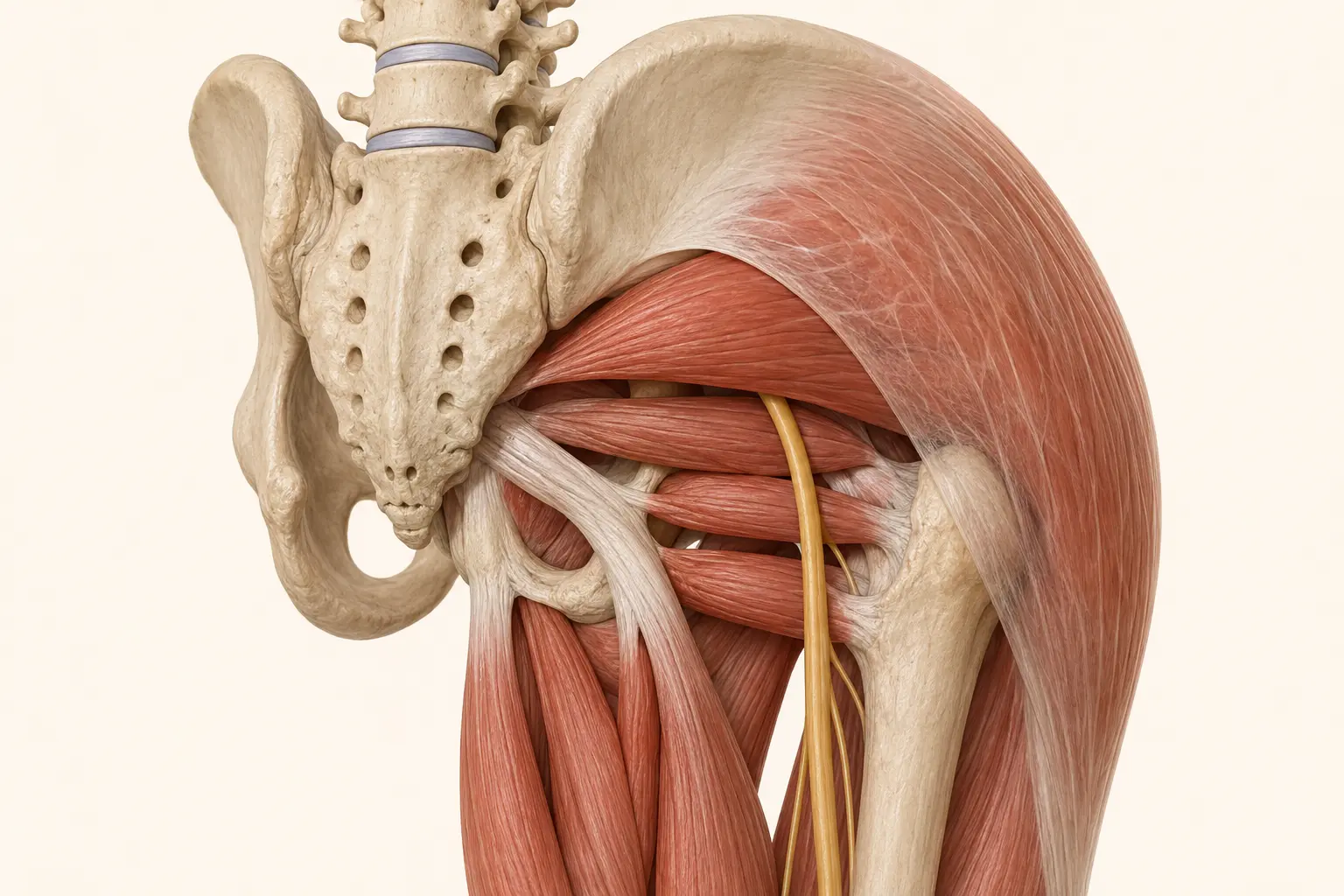
Needling gives a focused sensory input to a selected muscle and the nervous system. For some people, the familiar ache settles and a guarded reach, turn, stride, or squat becomes easier within minutes.
We do not need to call that a permanently released knot or broken scar tissue. We need to see whether the exact movement that mattered has changed—and then use that easier movement for the strength, control, or loading the person still needs.
- Pain and guarding: a previously sensitive movement may feel easier or more available.
- Comfortable range: turning, reaching, or bending may improve without forcing the motion.
- Force and confidence: the person may load the movement with less protective tension.
- The deciding test: the same meaningful task is repeated after the treatment dose.
Immediate re-testing
The re-test determines whether the intervention belongs in the plan.
Before treatment, choose one or two findings that matter: turning the head while driving, raising an arm, sitting into a squat, gripping a bar, taking a longer stride, or performing a specific strength test. Repeat them after the needle intervention under the same conditions.
A meaningful improvement supports using the change in active rehabilitation. No change does not mean the session failed; it indicates that the target, dose, or technique should be modified or removed from the plan. A short-lived change can still be useful when it improves training, but it should not become an open-ended reason to repeat passive care.
- 01
Measure before.
Pick a task related to the life or sport problem.
- 02
Use a focused dose.
Treat the smallest set of plausible targets.
- 03
Measure again.
Repeat the same task, not a different test that happens to look better.
- 04
Decide from the result.
Progress, modify, or stop based on the response.

From symptom change to active rehabilitation
The next minutes reinforce the movement or loading that pain had limited.
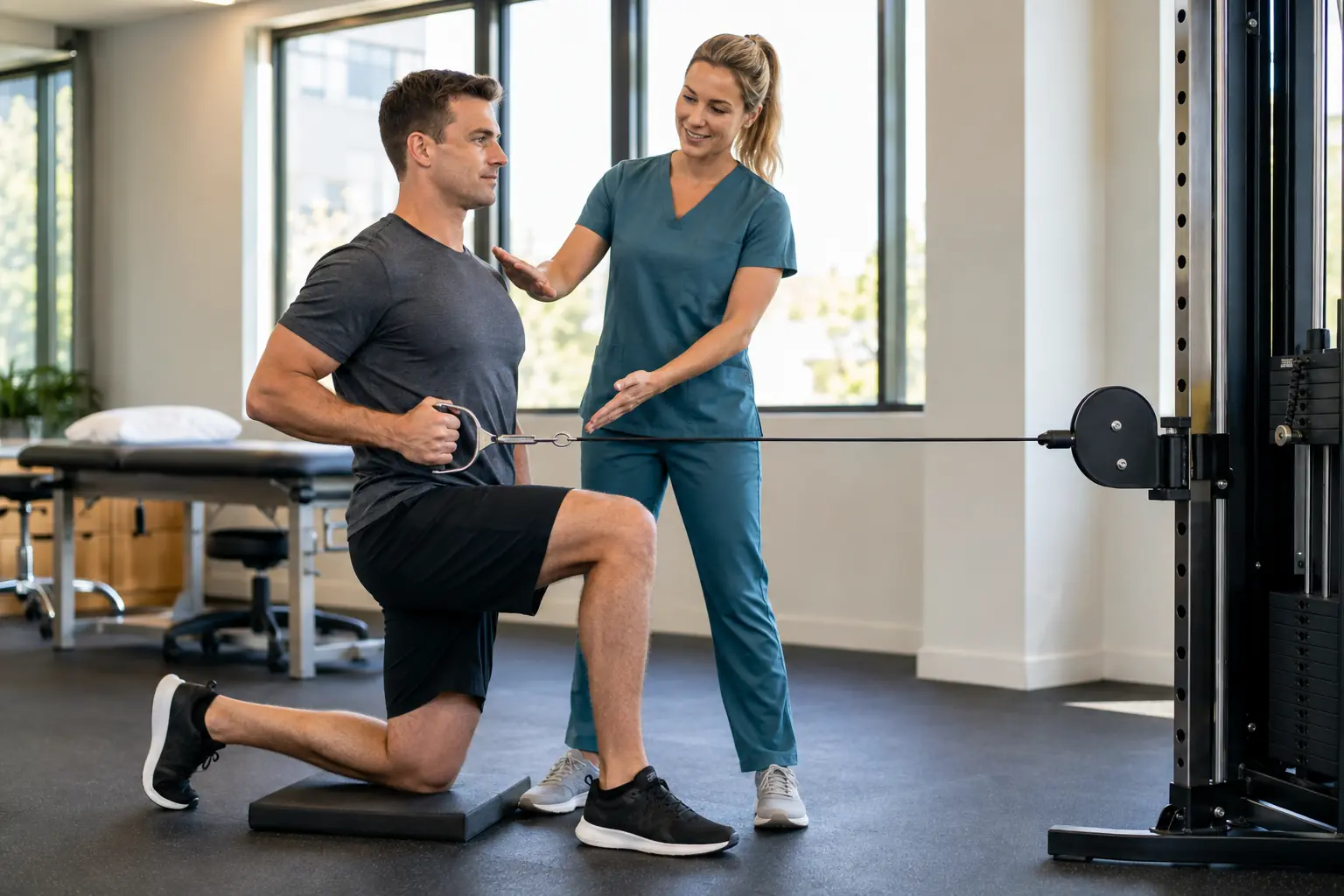
Pain can make people brace, avoid range, shift load, or solve a task with the same protective strategy every time. Once needling lowers the symptom, the next minutes are an opportunity to practice a different option with less threat. That can be a deep stabilizing pattern, a compound lift, gait work, sport-specific loading, or the daily movement that had become guarded.
The needle does not permanently switch a hidden muscle on. It can make the desired movement more accessible. Neuromuscular re-education then organizes the pattern, and repeated progressive loading supplies the actual dose for strength, endurance, coordination, and confidence.
Control
Practice the motion with a tolerable symptom response and useful alignment options.
Capacity
Add enough resistance, volume, or duration to build what the task requires.
Transfer
Progress toward the lift, run, work demand, or daily activity that matters.
Deciding whether to repeat treatment
Repeat dry needling only when the response remains measurable and clinically useful.
Repeat treatment when the response is meaningful, the benefit supports a larger rehabilitation goal, side effects are acceptable, and each session advances the plan. Reduce or stop when there is no measurable change, the benefit lasts only minutes without improving participation, soreness outweighs value, or the person simply prefers another approach.
The dose should remain as small as clinically necessary and should be reduced or discontinued when it no longer improves a relevant function.
What confident care looks like
A precise plan explains why dry needling is being used, what should change, and what follows next.
Many people arrive after imaging, rest, massage, stretching, or generic exercise has not answered the whole problem. That history does not make them untreatable. It tells us that another generic intervention is unlikely to be enough.
Dry needling is most useful when it is applied with discipline: choose a relevant target, measure the response, and connect the change to the control and capacity the patient still needs.
Continue exploring
Choose the next question that fits your symptoms.
Dry needling vs. acupuncture
Compare the shared tool and the different clinical frameworks.
Read nextWhy old injuries can still feel tight
See how symptom relief fits with rebuilding control and capacity.
Read nextDry needling and hypermobility
Learn where the tool fits without overstating what it changes.
Read nextCommon questions
Practical answers for the next step.
Does dry needling release a muscle knot?
It can reduce local pain, tenderness, or the feeling of tightness, but a 'knot' is not a single structure that research shows is permanently dissolved by a needle. The practical question is whether a relevant symptom or movement improves.
Does dry needling activate weak muscles?
A needle stimulus can alter pain and muscle activity, and electrical stimulation can create a contraction. That is not the same as proving a weak or inhibited muscle has been permanently activated. Strength and coordination still require progressive practice.
Why use electrical dry needling?
Low-level current provides a rhythmic, controllable stimulus through the needles. It is selected for specific pain or muscle presentations, but research does not show it is automatically better for every person or condition.
How many sessions should it take?
There is no evidence-based universal number. A useful response should be measurable early enough to justify repeating the treatment. The plan, not a preset package, should determine the dose.
Can dry needling replace exercise?
No. It can make exercise more comfortable for a selected patient, but it does not provide the progressive loading needed to build strength, endurance, coordination, or sport capacity.

Written & clinically reviewed by
Dr. Brandon Lim, PT, DPT, CMTPT, FMSC
Dr. Lim is the founder of Limitless Physiotherapy in Columbia, Maryland. His one-on-one approach integrates detailed examination, movement assessment, manual therapy, dry needling, and progressive exercise according to each person's presentation and goals.
Meet Dr. LimSelected sources
Evidence behind the discussion.
- Chys M, et al. Clinical effectiveness of dry needling in musculoskeletal pain: an umbrella review. J Clin Med. 2023.
- Gattie E, et al. Trigger point dry needling for musculoskeletal conditions: systematic review and meta-analysis. JOSPT. 2017.
- Baumann AN, et al. Dry needling with electrical stimulation for musculoskeletal shoulder pain: randomized controlled trial. Int J Sports Phys Ther. 2023.
- Pandya J, et al. Dry needling versus manual therapy for mechanical neck pain: randomized clinical trial. JOSPT. 2024.
- Boyce D, et al. Adverse events associated with therapeutic dry needling. Int J Sports Phys Ther. 2020.
Safety note
Before dry needling, the therapist screens for reasons not to needle and for findings that point elsewhere: progressive neurologic loss, fracture or infection concern, vascular symptoms, significant tissue injury, medication or bleeding considerations, pregnancy-related precautions, or a pattern needing medical coordination.