

When a deep ache has survived rest, stretching, massage, or a reassuring scan, another generic treatment is not very appealing. At Limitless, dry needling starts with the exact movement that is still difficult: turning your head to drive, reaching overhead, gripping a bar, taking a longer stride, or sleeping on one side.
That movement is tested first. A small, anatomically relevant target is treated, and the same movement is repeated while the change is still easy to feel. If it improves, the session immediately uses that opening for movement and loading. That full sequence—not the needle by itself—is what makes the treatment useful inside physical therapy.
The short answer
In physical therapy, the needle is chosen and judged through a movement examination.
Acupuncture is its own health profession and can use traditional East Asian medicine, contemporary biomedical approaches, or both. Dry needling in physical therapy is organized around the pain, motion, strength, work, or sport problem found during a physical examination.
For the patient, the useful difference is concrete: what movement did we measure, why was this target selected, what changed when we tested the movement again, and what will we do with that change now?
What looks similar
The needle can look identical. That tells you very little about the rest of the visit.
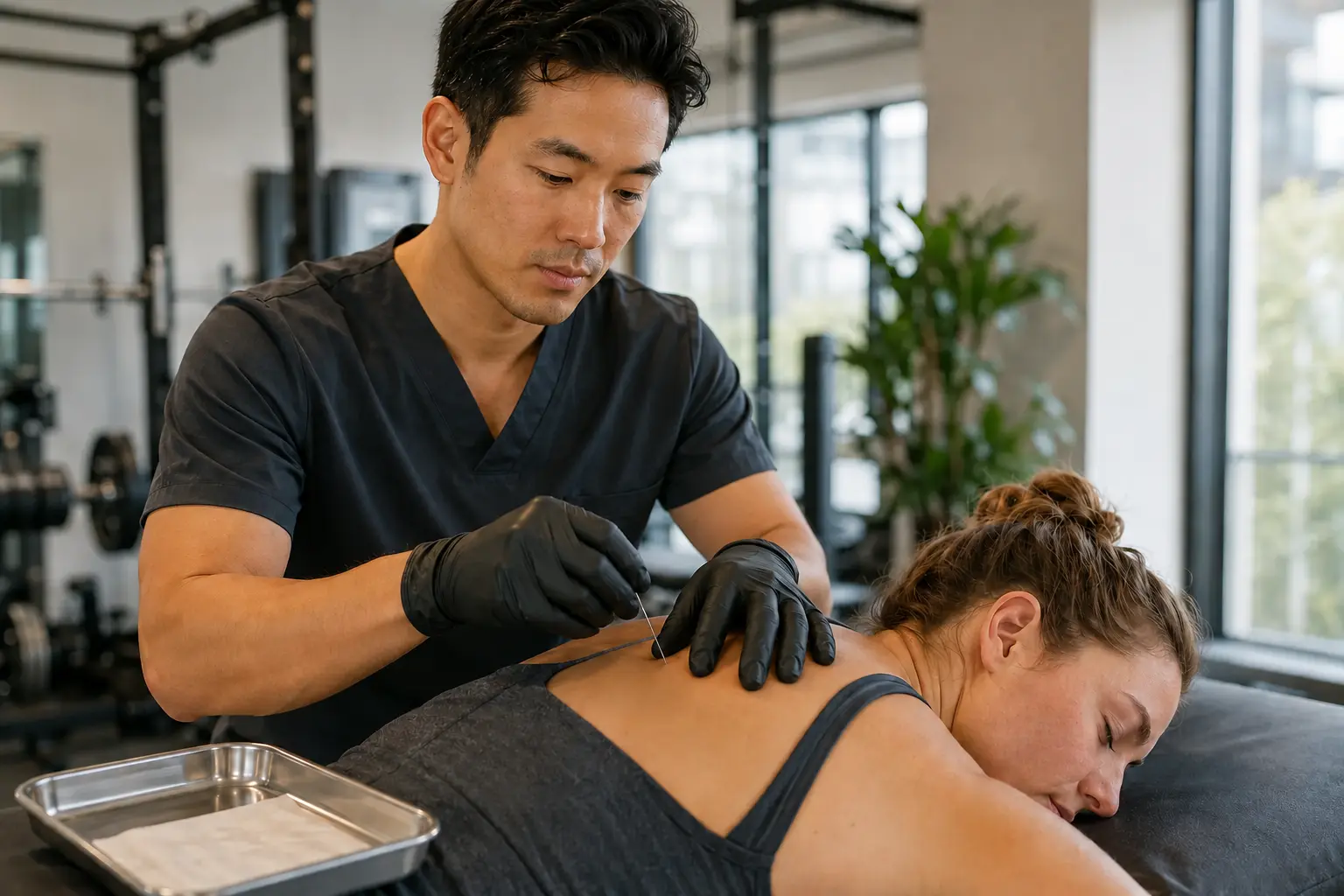
Both commonly use sterile, single-use filiform needles. Either may include manual stimulation or a carefully controlled electrical current, and treatment locations can overlap.
That overlap does not tell you why a particular spot was chosen or how success will be measured. Those answers come from the clinical process around the needle.
Similar instrument
Both commonly use thin, solid needles rather than hollow injection needles.
Possible sensory effects
Both can influence how the nervous system processes a local stimulus and pain.
Electrical options
Acupuncture and dry needling can both include low-level electrical stimulation.
How Limitless uses dry needling
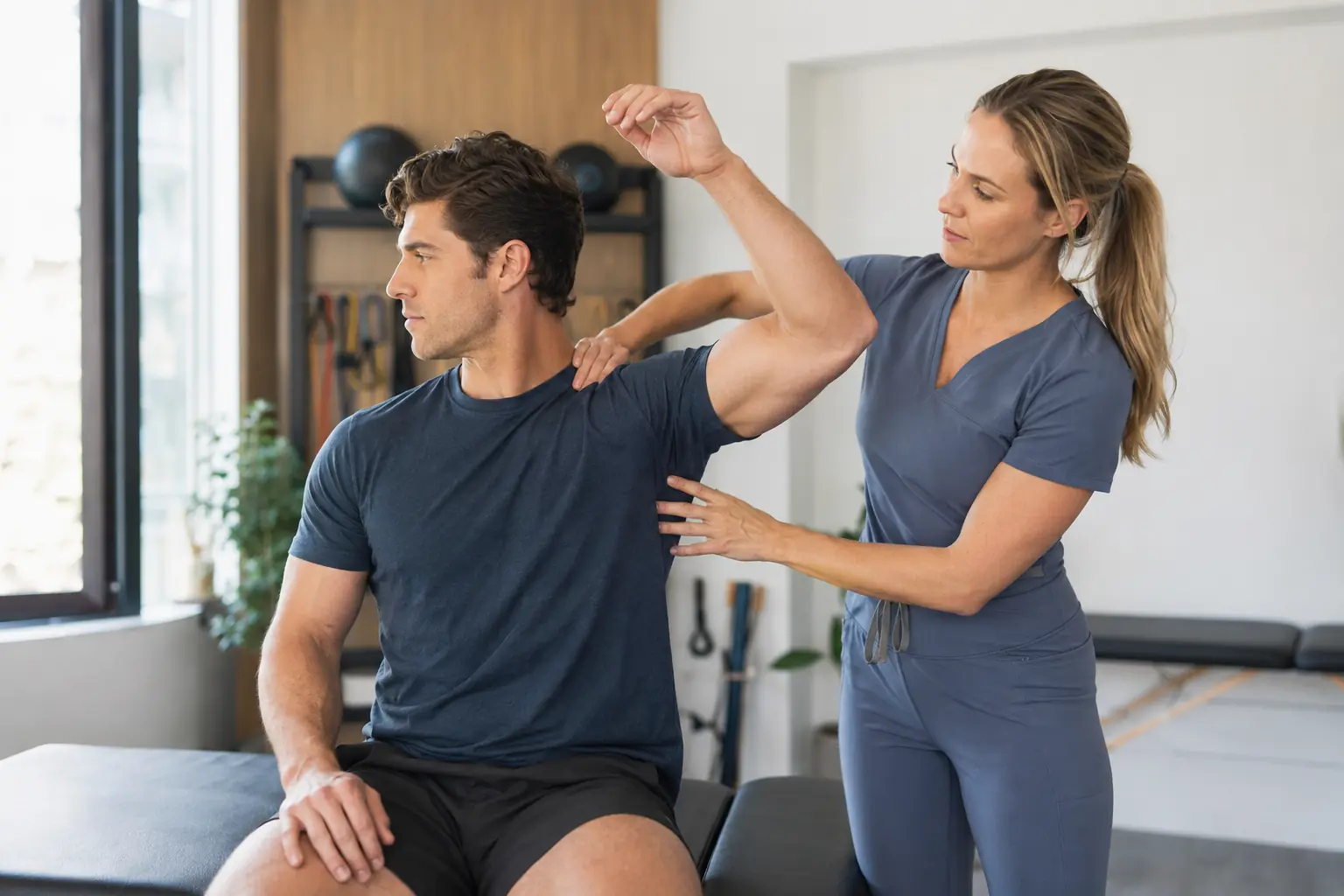
Treatment begins with a movement you can recognize—not a search for every tender spot.
Suppose turning your head to the right reproduces the ache into your shoulder blade. We first measure that turn, check the neck, shoulder, strength, and neurologic findings, and identify whether a specific muscle target reproduces the symptom you actually recognize.
Needling then has one clear assignment: reduce that barrier enough to improve the turn. The same rotation is repeated immediately, and the result guides the exercise, loading, or next clinical decision.
- Start with the real problem. The reach, turn, stride, grip, or lift you want back becomes the baseline.
- Treat a focused target. The target must connect to your familiar symptom and the examination—not simply feel tender.
- Repeat the same test. You should be able to compare the movement before and after treatment.
- Use the change. Movement and loading turn short-term relief into progress toward the larger goal.
What the visit feels like
The reason for each step should be easy to understand.
- 01
Reproduce the problem.
Choose a movement or task you can clearly recognize.
- 02
Record the starting point.
Range, pain, force, or ease gives us something real to compare.
- 03
Treat the relevant target.
The number, depth, and technique match the anatomy and the purpose of treatment.
- 04
Repeat the same movement.
The before-and-after comparison shows whether the treatment changed anything useful.
- 05
Practice what improved.
The session continues with movement or loading while the new option is available.
What patients can realistically expect
The most consistent research finding is short-term pain relief. The important question is what that relief makes possible.
Short-term does not mean unimportant. If a painful neck turns farther, a shoulder reaches with less guarding, or a stride becomes easier, the same visit can begin restoring the strength, control, and confidence that the activity requires.
There is no need to pretend that every tender point is a permanent knot or that one twitch proves success. The practical measure is simpler: did the meaningful symptom or movement change, and can we build on that change?
What to look for
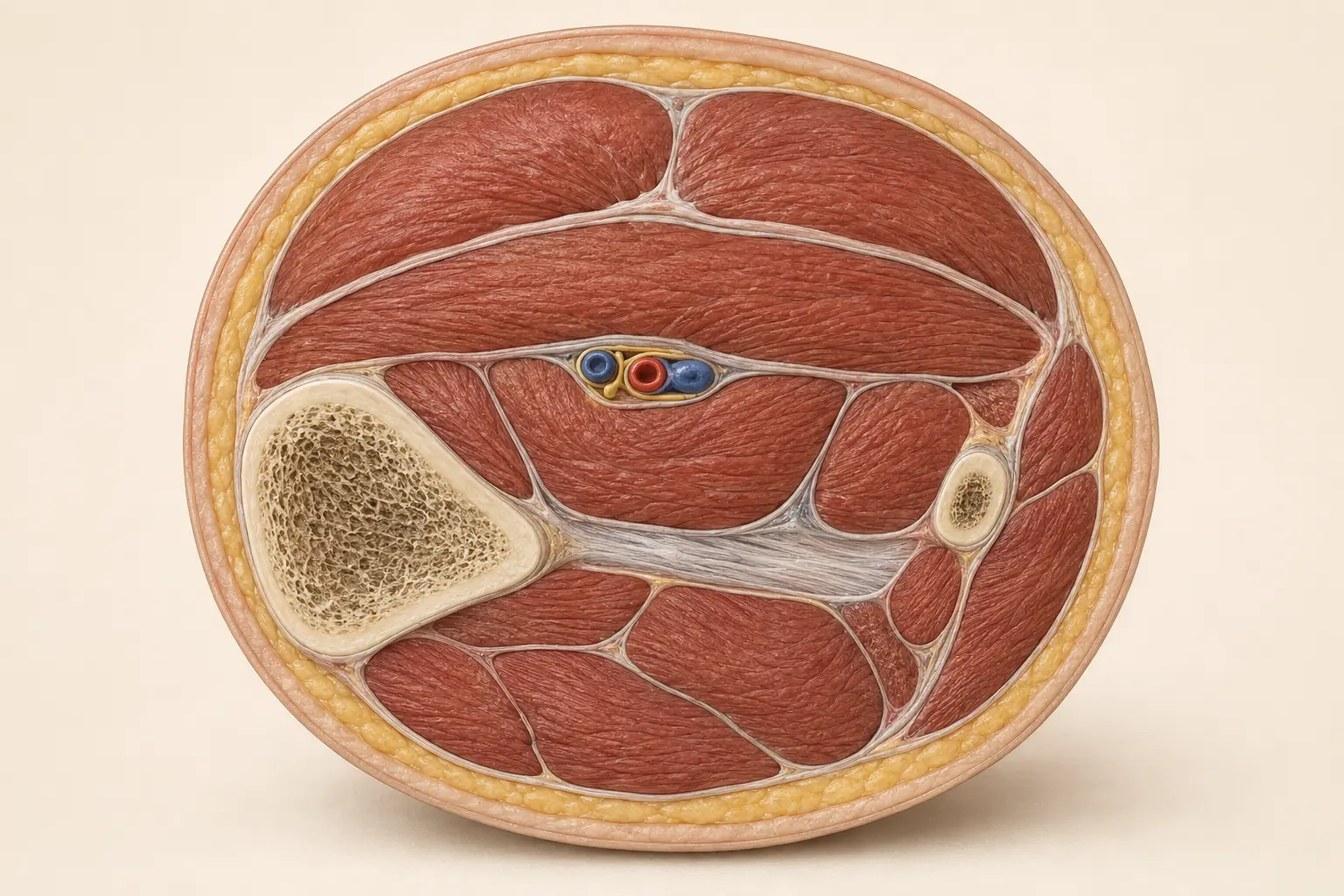
If your goal is to move, work, or train with less pain, ask how needling will change the rest of your rehabilitation.
Acupuncture has its own professional framework and may be the care you are seeking. When the main problem is a painful movement, lost strength, work demand, or return to sport, physical therapy dry needling can be integrated directly into that examination and rehabilitation plan.
Listen for a specific answer: this is the movement we measured, this is why the target matters, this is what changed, and this is the exercise or activity we can progress now. That is the experience dry needling at Limitless is designed to provide.

What confident care looks like
Good dry needling should make the rest of the plan clearer.
You should leave knowing which movement changed, which capacity still needs work, and how today's treatment connects to the activity you care about.
That clarity is more valuable than a dramatic-looking procedure or a long list of tender spots.
Continue exploring
Choose the next question that fits your symptoms.
What dry needling does inside a PT plan
See how symptom change, re-testing, and exercise fit together.
Read nextDry needling and hypermobility pain
See how needling can reduce a muscular symptom without claiming to tighten connective tissue.
Read nextDry needling in Columbia, MD
Learn how trigger point and electro dry needling are delivered at Limitless.
Read nextCommon questions
Practical answers for the next step.
Is dry needling a type of acupuncture?
They use the same kind of filiform needle and can share treatment locations or physiological effects. In physical therapy, dry needling is selected from a musculoskeletal examination, checked against a movement or function goal, and followed by rehabilitation.
Does dry needling use medication?
No. The needle is solid and does not inject medication. That is one reason the technique is called dry needling.
Can electrical stimulation be used with both?
Yes. Electroacupuncture and electrical dry needling both exist. The presence of current does not by itself define the clinical framework.
Which one hurts more?
Sensation depends on the target, technique, dose, individual sensitivity, and clinician. Both can be gentle. Common sensations include a brief prick, ache, pressure, twitch, or temporary soreness, and you can ask to stop at any time.
Do I need dry needling to benefit from physical therapy?
No. It is an optional adjunct. Exercise, education, activity modification, hands-on care, and progressive loading can all be used without needling.

Written & clinically reviewed by
Dr. Brandon Lim, PT, DPT, CMTPT, FMSC
Dr. Lim is the founder of Limitless Physiotherapy in Columbia, Maryland. His one-on-one approach integrates detailed examination, movement assessment, manual therapy, dry needling, and progressive exercise according to each person's presentation and goals.
Meet Dr. LimSelected sources
Evidence behind the discussion.
- National Center for Complementary and Integrative Health. Acupuncture: Effectiveness and Safety, updated 2026.
- American Physical Therapy Association. Dry Needling.
- Maryland Department of Health. COMAR 10.38.12 Dry Needling.
- Chys M, et al. Clinical effectiveness of dry needling in musculoskeletal pain: an umbrella review. J Clin Med. 2023.
- Boyce D, et al. Adverse events associated with therapeutic dry needling. Int J Sports Phys Ther. 2020.
- Mintken PE, et al. Pneumothorax after dry needling of intrascapular muscles using a rib-bracketing technique. Phys Ther. 2025.
Safety note
In Maryland, physical therapists must meet state education, experience, registration, consent, and documentation requirements before performing dry needling. Those rules establish a minimum framework for qualified practice.
Your clinician should explain the expected sensation, common minor effects, meaningful alternatives, and any reason to modify or avoid the technique. You can decline or stop at any time. The dose can be as small as one carefully selected target, especially during a first exposure.
Minor effects such as small bleeding, bruising, soreness, or discomfort are common in prospective surveys. Serious events are reported much less often, but survey designs cannot establish a perfect risk rate. Anatomy, screening, sterile technique, training, and informed consent still matter. Rib bracketing does not eliminate pneumothorax risk and belongs only in trained clinical practice.