

The swelling disappeared. The scan was reassuring. You returned to normal life and were told the injury had healed. Yet the area still feels tight when you squat, guarded when you reach, weak when you land, or strangely different from the other side. That experience is common—and it is not imaginary.
It also does not automatically mean the original tissue is still damaged. In many persistent cases, recovery ended when pain settled and daily life became possible. The unfinished work is not more waiting. It is restoring the range, force, coordination, balance, and workload the real activity still demands.
The short answer
Biological healing and functional recovery do not always finish at the same time.
A new injury, fracture, progressive neurologic change, infection, vascular concern, or another red flag still deserves appropriate medical assessment. Once those explanations are not driving the current problem, persistent tightness becomes a testable rehabilitation question: what can the area sense, control, produce, and tolerate today?
The answer is often bigger than flexibility. A complete plan restores any truly missing motion, rebuilds strength through that range, retrains balance and reaction, and progressively returns the speed or load the person has been avoiding.
Healing time and functional recovery
Tissue healing can be complete while the demands of the activity still exceed current capacity.
Different injuries heal on different timelines, so no generic calendar can declare every structure recovered. But once serious pathology has been excluded and the expected biological healing period is no longer the main limiter, continuing symptoms should not be explained only as an unhealed tear or fragile joint.
After injury, people commonly unload the area, limit range, brace, change gait, stop lifting, or avoid faster reactions. Those choices can be appropriate early. When they remain after the tissue can tolerate more, strength, endurance, balance, and task confidence often lag behind.
Symptoms at rest
The area is no longer constantly painful or swollen.
Load capacity
The area can produce and absorb the force the task requires.
Movement confidence
The person can react, load, and move without excessive guarding.
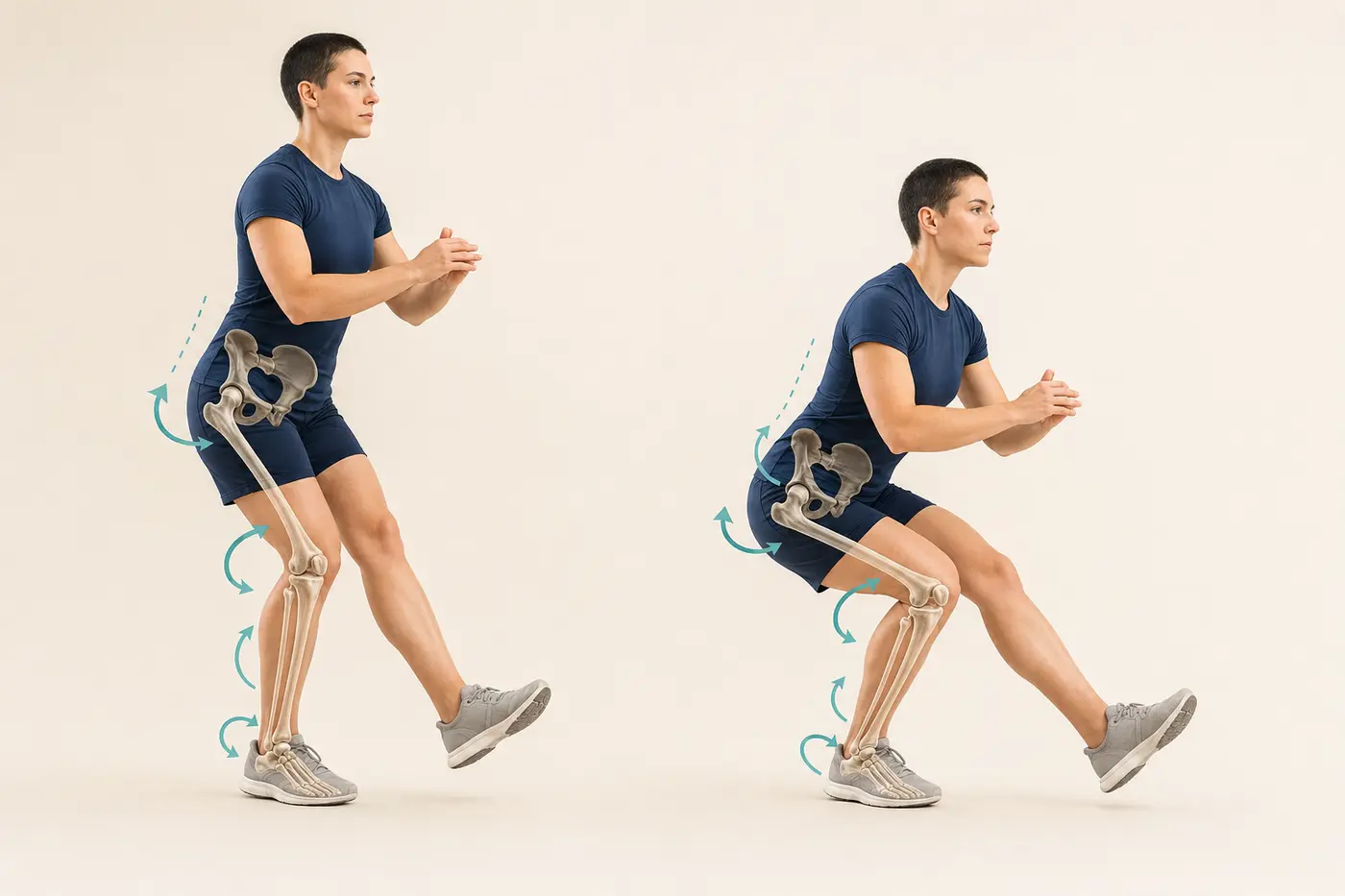
Loaded movement examination
Test the symptom in the position, range, and load that reproduce it.
The feeling can come from a true joint-motion restriction. It can also reflect protective muscle activity, fatigue, sensitivity, altered movement strategy, neural mechanosensitivity, or a protective response that increases when the position is loaded. More than one factor often coexists.
This is why repeatedly stretching the place that feels tight can create only brief relief. The stretch changes sensation for a while, but the same movement strategy returns when the next step, landing, lift, or long day asks for control that has not been restored.
- Motion: Is weight-bearing range actually limited, and where does the restriction appear?
- Force: Can the area produce and absorb force through the range the task uses?
- Position sense: Can the person find, hold, and recover from relevant positions?
- Task tolerance: Does the problem emerge only with speed, fatigue, volume, or uncertainty?
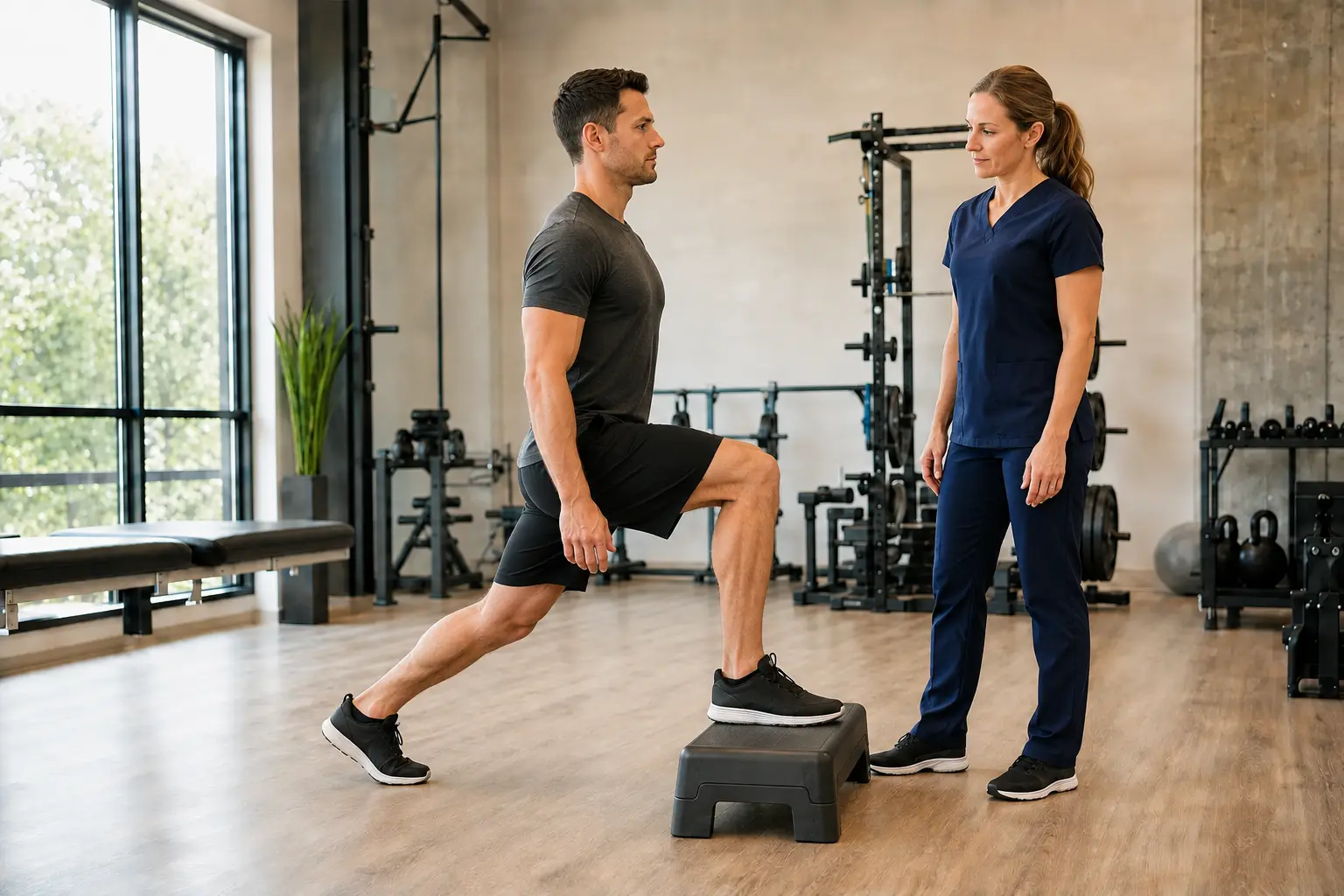
Neuromuscular re-education
Train the measured deficit, then retest the task that exposed it.
Neuromuscular re-education is not a claim that one hidden muscle has switched off. It is deliberate training for how the nervous and musculoskeletal systems coordinate a task. The work improves position sense, timing, balance, controlled range, and the ability to adjust when the surface, speed, load, or direction changes.
Early work often begins slowly with support, but it should progress. A single-leg balance drill becomes reaching, load, speed, perturbation, deceleration, or sport-specific decision-making. Deep trunk, hip, shoulder, foot, or ankle muscles are trained as parts of the larger task rather than treated as isolated on/off switches.
- 01
Find the missing quality.
Range, strength, endurance, balance, timing, or confidence should be measured—not assumed.
- 02
Choose a tolerable entry point.
Start where the person can succeed without reinforcing excessive guarding.
- 03
Add a real demand.
Load, reach, speed, surface, fatigue, or decision-making makes the exercise relevant.
- 04
Re-test the original task.
Improvement should transfer beyond the exercise itself.

The selective role of dry needling
Dry needling can reduce a focal muscular barrier; rehabilitation must restore the remaining capacity.
A chronically guarded or sensitive muscle can block a position that the joint is structurally able to reach. When a focused dry needling treatment reduces that familiar symptom and improves the re-test, the next movement becomes easier to practice. That immediate, repeatable change gives the rehabilitation session momentum.
The needle does not restore ligament integrity, rebuild balance, or create endurance. It should be paired with the specific training that addresses those needs. If needling does not improve a meaningful sign, the plan should move on rather than treating more spots by habit.
Measuring functional recovery
Progress should appear in controlled range, balance recovery, load tolerance, and the activity that remains limited.
The best outcome is not simply that the area feels looser on the treatment table. It is that you can use more range under control, recover balance with less hesitation, tolerate more load or volume, and return to the activity that originally exposed the gap.
Some cases move quickly once the missing quality is identified. Others require coordination with a physician or additional testing. A confident rehabilitation plan makes that distinction without treating every persistent symptom as damage or dismissing it as nothing.
What confident care looks like
A healed structure and an incomplete recovery can coexist. The remaining deficits are often measurable and trainable.
Persistent symptoms remain real when imaging is reassuring and the original tissue is no longer acutely injured. That middle ground is exactly where a detailed examination has the most value.
Once the limiting quality can be reproduced, changed, and trained, the plan can move beyond protecting an old injury and toward the demands of the current task.
Continue exploring
Choose the next question that fits your symptoms.
Ankle stiffness after a sprain
Apply this framework to dorsiflexion, balance, and calf capacity.
Read nextWhy the hamstring keeps feeling tight
Separate muscle length from sensitivity, control, and spine or hip contribution.
Read nextHow dry needling fits rehabilitation
See how a measured symptom change is integrated with active training.
Read nextCommon questions
Practical answers for the next step.
Can an injury be healed and still cause symptoms?
Yes. Pain can settle before range, strength, balance, endurance, or confidence fully returns. Persistent symptoms can also have several contributors, so a new or changing pattern deserves appropriate assessment.
Does tightness always mean scar tissue?
No. Scar tissue can be relevant in some cases, especially after surgery or significant injury, but tightness can also reflect joint mobility, muscle activity, sensitivity, neural factors, fatigue, or a protective movement strategy.
What is neuromuscular re-education?
It is task-specific training for how the nervous and musculoskeletal systems coordinate position, balance, timing, controlled range, and force. It should progress toward the real activity rather than remain an isolated low-level drill forever.
Can dry needling fix instability?
No. It can reduce a painful muscle symptom that interferes with training, but ligament support, balance, strength, reaction, and workload tolerance require rehabilitation.
When should persistent symptoms be medically reassessed?
Seek medical evaluation for a significant new injury, progressive weakness or numbness, unexplained swelling, fever or systemic illness, vascular symptoms, inability to bear weight, major night or rest pain, or any pattern that is worsening rather than gradually improving.

Written & clinically reviewed by
Dr. Brandon Lim, PT, DPT, CMTPT, FMSC
Dr. Lim is the founder of Limitless Physiotherapy in Columbia, Maryland. His one-on-one approach integrates detailed examination, movement assessment, manual therapy, dry needling, and progressive exercise according to each person's presentation and goals.
Meet Dr. LimSelected sources
Evidence behind the discussion.
- Martin RL, et al. Lateral ankle ligament sprains revision 2021: clinical practice guideline. JOSPT. 2021.
- Xue X, et al. Chronic ankle instability is associated with proprioception deficits: systematic review and meta-analysis. J Sport Health Sci. 2021.
- Chys M, et al. Clinical effectiveness of dry needling in musculoskeletal pain: an umbrella review. J Clin Med. 2023.
- Weppler CH, Magnusson SP. Increasing muscle extensibility: a matter of increasing length or modifying sensation? Phys Ther. 2010.