

Most ankle sprains are treated until swelling settles and normal walking returns. That milestone matters, but walking down a hallway is a very low-demand test. Months later, the real gap appears: the ankle blocks a deep squat, hesitates on uneven ground, fades during repeated heel raises, or feels one step behind during a cut or landing.
Those symptoms do not automatically mean the ligament is still freshly torn. They show that pain relief and restored performance are different milestones. Weight-bearing dorsiflexion, joint or soft-tissue mobility, calf capacity, position sense, balance, and fast reactive control can all remain incomplete after the acute injury feels 'healed.'
The short answer
Persistent ankle stiffness can reflect restricted motion, protective guarding, limited force capacity, or a combination.
Clinical guidelines for chronic ankle instability support proprioceptive and neuromuscular exercise, and they support manual therapy for short-term improvements in dorsiflexion and balance. Neither should stand alone: the available motion must be trained under progressive force, speed, and task demand.
A good examination separates a joint-motion problem from strength, balance, foot-control, tendon, nerve, or load-tolerance problems. The plan then targets the relevant combination instead of repeatedly stretching the calf without checking why the restriction returns.
Defining the source of stiffness
The sensation of stiffness must be separated from measurable motion, control, and load tolerance.
One person has a measurable loss of weight-bearing dorsiflexion. Another has nearly equal range but feels guarded near end range. A third moves well when fresh but loses control after repeated jumps. A fourth has pain or swelling that requires a different medical or tissue-specific evaluation.
The word stiff is useful because it tells us how the ankle feels. It is not enough to select treatment. The next step is to measure motion, symptom behavior, force, balance, and the exact task that exposes the problem.
Motion limit
The knee-to-wall or squat shows reduced usable dorsiflexion.
Control limit
The range exists, but the foot and ankle cannot manage it under load.
Capacity limit
Symptoms emerge with repetitions, speed, terrain, or sport volume.
Stability after a lateral ankle sprain
Pain can resolve while balance, position sense, and rapid muscular response remain impaired.
Chronic ankle instability can include repeated giving way, perceived instability, balance deficits, and altered position sense after a lateral ankle sprain. Mechanical ligament laxity can be part of the picture, but some people feel unstable without large mechanical laxity. Function depends on the whole sensorimotor system.
That system includes sensory input from the ankle and foot, rapid muscle response, calf and peroneal capacity, hip and trunk control, vision, surface, footwear, fatigue, and the person's exposure to the task. Stability is therefore trainable even when a clinician cannot make the ligament biologically new again.
- Position sense. Can the ankle detect and reproduce relevant positions?
- Dynamic balance. Can the person reach, step, and recover without repeated collapse or hesitation?
- Force production. Can the calf and surrounding muscles produce repeated force through useful range?
- Reactive control. Can the system respond to speed, uncertainty, and changing surfaces?
Measuring weight-bearing dorsiflexion
A standardized test measures the maximum toe-to-wall distance while the heel stays grounded.
For the distance-based weight-bearing lunge test, the test foot is placed straight along a tape measure with the great toe initially about 4 inches (10 cm) from the wall. The knee moves forward to touch the wall over the second-toe line while the entire heel and forefoot stay on the floor. The foot is moved farther away or closer until the clinician finds the greatest clean toe-to-wall distance that preserves knee contact and heel contact.
Four inches is a practical starting position, not a universal pass-or-fail cutoff. The final value is the person's maximum distance or tibial inclination measured with the same setup. Current adult reference values vary with age and sex, so interpretation should also consider side-to-side difference, symptoms, prior level, and the movement or sport demand.
The test measures usable weight-bearing dorsiflexion; it does not identify the limiting tissue by itself. Joint restriction, calf or other soft tissue, pain, guarding, and motion shared through the rearfoot and midfoot can all influence the result. A mobilization or stretch is not a diagnosis; the immediate re-test and longer training response clarify the plan.
- 01
Test the real complaint.
Squat, stairs, running, cutting, or uneven ground should shape the baseline.
- 02
Measure motion and force.
Range without strength and strength without usable range are different problems.
- 03
Challenge balance progressively.
Static stance is an entry point, not the final test for an athlete.
- 04
Re-test after an intervention.
A change in range or control helps confirm what deserves more emphasis.
Progressing from mobility to performance
Available range must be controlled under force, speed, fatigue, and changing conditions.
Clinical guidelines support manual therapy and mobilization-with-movement for short-term improvements in weight-bearing dorsiflexion and balance in chronic ankle instability. Mobility work is useful when the range is limited, and the newly available motion should be followed by active loading so the ankle learns to control it.
Balance and neuromuscular training improve dynamic stability and patient-reported function. Strength work develops the calf, evertors, invertors, dorsiflexors, foot intrinsics, and the larger kinetic chain. Later phases add hopping, deceleration, cutting, uneven surfaces, fatigue, and sport or work decisions.
Dry needling can fit when a focal calf or lower-leg muscle symptom reproduces the familiar restriction and a knee-to-wall, squat, heel raise, or gait test improves afterward. The change creates access to the range; mobility, strength, balance, and reactive training are what make that access dependable.
Mobility
Create enough dorsiflexion and foot motion for the task.
Strength
Build repeated force through the range instead of only stretching into it.
Reaction
Progress balance toward speed, uncertainty, and real-world demands.

The foot's contribution
Foot mobility and control influence how the ankle uses motion under load.
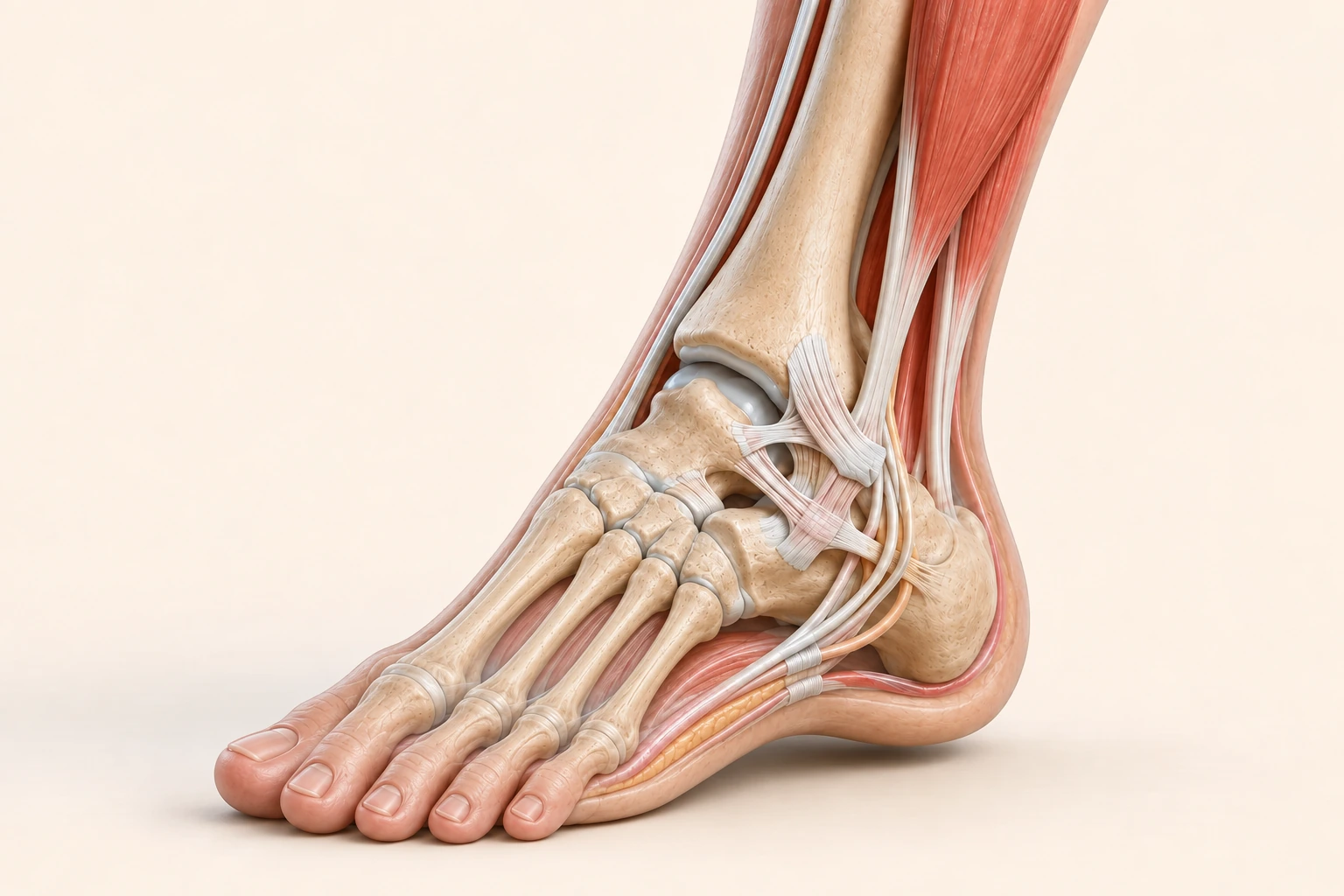
The foot is not a rigid block beneath the ankle. The rearfoot includes the talus and calcaneus, the midfoot includes the navicular, cuboid, and cuneiform region, and the forefoot includes the metatarsals and toes. Motion between those segments helps the foot adapt to the ground, accept load, and then become sufficiently stiff for propulsion.
A useful foot assessment looks at how each region changes under load, whether the person can control the available motion, how footwear affects the task, and whether foot-focused strength changes balance or symptoms. The next article explores that question without labeling flat or high arches as inherently bad.
What confident care looks like
Long-standing stiffness becomes more treatable when range, force, balance, and reaction are measured separately.
Repeated sprains and years of stiffness can make the ankle feel permanently unreliable. That history matters, but it is not a forecast. Range, force, balance, and reaction are measurable qualities, and measurable qualities can be progressively challenged.
The plan becomes clear when it stops asking only whether the old sprain healed and starts asking what the ankle can do today, what breaks down first, and what dose will let it do more next month.
Continue exploring
Choose the next question that fits your symptoms.
Foot shape, function, and ankle stability
Learn why arch appearance is only one part of the assessment.
Read nextWhy old injuries still feel tight
See how healing, protection, and incomplete capacity can diverge.
Read nextSports rehabilitation
Build from clinic tests toward running, cutting, lifting, and real activity.
Read nextCommon questions
Practical answers for the next step.
Why is my ankle stiff even though the sprain no longer hurts?
Pain often settles before weight-bearing dorsiflexion, calf capacity, balance, position sense, or confidence fully returns. The sensation can reflect one or several of those factors.
Does chronic ankle instability mean my ligaments are permanently loose?
Not always. Mechanical laxity can contribute, but chronic ankle instability can also involve perceived giving way, balance and proprioception deficits, strength, and altered movement. Function can improve even when ligament structure is not changed.
Should I keep stretching my calf?
Stretching helps when calf extensibility limits dorsiflexion. If the restriction comes from joint mechanics, pain, guarding, foot contribution, or poor control, stretching alone has limited carryover.
Are balance exercises enough?
They are important, but later rehabilitation usually needs strength, hopping, landing, cutting, fatigue, and task-specific exposure. A brace or simple balance drill should not be the entire plan.
Can dry needling help ankle stiffness?
It can reduce a focal calf or lower-leg muscle symptom for a selected person, but it does not restore ligament stability or replace mobility, strength, balance, and progressive task training.

Written & clinically reviewed by
Dr. Brandon Lim, PT, DPT, CMTPT, FMSC
Dr. Lim is the founder of Limitless Physiotherapy in Columbia, Maryland. His one-on-one approach integrates detailed examination, movement assessment, manual therapy, dry needling, and progressive exercise according to each person's presentation and goals.
Meet Dr. LimSelected sources
Evidence behind the discussion.
- Martin RL, et al. Lateral ankle ligament sprains revision 2021: clinical practice guideline. JOSPT. 2021.
- Xue X, et al. Chronic ankle instability is associated with proprioception deficits: systematic review and meta-analysis. J Sport Health Sci. 2021.
- Basnett CR, et al. Ankle dorsiflexion range influences dynamic balance in chronic ankle instability. Int J Sports Phys Ther. 2013.
- Hoch MC, et al. Weight-bearing dorsiflexion and landing biomechanics in chronic ankle instability. J Athl Train. 2015.
- Bennell KL, et al. Intra-rater and inter-rater reliability of a weight-bearing lunge measure of ankle dorsiflexion. Aust J Physiother. 1998.
- Chisholm MD, et al. Reliability and validity of a weight-bearing measure of ankle dorsiflexion range of motion. Physiother Can. 2012.
- Konor MM, et al. Reliability of three measures of ankle dorsiflexion range of motion. Int J Sports Phys Ther. 2012.
- McBride S, et al. International normative values for the weight-bearing lunge test across age and sex in 899 healthy adults. Musculoskelet Sci Pract. 2026.
- Zhang C, et al. Exercise therapy for chronic ankle instability: systematic review and network meta-analysis. Sci Rep. 2025.