

You stretch. It feels better for an hour. By the next morning, the same deep pull is back. Or you can touch the floor easily, yet one hamstring still feels permanently short. Both patterns reveal the same problem with the usual explanation: a sensation of tightness is not a direct measurement of muscle length.
A hamstring can truly lack extensibility. But a straight-leg raise also loads the nervous system, changes with pelvic and spinal position, and is limited by stretch tolerance, subtle muscle activity, and strength near end range. Treating every one of those possibilities as a short muscle creates years of stretching without ever asking the test that could change the plan.
The short answer
The word “tight” describes a sensation; examination determines the source and the appropriate treatment.
Stretching improves range of motion, often by changing stretch tolerance and sometimes passive stiffness. That is useful when limited range is the actual problem. It is a poor standalone answer when the limiter is a familiar radiating symptom, protective muscle activity, weakness at longer lengths, hip control, or a spine-related pattern.
The goal of the evaluation is not to blame the back for every hamstring complaint. It is to determine whether changing the knee, ankle, neck, pelvis, hip, or lumbar position meaningfully changes the familiar symptom—and then treat the finding that actually matters.
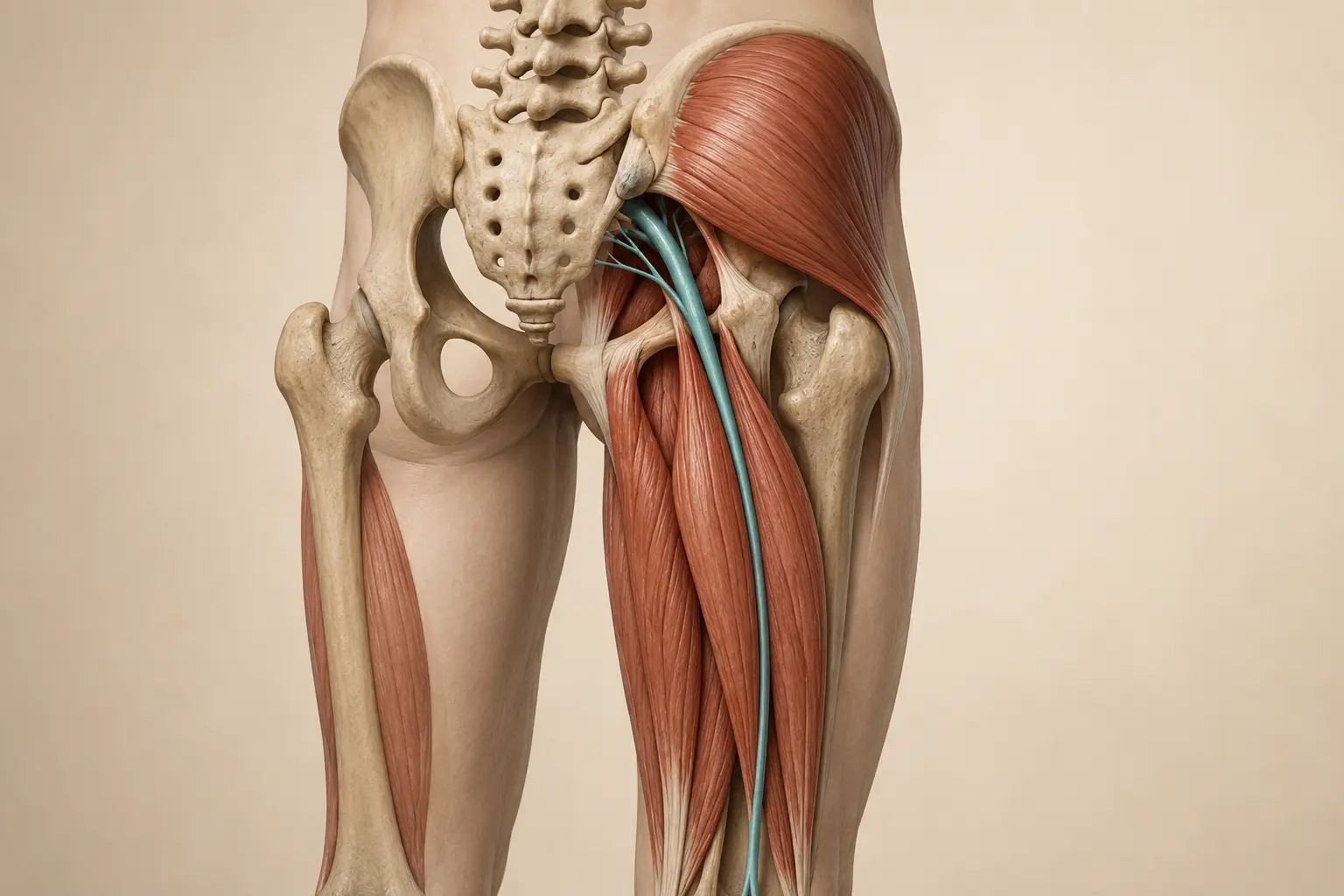
Several mechanisms can create the same sensation
Persistent posterior-thigh tightness is not a direct measurement of hamstring length.
Human range of motion is not a simple ruler measurement of muscle length. Studies show that even low levels of involuntary hamstring activity can reduce passive straight-leg-raise range. Other research shows that repeated stretching can increase range largely because people tolerate the end-range sensation differently.
That means a smaller range does not automatically prove damaged or shortened tissue. It means the test needs context: where the pull is felt, whether it is the familiar complaint, how the pelvis and spine move, whether symptoms change with sensitizing positions, and whether strength is available through the range.
Extensibility
The muscle-tendon unit can have less available passive range.
Protective activity
Low-level contraction can limit range even when a person is trying to relax.
Neural sensitivity
A leg position can load neural tissue as well as muscle and fascia.
Testing one variable at a time
A useful examination reproduces the familiar pull and identifies which position or load changes it.
No single flexibility score supplies the whole diagnosis. Comparing active and passive range, knee position, ankle position, trunk and neck position, hip motion, lumbar symptoms, and hamstring strength can change the clinical hypothesis.
The most useful finding is reproducible and modifiable. If changing spinal position immediately changes the familiar posterior-thigh pull, the lumbar region becomes more clinically relevant. If the sensation stays local and behaves with resisted knee flexion or loading at long muscle lengths, the hamstring itself deserves more attention.
- Active vs. passive range. A large difference can suggest control, strength, or apprehension matters in addition to passive mobility.
- Structural differentiation. Changing a distant joint while holding the leg position can alter neural loading without meaningfully lengthening the hamstring.
- Local loading. Resisted knee flexion and hip-extension tasks help assess symptom behavior and capacity.
- Neurologic screen. Strength, reflex, sensation, and symptom distribution matter when nerve-root involvement is plausible.

Hip, spine, and neural contributions
Pelvic position, spinal movement, and neural loading can each alter a hamstring test.
The hamstrings attach to the pelvis, so pelvic position changes their relative length. The hip and lumbar spine share motion during bending and lifting. The sciatic nerve and nerve roots also move and tolerate load during leg-raise positions. None of this means a crooked pelvis or out-of-place vertebra is the cause.
It means the examination can use position changes to identify which system is most related to the complaint. If the person also has back pain, radiating symptoms, numbness, weakness, or cough/sneeze sensitivity, the neurologic and spinal examination becomes more important.
- 01
Reproduce the familiar pull.
A generic stretch sensation is not enough.
- 02
Change one variable.
Ankle, knee, neck, pelvis, or lumbar position is adjusted while the test is held.
- 03
Compare sides and tasks.
Walking, bending, sprinting, lifting, and sitting each reveal different possible limiters.
- 04
Treat and re-test.
The same sign should change if the hypothesis is useful.
Matching treatment to the limiting factor
When range is available but force and control are limited, rehabilitation should emphasize loaded capacity.
When true range loss matters, progressive stretching or mobility work helps. When the person lacks strength at longer muscle lengths, loaded hinges, knee-flexion work, isometrics, and graded eccentric exercise build a more durable solution. When neural sensitivity is relevant, carefully dosed movement restores tolerance without treating the nerve like a tight rope that needs aggressive pulling.
The spine and hip are also trained when changing their movement or capacity changes the complaint. The goal is not perfect posture. It is giving the person more options and more tolerance for the specific run, lift, work position, or daily task.
Mobility
Build only the range the person needs and can control.
Long-length strength
Train the hamstring to produce force where it previously felt vulnerable or guarded.
Task tolerance
Progress speed, volume, sitting time, running, or lifting demands.

The selective role of dry needling
Dry needling can reduce a local muscular barrier when the same-day re-test improves.
Dry needling fits when a selected hamstring or related muscle reproduces the familiar local symptom and the clinician has a meaningful movement ready to re-test. A strong response lowers focal pain or guarding enough to improve a hinge, stride, or strength exercise that same day.
Dry needling does not prove the hamstring was permanently shortened, does not replace a neurologic examination, and should not be used to chase every tender point. If the re-test does not change, the treatment hypothesis should change.
What confident care looks like
The sensation is real. The correct treatment depends on what reproduces and changes it.
Repeatedly targeting the sensation without identifying the system that produces it is why so many people stay in the same loop. Once the relevant finding is measurable, the plan becomes specific: restore range, reduce sensitivity, build long-length strength, or change how the task is loaded.
Persistent posterior-thigh complaints become more specific when the hamstring is tested as part of a moving, load-bearing system rather than as an isolated measure of flexibility.
Continue exploring
Choose the next question that fits your symptoms.
Why an old injury can still feel tight
Understand the difference between tissue healing and fully restored function.
Read nextWhen pain travels into the leg
Learn how a neurologic and movement examination narrows radiating symptoms.
Read nextHow dry needling fits PT
See why the re-test matters more than the story about a muscle knot.
Read nextCommon questions
Practical answers for the next step.
Can lower-back problems make the hamstring feel tight?
They can contribute in some people, particularly when spinal position or neural loading changes the familiar symptom. The location of tightness alone does not prove the lumbar spine is the cause, so the finding should be tested.
Should I stop stretching my hamstrings?
Not necessarily. Stretching can improve range and provide short-term relief. It is less likely to solve the whole problem when the limiter is neural sensitivity, strength, protective activity, or task load rather than passive range.
How can I tell muscle stretch from nerve sensitivity?
Clinicians use symptom location, quality, neurologic findings, and structural differentiation—changing ankle, knee, neck, or spinal position while controlling the leg position. No home test is perfectly diagnostic by itself.
Can strengthening make a tight hamstring feel better?
Yes, when the issue includes fatigue, protective activity, or limited capacity at longer muscle lengths. The exercise and dose should match the person's current tolerance and goals.
Can dry needling improve hamstring flexibility?
It can temporarily change pain, stretch sensation, or range in a selected patient. That does not prove permanent muscle lengthening. The useful question is whether the treatment improves a meaningful movement and supports progressive loading.

Written & clinically reviewed by
Dr. Brandon Lim, PT, DPT, CMTPT, FMSC
Dr. Lim is the founder of Limitless Physiotherapy in Columbia, Maryland. His one-on-one approach integrates detailed examination, movement assessment, manual therapy, dry needling, and progressive exercise according to each person's presentation and goals.
Meet Dr. LimSelected sources
Evidence behind the discussion.
- Foo Y, et al. Involuntary hamstring muscle activity reduces passive hip range during straight leg raise. BMC Musculoskelet Disord. 2019.
- Magnusson SP, et al. Passive properties of human skeletal muscle during stretch maneuvers. Scand J Med Sci Sports. 1998.
- Weppler CH, Magnusson SP. Increasing muscle extensibility: increasing length or modifying sensation? Phys Ther. 2010.
- Castellote-Caballero Y, et al. Immediate effects of neurodynamic sliding versus muscle stretching on hamstring flexibility. J Sports Med. 2014.
- Hermosura J, et al. Modified straight-leg raise neurodynamic test and hamstring length. Int J Sports Phys Ther. 2024.