
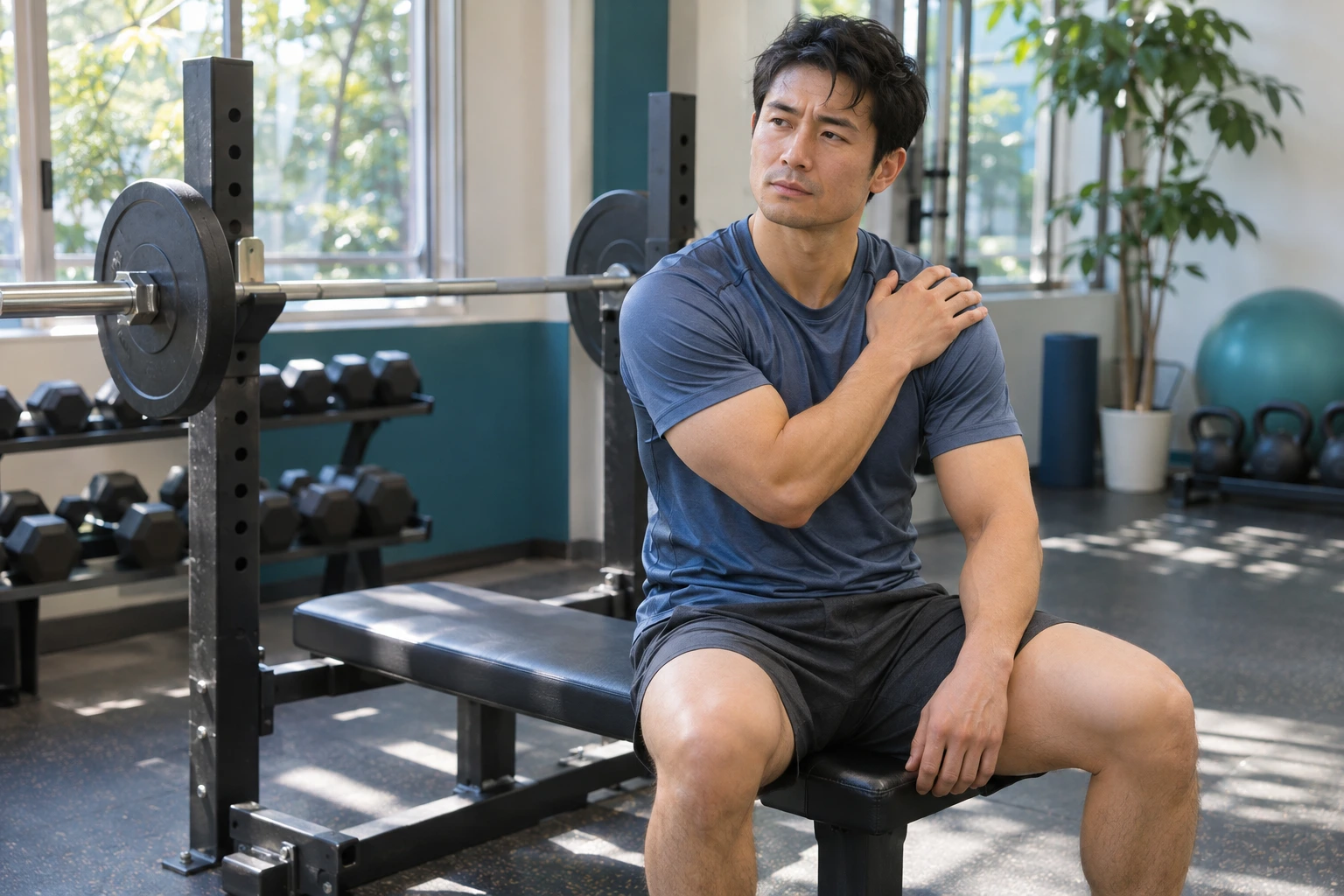
Shoulder pain at the bottom of a bench press, discomfort that builds late in a set, and soreness that affects reaching the next morning can call for different adjustments.
What helps is a more specific question: Which part of pressing is your shoulder struggling with right now—the position, the resistance, or how much work you accumulate? Those possibilities lead to different adjustments. An exercise that helps one does not automatically solve the others.
This guide offers a way to organize those decisions. It cannot identify an injury from your symptoms alone.
First, recognize when a training adjustment is not enough
A sudden pop or tearing sensation during a press, followed by bruising across the chest or inner arm, a change in the front armpit contour, or immediate weakness deserves prompt medical assessment. A pectoralis tendon tear can happen during the lowering phase of a bench press. Do not keep testing it with lighter sets. AAOS: Pectoralis tendon tear
Seek urgent assessment after an injury if the shoulder looks deformed or you cannot use the arm. Chest pressure with shortness of breath, sweating, or faintness needs emergency care, not a shoulder warm-up. New or progressive weakness or numbness also needs assessment. Clinical assessment guidance
The exercise examples below are for gradual, nontraumatic symptoms without those warning signs. They are not postoperative protocols or clearance to train through a suspected tear or dislocation.
Three shoulder problems that can need different plans
Rotator cuff–related pain. The cuff helps control the upper arm at the shoulder. For rotator cuff tendinopathy, current clinical guidance supports active rehabilitation that can include resistance and movement-control exercises. That does not mean every painful bench press is a cuff problem—or that everyone needs the same band routine. 2025 clinical practice guideline
Pain around the AC joint. This is the small joint on top of the shoulder where the collarbone meets the shoulder blade. One condition seen in lifters is distal clavicle osteolysis, involving changes in the end of the collarbone. It can require reducing the provoking loading rather than simply adding cuff exercises. An imaging study first published online in 2025 (2026 issue) examined people who already had this condition; it does not tell us how likely an otherwise healthy lifter is to develop it. Persistent focal pain here warrants examination rather than a self-diagnosis of “impingement.” Gulati and colleagues
Instability. A shoulder that repeatedly slips, gives way, or feels as though it may come out of place needs a different conversation from ordinary muscle fatigue. Previous dislocations matter. Rehabilitation may include strengthening and activity changes, but repeatedly pushing into the position that creates that sensation is not a useful self-test. AAOS: Shoulder instability
These categories overlap in how they feel. Their purpose here is to explain why the same exercise advice cannot fit every painful shoulder.
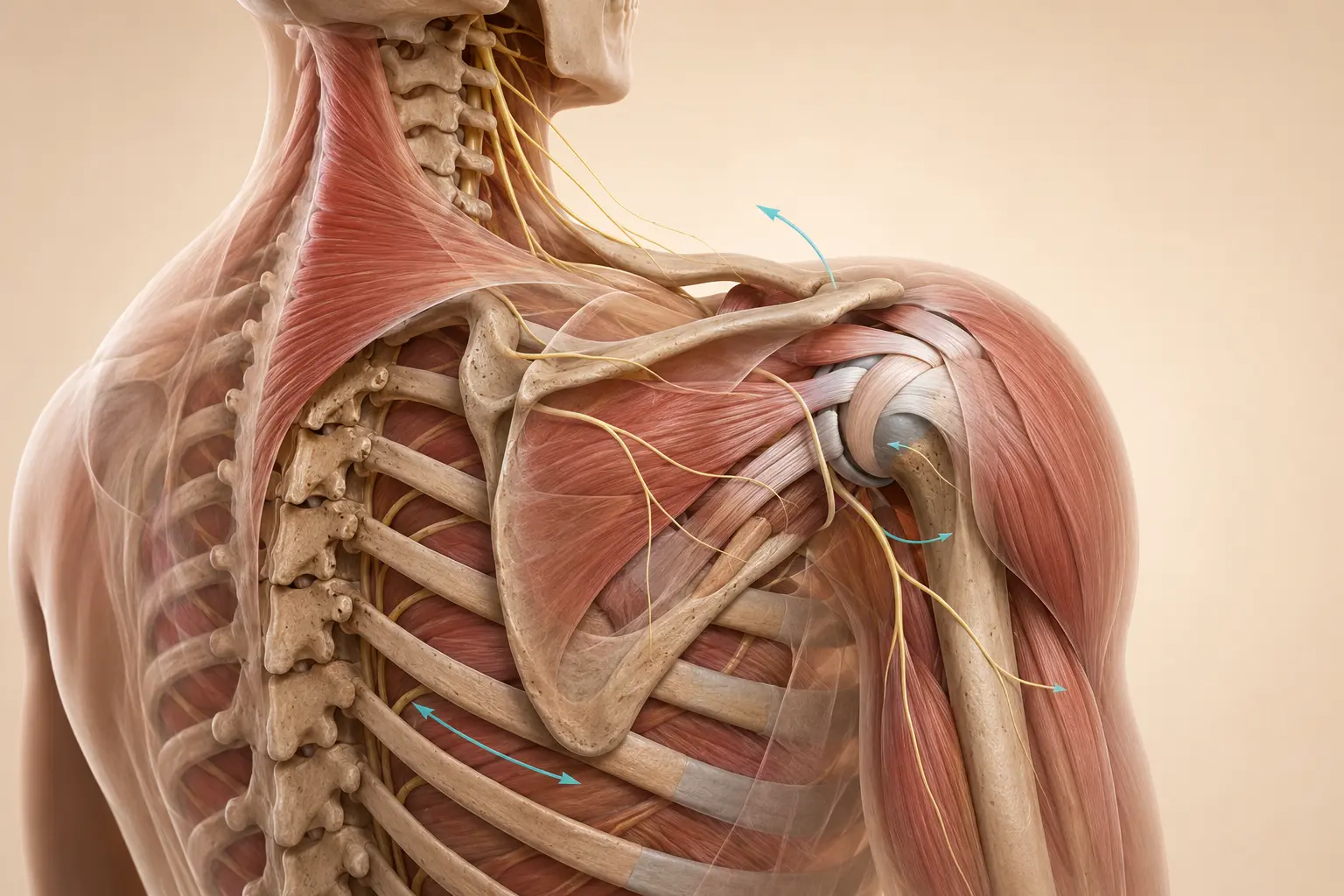
Record the moment pain appears—not just where it hurts
Before changing five things, write one sentence about a recent session:
“It starts near my chest on the last two reps of the third set, and reaching overhead is harder the next morning.”
That is more useful for planning than “bench hurts.” It gives you a position, a fatigue point, and an after-effect to discuss with your clinician or coach.
The following is a practical decision aid, not a validated diagnostic test:
| Pattern you notice | One adjustment to consider | What the result can tell you |
|---|---|---|
| Discomfort mainly in the deepest part of the press | Try a light press with a shorter range, such as a floor press | Whether a smaller range is currently better tolerated—not which tissue is injured |
| Early repetitions feel comfortable; later repetitions become painful | End the set earlier while keeping the setup consistent | Whether you can practice the movement without the same accumulation of symptoms |
| Symptoms appear mainly with heavier weights | Lower the resistance while keeping the movement recognizable | Whether load is a useful variable to modify |
| The session feels acceptable but sleep or daily reaching is worse afterward | Reduce the next exposure and review the rest of that week’s upper-body work | Whether the whole session was more than you recovered from comfortably |
| Slipping, giving way, sudden weakness, or progressively worsening pain | Stop experimenting and arrange an assessment | These symptoms need more than a technique substitution |
An easier variation is information. It is not proof that your shoulder has healed. Record the later response before deciding that a modification worked.
The CrossFit detail a bench-only program can miss
Imagine that you reduce bench pressing but keep ring dips, burpees, handstand push-ups, and extra pressing accessories unchanged. You have changed the bench session, but much of your shoulder’s work remains.
For your next review, place every upper-body session on one page. List the exercise, hard sets or repetitions, and when symptoms appeared. Include conditioning work, not only the strength portion of class.
Do not turn this into a fake-precise conversion: ten burpees are not equivalent to ten heavy bench repetitions. The useful question is whether several demanding exposures are clustered together, especially after a recent increase. The Barbell Physio likewise emphasizes reviewing training changes when addressing bench-related symptoms. Training-volume discussion
An illustrative adjustment might be to practice a comfortable shortened-range press on one day and ask your coach for conditioning that does not reproduce the shoulder symptoms on another. That preserves a training routine while creating a clearer opportunity to judge the shoulder’s response.
Should you narrow your grip and squeeze your shoulder blades?
A 2024 study of ten healthy, experienced lifters modeled shoulder forces during bench-press variations using a 16 kg bar. Wider grips increased several modeled shoulder and AC-joint forces. Scapular retraction reduced several forces, particularly around the lower part of the lift. But the narrowest grip increased a different force component compared with a moderate grip.
The important limitation: this was a biomechanics study, not a trial showing that a particular grip cures pain or prevents injuries. It also did not test maximal lifting. Noteboom and colleagues
A practical application is to test a small, comfortable setup change with a light load rather than force an extreme grip or elbow position. You do not need to chase one universal elbow angle.
Also, a bench-press cue is task-specific. The stable upper-back position used on a bench should not become an instruction to hold the shoulder blades down and together during every overhead exercise. The wall-slide example below practices a different movement.
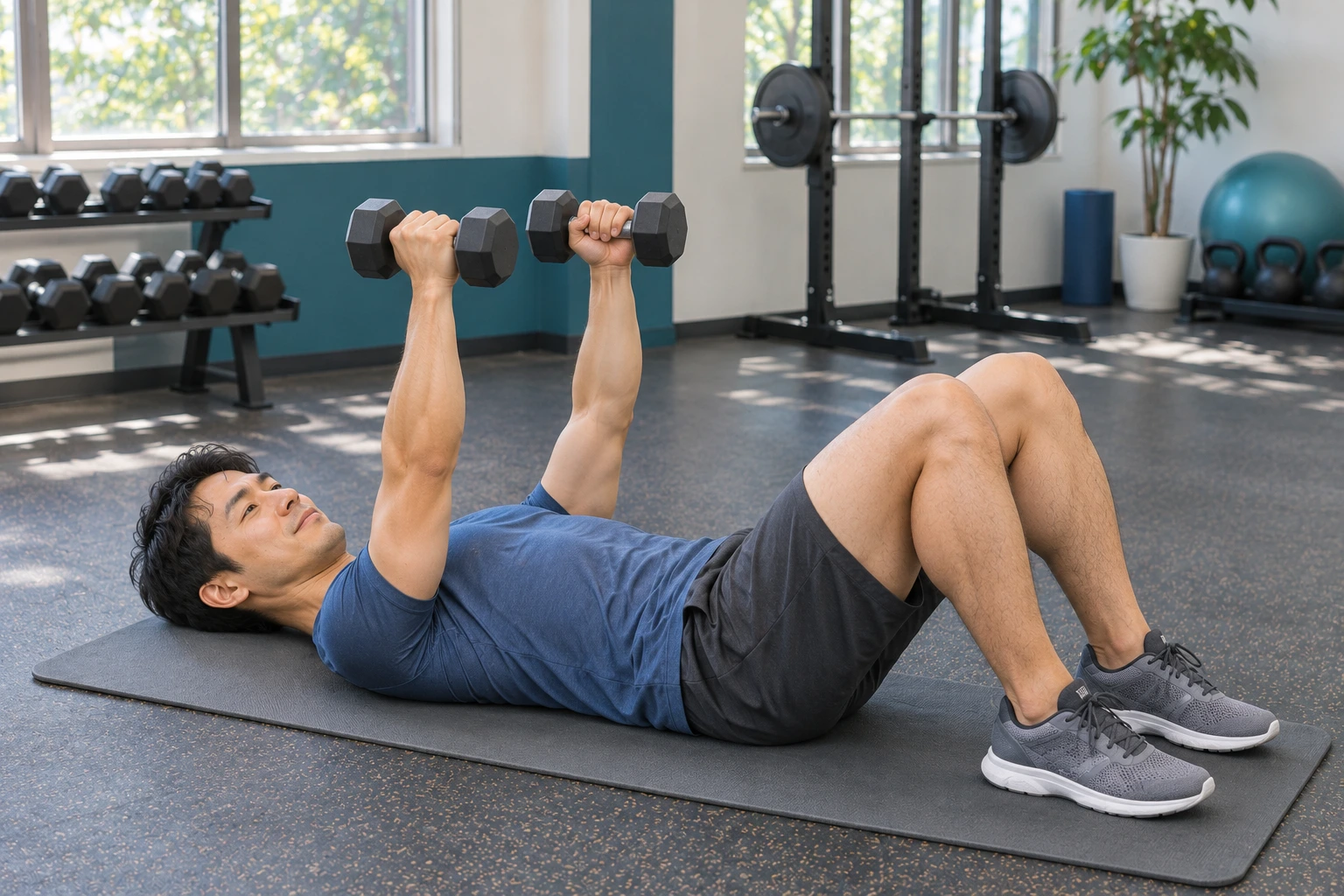
Example 1: Neutral-grip dumbbell floor press
Why consider it: The floor limits how far the upper arms travel behind the torso, while palms facing each other provide an alternative hand position. The Barbell Physio includes this combination among options for modifying an uncomfortable bench press. It is a temporary loading option, not a special exercise that repairs every shoulder problem. Bench-press variations
Try it only if: Getting into position and moving through the shortened range are comfortable. Skip it if there is slipping, recent trauma, or pain even with very light resistance.
- Lie on your back with knees bent and feet supported. Use light dumbbells you can position and remove safely; get assistance if needed.
- Face the palms toward each other. Keep wrists comfortably aligned over the forearms.
- Lower slowly until the upper arms gently meet the floor. Do not bounce or force the elbows into an exaggerated tuck.
- Press smoothly, stopping the set before effort changes your movement or symptoms increase.
Conservative trial, not a research-established prescription: Start with one set of six easy repetitions, leaving several repetitions in reserve. If comfortable, a second set may be reasonable. After a tolerable first trial, two sessions on nonconsecutive days can be an example starting schedule, adjusted to your other pressing work and recovery. This replaces some pressing work; it is not extra volume added to a session that already irritates the shoulder.
Check your familiar daily movement later and the next morning. If symptoms are worse, the trial was not a good fit at that dose. The floor limiting your range does not make heavy loading automatically appropriate.
Example 2: Forearm wall slide
Why consider it: This practices raising the arms while the shoulder blades move around the rib cage. It is particularly relevant if you also press overhead. It is not an obligatory fix for pain at the bottom of a bench press.
Squat University describes the wall slide as a serratus anterior exercise. A study of 20 healthy adults found that it activated this muscle at and above shoulder height. That is evidence about muscle activity, not proof of pain relief or injury prevention. Squat University’s explanation · Hardwick and colleagues
- Face a wall with one foot slightly forward. Place your forearms against it, elbows bent, near shoulder height.
- Apply gentle pressure and slide upward through a comfortable range. Let the shoulder blades move with the arms.
- Avoid gaining height by markedly arching the lower back. Do not force the shoulders down as you reach.
- Return slowly. Begin without a band or added weight.
For an easier option, keep the elbows below shoulder height and slide through a smaller arc, or support your forearms on a table and gently sit back into a comfortable reach. Progress by adding a little height or a few repetitions after the same movement is consistently controlled and daily reaching stays stable the following morning.
Illustrative starting dose: Five to eight easy repetitions. Stop for pinching, worsening pain, or instability. Reaching higher is not the goal if doing so recreates your symptoms.
If this drill is comfortable but your bench still hurts, that does not mean you performed it incorrectly. It may simply be addressing a different demand.
How to tell whether you are actually improving
Choose a repeatable reference: the same easy press variation, a daily reach, or a comfortable warm-up movement. Record enough detail to compare sessions, without repeatedly provoking pain to “check” the shoulder.
Look for three things together:
- The movement is more comfortable or controllable at a comparable workload.
- Your shoulder is not becoming progressively more irritated later that day or overnight.
- Daily function and confidence are improving, not just the weight on the bar.
When a modification is consistently tolerated, a practical progression is to change one demand at a time: a little more range, a little more resistance, or another set. Do not restore all three at once and then struggle to identify what changed. This is a monitoring strategy, not a fixed recovery schedule.
There is no single pain-score cutoff in this article that clears everyone to continue. Your diagnosis, symptom behavior, and recovery stage affect what is appropriate.
When muscle pain limits pressing
During your one-on-one evaluation, Dr. Brandon Lim can compare a comfortable reach or light pressing movement before and after treatment. If the examination identifies a muscular component to pain or guarding, trigger point dry needling can be considered to make that movement more comfortable and help you begin the relevant exercise.
Dr. Lim, PT, DPT, CMTPT, FMSC, also holds the International Diploma in Electro-Dry Needling. Electro dry needling uses controlled, rhythmic electrical stimulation through selected needles, with intensity adjusted to your comfort. He reviews suitability, alternatives and consent, including bleeding risk, implanted electronic devices, expected soreness or bruising, and the rare risk of lung puncture when treating near the chest.
Repeat the same comfortable movement afterward, then connect an improved response to graded pressing or shoulder exercise. New chest pain, shortness of breath or a persistent cough after needling near the chest requires urgent medical assessment.
How shoulder needling research applies
A trial of 121 people with subacromial pain found no statistically clear primary shoulder pain and disability advantage at one year when dry needling was added to exercise and manual therapy. Some secondary comparisons of acceptable symptoms favored needling. The study did not test bench-press recovery or establish an advantage for electrical stimulation. Hando et al., 2026, DOI 10.2519/jospt.2025.13460.
What to bring to an assessment
Bring a short video of a comfortable lifting set and a week of training notes, if you have them. Include the load, grip, range, when symptoms start, and what happens afterward. You do not need to film a painful maximal attempt.
A useful assessment considers the injury history, shoulder movement and strength, relevant neck or neurological findings, and the demands you want to return to. Imaging is not routinely needed at the outset for suspected rotator cuff tendinopathy; trauma and other suspected conditions can change that decision. Clinical practice guideline
If your shoulder keeps forcing the same training changes, you can book an evaluation at Limitless Physiotherapy in Columbia, Maryland. Your training notes help make the conversation specific: which pressing options fit now, what needs further assessment, and what progress would look like for your goals.
For related reading, see Why do my squat, deadlift, or press hurt? and Shoulder pain and rotator cuff care.
The Barbell Physio and Squat University provide educational exercise ideas referenced above. Their inclusion does not imply affiliation or endorsement. Starting doses are examples, selected for tolerability and adjusted to your response.
Common questions
Practical answers for the next step.
Should I stop bench pressing if my shoulder hurts?
After gradual symptoms, a smaller range, lighter load or shorter set may let you keep a tolerable pressing option. A pop, bruising, deformity, sudden weakness or slipping requires assessment before further pressing. Review the later and next-morning response before progressing.
Is the narrowest bench grip safest?
No universal grip follows from the available research. A study in ten healthy experienced lifters modeled different forces across grip widths using a 16 kg bar. Smaller comfortable changes can be tested with light loads, but the study did not demonstrate injury prevention or pain relief.
Is a neutral-grip floor press a treatment for every painful shoulder?
It is one possible way to reduce pressing depth and change hand position. Begin with light resistance only if getting into position and the movement are comfortable. Reduce or stop the trial if symptoms build or daily reaching is worse later or the next morning.
Do I need an MRI before starting shoulder rehabilitation?
Imaging is not routinely required initially to confirm suspected rotator cuff tendinopathy. Trauma, substantial weakness, suspected tendon tear, instability or another concerning finding can change the decision.
Can I receive electro dry needling at Limitless?
Yes. Dr. Lim offers trigger point and electro dry needling when appropriate after an individual evaluation and consent. Selected needles deliver controlled rhythmic stimulation at a comfort-adjusted intensity. Treatment is linked to a repeatable movement and an exercise plan.

About the clinician
Dr. Brandon Lim, PT, DPT, CMTPT, FMSC
Dr. Lim is the founder of Limitless Physiotherapy in Columbia, Maryland. His one-on-one approach integrates detailed examination, movement assessment, manual therapy, dry needling, and progressive exercise according to each person's presentation and goals.
Meet Dr. LimSelected sources
Evidence behind the discussion.
- Desmeules et al. Rotator cuff tendinopathy clinical practice guideline. JOSPT 2025. DOI 10.2519/jospt.2025.13182. PMID 40165544.
- Noteboom et al. Bench press technique and modeled shoulder loads. Front Physiol 2024. DOI 10.3389/fphys.2024.1393235. PMID 38974522.
- Gulati et al. Distal clavicular osteolysis imaging study. Skeletal Radiol 2026, online 2025. DOI 10.1007/s00256-025-05014-0. PMID 40826189.
- Hardwick et al. Serratus muscle activity during wall slides in 20 healthy adults. JOSPT 2006. DOI 10.2519/jospt.2006.2306. PMID 17193867.
- AAOS and ASES. Pectoralis tendon tear.
- AAOS and ASES. Chronic shoulder instability.
- Hando et al. Dry needling alongside exercise and manual therapy for subacromial pain. JOSPT 2026. DOI 10.2519/jospt.2025.13460. PMID 41476428.