
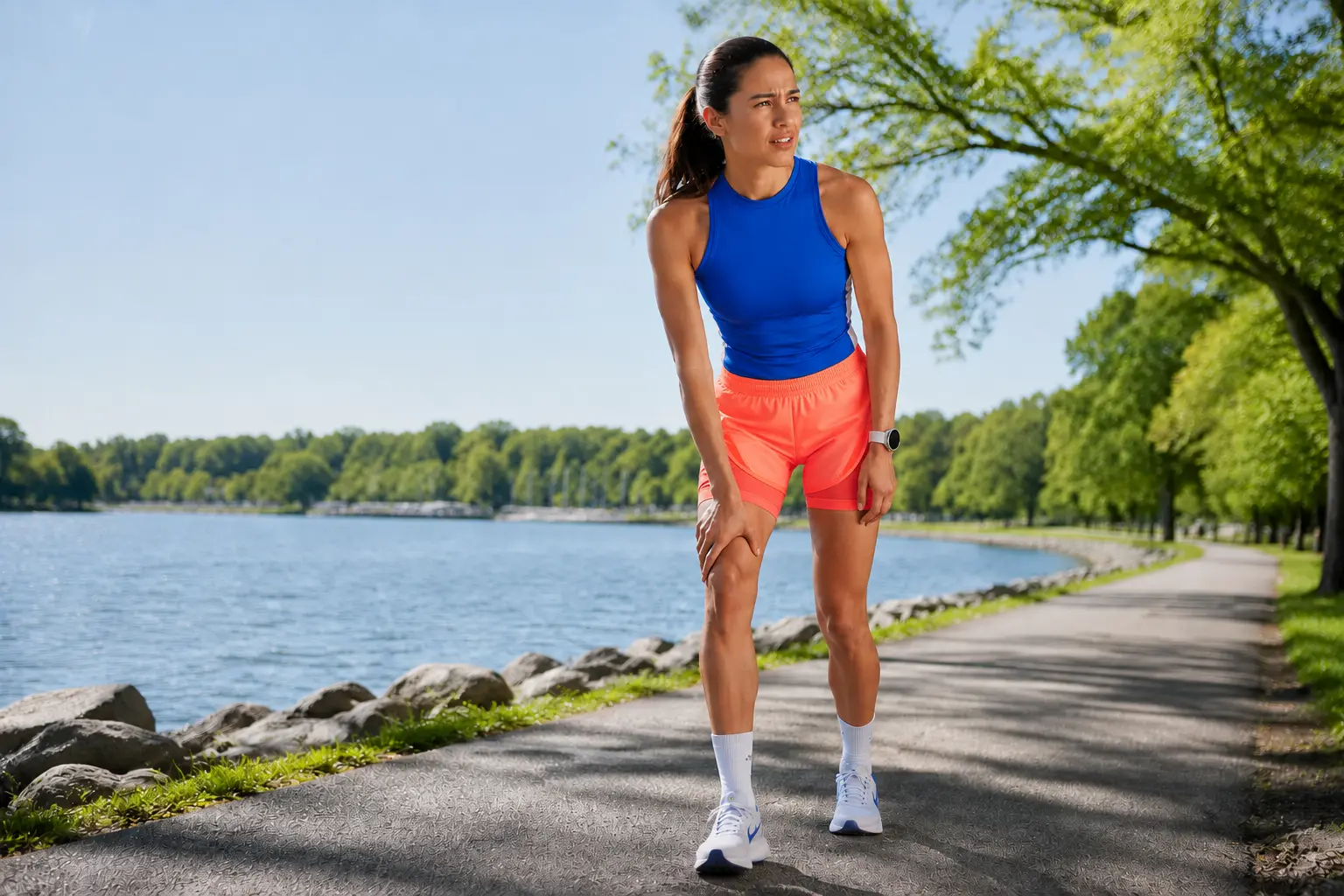
A run can feel normal for the first mile, then a dull ache begins around or behind the kneecap. Hills, stairs, squats, or sitting afterward may bring it back. You may be told that your kneecap is tracking badly, your glutes are weak, your shoes are wrong, or your form needs to be rebuilt.
What makes this frustrating is not only the ache. It is the uncertainty—whether finishing today’s run will make tomorrow worse, whether time off will cost the fitness you worked hard to build, and why a routine that used to feel normal suddenly does not. Advice such as ‘stop running,’ ‘strengthen your glutes,’ or ‘change your shoes’ may contain part of the answer, but it still leaves the most important question unanswered: what is driving your knee’s response?
Patellofemoral pain is a clinical pattern with several possible contributors. Two runners can point to the same place and need different starting points, which is why a useful evaluation tests the likely contributors instead of choosing one explanation in advance.
The short answer
Runner’s knee is usually a load problem that deserves a specific examination—not a permanent ban on running.
Patellofemoral pain describes pain around or behind the kneecap that is aggravated by activities that load the knee while it bends. It is one of the most prevalent running-related musculoskeletal injuries, but the diagnosis does not tell us which combination of training exposure, knee capacity, hip strength, ankle or foot function, and running mechanics matters for one person.
Current best-practice guidance places education and knee-targeted exercise at the center of care, with hip exercise and other supports added according to the examination. Running retraining can help selected runners, but there is no universal cadence, foot strike, or alignment correction that every painful knee needs.
Recognize the pattern
Pain around the kneecap fits the pattern—but the knee still needs to be examined directly.
Patellofemoral pain is commonly reproduced by running, stairs, squatting, jumping, or sitting with the knee bent. The discomfort can feel diffuse rather than pinpoint, and some runners notice grinding or clicking. Noise by itself does not establish damage, and it does not predict whether someone can return to running.
A careful examination also looks for presentations that need a different plan: a swollen knee after a twist, true locking, repeated giving way, focal joint-line pain, tendon pain below the kneecap, pain referred from the hip or back, or a recent traumatic injury. Calling every painful run ‘runner’s knee’ can delay the right decision.
- Location: around or behind the kneecap is different from a focal tendon, joint-line, or bone symptom.
- Behavior: note when pain begins, which terrain changes it, and how long it lasts afterward.
- Irritability: stairs and daily activity after the run show whether the current dose exceeded tolerance.
- Mechanical symptoms: swelling, locking, instability, or trauma changes the differential diagnosis.
Why it started now
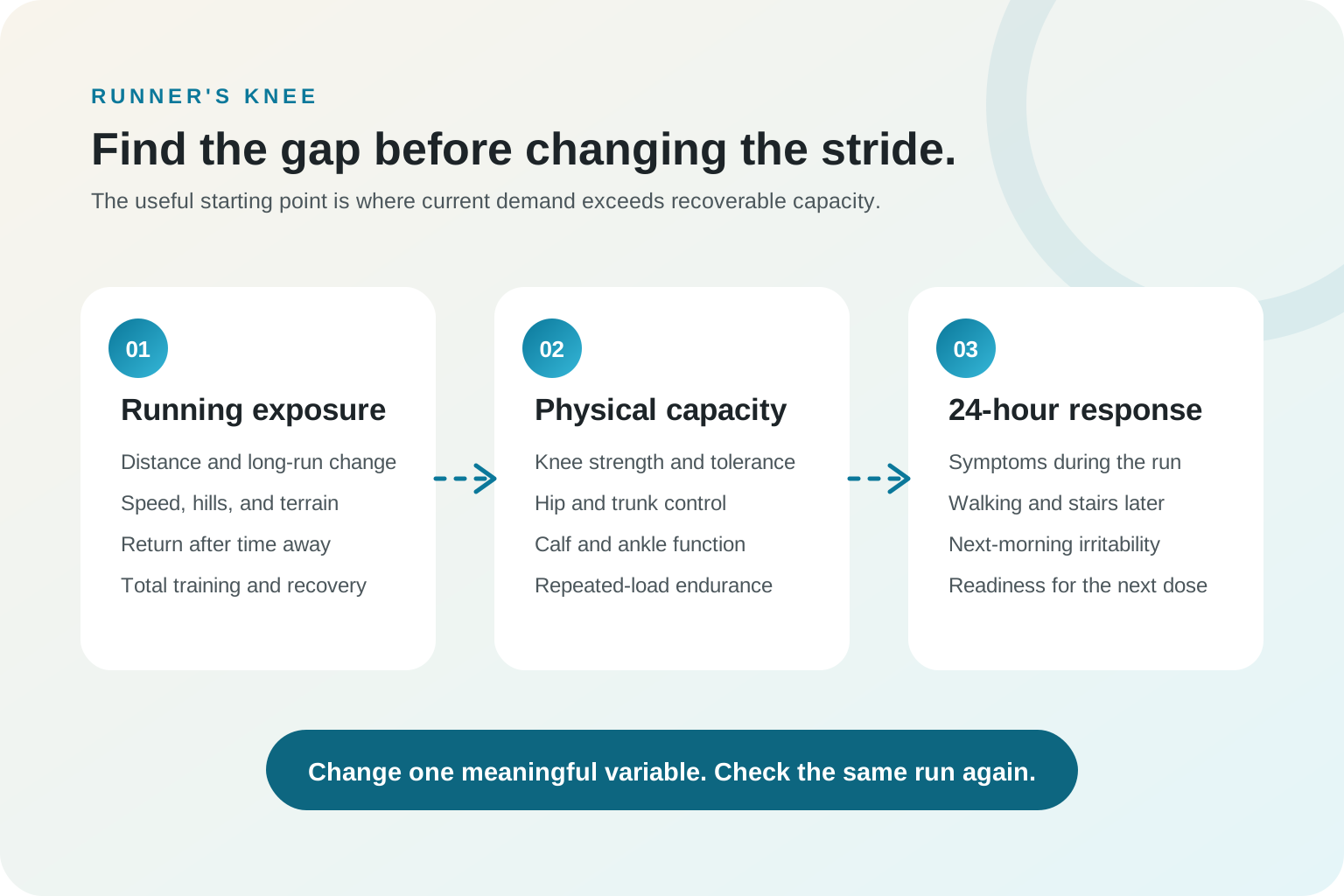
The useful question is not only how you run. It is what changed between your capacity and your running demand.
Symptoms often appear after a change in long-run distance, weekly volume, speed work, hills, strength training, race preparation, recovery, or a return after time off. The change does not have to look dramatic on a training calendar. A familiar mileage can become too much when sleep, illness, travel, work stress, or another sport has reduced recovery.
Movement still matters, but it should be tested rather than blamed. Hip adduction, pelvic motion, knee flexion, step rate, stride length, and foot mechanics may influence patellofemoral load. They are also normal variables in healthy runners. A visible asymmetry becomes useful only when it connects to the painful task and a reasonable modification changes the response. The goal is not to find one training mistake to blame; it is to identify the change that gives us the clearest and most useful place to intervene.
Training exposure
Mileage, long-run distance, speed, hills, surface, and recent time away from running.
Physical capacity
Knee and hip strength, calf function, ankle motion, control, and repeated-load tolerance.
Recovery context
Sleep, nutrition, illness, life stress, and the total load from work and other training.
A runner-specific examination
Measure the knee, the connected system, and the run that actually brings the pain on.
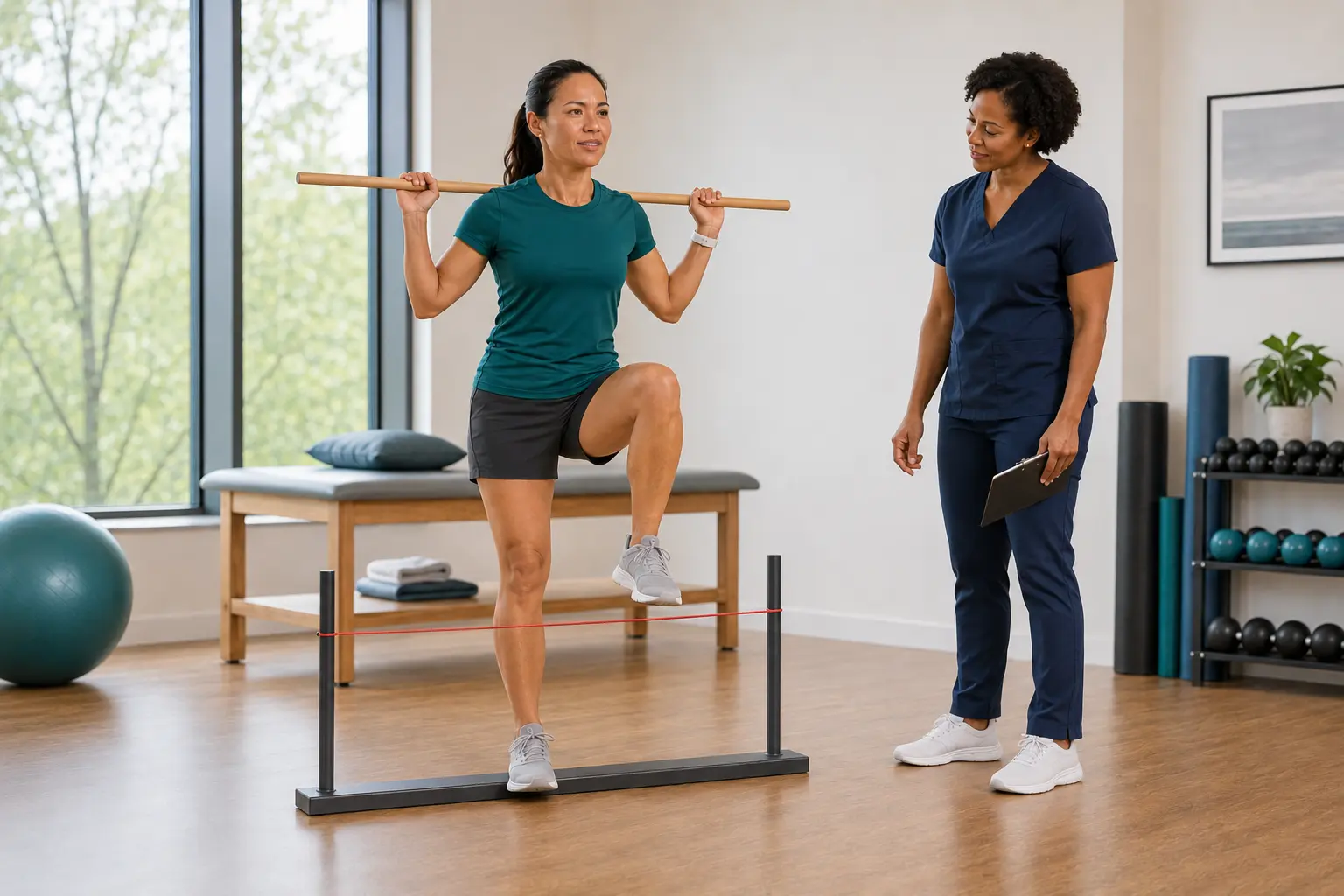
The evaluation begins with the knee: symptom location, swelling, range, patellar and tendon findings, and the ability to produce and absorb force. Hip strength, calf capacity, ankle motion, foot function, balance, and trunk control are added when the history or task makes them relevant. A single squat can provide information, but it is not a verdict on running form.
When running analysis is likely to change the plan, it should include the pace and duration that reproduce the problem. A brief video at an easy pace may miss pain that only appears after fatigue, on a downhill, or during faster work. The goal is not to make the runner look textbook-perfect. It is to find one or two modifiable factors that reduce symptoms or improve load management while preserving a natural stride. You should understand why each test is being done and how its result changes the plan.
- 01
Define the exact irritant.
Distance, pace, terrain, and the point in the run when symptoms begin.
- 02
Test local capacity.
Knee strength, tolerance to bending, and repeated loading come first.
- 03
Check connected contributors.
Hip, calf, ankle, foot, and trunk findings are included when they can change the task.
- 04
Trial a meaningful change.
Adjust one variable, repeat the painful task, and decide from the response.
Treatment that earns its place
Build knee capacity first, then add the supports that match your presentation.
Exercise is not a generic sheet of clamshells. Knee-targeted loading is progressed through the ranges, resistance, speed, and fatigue the runner needs. Hip exercise can be valuable when hip capacity is limited or when it helps the runner control a relevant task. Calf and foot work may matter when the lower leg is not managing repeated impact well.
Taping or prefabricated foot orthoses can provide short-term help for selected people when an immediate trial improves pain. Running retraining may use a modest step-rate change, a softer landing cue, or another individualized strategy. The change should be tested, practiced, and monitored rather than prescribed from appearance alone.
Hands-on treatment or dry needling may have a supporting role when the examination finds a specific joint or muscular restriction that changes motion, force, or comfort. At Limitless, Dr. Lim performs that treatment himself, then repeats the relevant squat, step-down, strength test, or running movement. A useful short-term change can create a better starting point for loading; if the meaningful task does not change, the approach should be reconsidered rather than repeated by habit.

Reduce the current irritant
Adjust the smallest necessary part of the running dose while maintaining safe conditioning.
Restore usable capacity
Progress knee, hip, calf, and task-specific strength according to measured deficits.
Rehearse the real demand
Build from controlled loading toward hills, speed, distance, and fatigue.
Return to miles
A good return-to-running plan watches the run, the hours afterward, and the next morning.
For many runners, the hardest advice to follow is ‘wait until it feels perfect’ when no one can explain what that means. A return plan does not require every sensation to disappear before rebuilding, but it does require an entry dose that does not create an escalating response. Track pain during the run, how stairs and walking feel later that day, and whether the knee is more irritable the next morning. That full pattern is more useful than judging one moment in isolation.
Progress one main variable at a time. Many runners rebuild comfortable volume before adding faster work, steep hills, or back-to-back hard sessions. A universal ten-percent rule cannot account for the runner, the injury, or the prior training base. The next dose should be earned by a stable response to the current one.
- 01
Choose an entry dose.
Use a pace and run-walk duration that keeps mechanics natural and symptoms stable.
- 02
Check the full response.
During, immediately after, later that day, and the next morning.
- 03
Progress one stressor.
Increase duration, then layer speed, hills, and density according to the goal.
- 04
Re-test under fatigue.
Strength and form that hold for one repetition may fail late in a run.
What the plan should give you
A good plan should make the next training week clearer—not leave you afraid of every sensation.
By the end of the evaluation, you should understand which pattern best fits, what findings would make us more cautious, what can safely remain in training, and which capacity needs to be rebuilt first. If hands-on treatment, taping, an orthosis, or a gait cue is used, it is connected to a meaningful task so its value is observed rather than assumed.
The goal is not a perfect-looking stride or a temporary pain-free test in the clinic. It is a knee that can tolerate the distance, pace, terrain, and life around the running you value.

Continue exploring
Choose the next question that fits your symptoms.
Running & sports rehabilitation
See how one-on-one care progresses strength, impact, and sport-specific capacity.
Read nextPart 2: Achilles pain
Understand tendon loading, calf capacity, and the return to faster running.
Read nextPart 3: Shin pain
Learn when shin pain may be a load-management problem—and when bone stress must be considered.
Read nextCommon questions
Practical answers for the next step.
Can I keep running with runner’s knee?
Sometimes. The decision depends on symptom irritability, swelling or mechanical symptoms, the running dose, and the response later that day and the next morning. Many runners can maintain a modified dose while strength and tolerance are rebuilt; an escalating response means the plan needs to change.
Do weak glutes cause patellofemoral pain?
Hip strength can matter, but it is not a complete explanation for every painful knee. Knee capacity, training exposure, calf and ankle function, recovery, and running mechanics may also contribute. The useful finding is the one that changes symptoms or function when addressed.
Should I increase my cadence?
Only when a trial supports it. A modest step-rate increase can reduce knee load or pain for some runners, but it is not universally helpful and may shift demand to the calf or Achilles. The change should be tested at a relevant pace and progressed gradually.
Can dry needling help runner’s knee?
It may help when a reproducible muscular component limits movement or loading, but it does not replace knee-targeted strengthening or running progression. At Limitless, any short-term change is reassessed and connected to active rehabilitation.
Do I need an MRI?
Patellofemoral pain is commonly diagnosed from the history and examination. Imaging may be considered when trauma, significant swelling, locking, persistent symptoms, or findings suggesting another condition change the clinical question.

Written & clinically reviewed by
Dr. Brandon Lim, PT, DPT, CMTPT, FMSC
Dr. Lim is the founder of Limitless Physiotherapy in Columbia, Maryland. His one-on-one approach integrates detailed examination, movement assessment, manual therapy, dry needling, and progressive exercise according to each person's presentation and goals.
Meet Dr. LimSelected sources
Evidence behind the discussion.
- Kakouris N, Yener N, Fong DTP. A systematic review of running-related musculoskeletal injuries in runners. Journal of Sport and Health Science. 2021.
- Neal BS, Lack SD, Bartholomew C, Morrissey D. Best practice guide for patellofemoral pain. British Journal of Sports Medicine. 2024.
- Willy RW, Hoglund LT, Barton CJ, et al. Patellofemoral Pain Clinical Practice Guideline. JOSPT. 2019.
- Esculier JF, Bouyer LJ, Roy JS. Immediate effects of running gait modifications in runners with patellofemoral pain. Frontiers in Sports and Active Living. 2023.
- de Souza Júnior JR, et al. Effects of two gait-retraining programs on pain, function, and lower-limb kinematics in runners with patellofemoral pain. PLOS ONE. 2024.
When knee pain deserves prompt medical evaluation.
Seek prompt evaluation after a significant injury when you cannot bear weight, the knee is visibly deformed, swelling increases rapidly, the joint truly locks, or the knee repeatedly gives way. Fever with a hot, red, swollen joint also requires urgent medical attention.