

The phrase ‘shin splints’ can sound routine until the pain starts earlier in each run, settles more slowly, or seems to narrow into one exact spot. The difficult part is not only the pain. It is not knowing whether you are dealing with something that can be carefully modified or a bone stress problem that should not be tested through another run.
A runner who wants to protect fitness does not need a vague warning or automatic reassurance. The first job is to map the pain, learn how it behaves with running and daily activity, examine the bone and surrounding tissues, and decide whether rehabilitation can begin or medical imaging and time away from impact are more appropriate.
Shin pain can represent medial tibial stress syndrome, a tibial bone stress injury, calf-related pain, exertional compartment syndrome, nerve-related symptoms, or another condition. ‘Shin splints’ is too broad a label to make the safety decision by itself.
The short answer
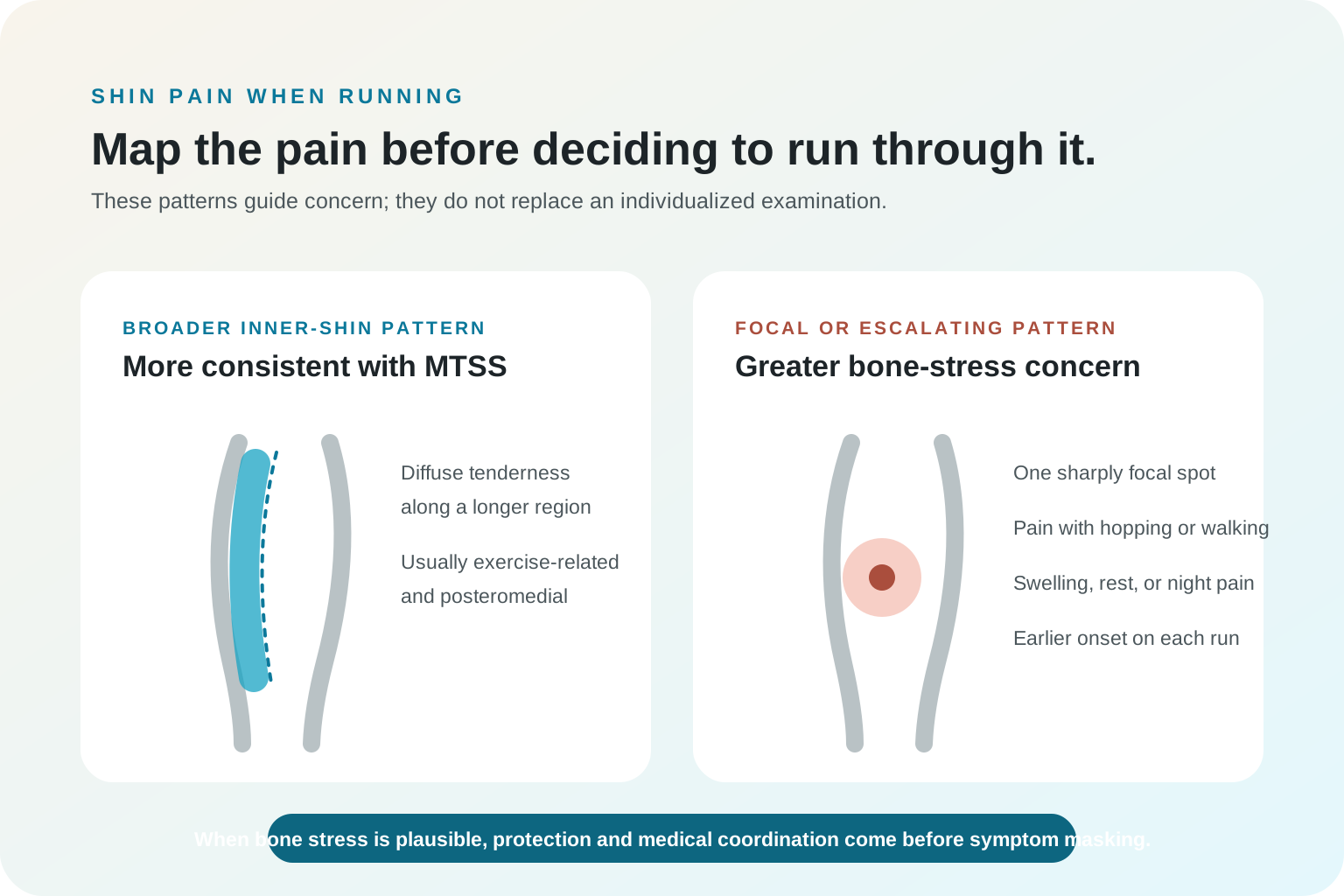
Diffuse inner-shin pain may fit medial tibial stress syndrome. Focal or escalating pain raises greater concern for bone stress injury.
Medial tibial stress syndrome is typically exercise-induced pain along the posteromedial border of the tibia with recognizable tenderness spread over at least five centimeters. A bone stress injury often becomes more focal and may progress from pain with running to pain with hopping, walking, or rest. Those patterns overlap, so no single home test safely rules a stress injury in or out.
When bone stress is plausible, continuing to test the pain through repeated runs can make the problem harder to manage. Early identification protects healing time. When the presentation is lower risk and daily activity becomes pain-free, a staged return can restore impact gradually while the runner maintains fitness through appropriate cross-training.
Two important patterns
The length of the painful area, the response to impact, and the trend over time change the level of concern.
Medial tibial stress syndrome commonly causes a broader ache along the lower inner border of the shin. It may begin with running and settle after stopping, then become easier to provoke if the load continues to rise. Tenderness is usually spread over a longer region rather than concentrated at one point.
A tibial bone stress injury exists on a continuum from stress reaction to stress fracture. Suspicion increases with sharply focal bone tenderness, pain that begins earlier on successive runs, pain with hopping or walking, swelling, or symptoms at rest or at night. The front edge of the tibia and other high-risk locations deserve particular caution because healing and complication risk can differ.
- More consistent with MTSS: diffuse posteromedial shin pain and tenderness extending over at least five centimeters.
- Greater bone-stress concern: focal tenderness, escalating impact pain, painful walking, swelling, or rest and night symptoms.
- Different urgent pattern: tightness with neurologic symptoms, marked weakness, or symptoms that predictably intensify during exercise may require another workup.
- Important limitation: a runner can have overlapping findings; examination and imaging decisions use the complete pattern.
Why the shin became painful
Bone and surrounding tissues respond to the size, speed, and recovery of repeated loading.
Shin pain often follows a return to running, a longer single session, added speed or hills, a new surface, a footwear change, military or sport conditioning, or an increase in total lower-body training. In a 2025 prospective cohort of 5,205 adult runners, a single run more than 10% longer than the runner’s longest run in the previous 30 days was associated with a higher rate of self-reported overuse injury. The study was not specific to shin pain, and it does not establish a safe cutoff for every runner. It does support asking whether one recent run was a much larger jump than the weekly total makes obvious.
Bone health also matters. Prior bone stress injury, low energy availability, menstrual or hormonal changes, inadequate fueling, low vitamin D or calcium status when medically confirmed, certain medications, and other health factors can change risk. These are not moral judgments about training discipline. They are clinical information that can lower the threshold for referral and a medical bone-health assessment.
Impact change
A longer run, faster work, hills, harder surfaces, or a rapid return after time off.
Capacity gap
Calf endurance, ankle and foot function, hip strength, and impact tolerance may not match the new demand.
Bone-health context
Prior stress injury, fueling, hormonal or menstrual history, medication, and medical risk factors.
A careful shin examination
Map the pain before treating the muscles around it.
The examination identifies the exact borders of tenderness, whether the painful area is diffuse or focal, and how walking, hopping, calf loading, ankle motion, and repeated impact affect symptoms. Calf and foot strength, balance, hip function, running mechanics, and training history can help build the rehabilitation plan, but they do not erase a concerning bone finding.
Plain radiographs may be used when a stress fracture is suspected, but an early X-ray can be normal. MRI is often the preferred advanced study when the clinical question remains and imaging will change management. The decision belongs with the appropriate medical team and depends on the location, severity, timeline, and risk profile.

- 01
Map the tenderness.
Record the exact location, length, and whether pain is on the bone or surrounding tissue.
- 02
Check daily function.
Walking, stairs, hopping, and rest symptoms help establish irritability.
- 03
Review load and health.
Training changes, recovery, prior injury, fueling, and bone-health factors belong in the history.
- 04
Escalate when needed.
Concerning findings prompt medical coordination and imaging rather than another test run.
Treatment depends on the classification
A suspected bone stress injury and diffuse medial tibial stress syndrome should not receive the same first-week plan.
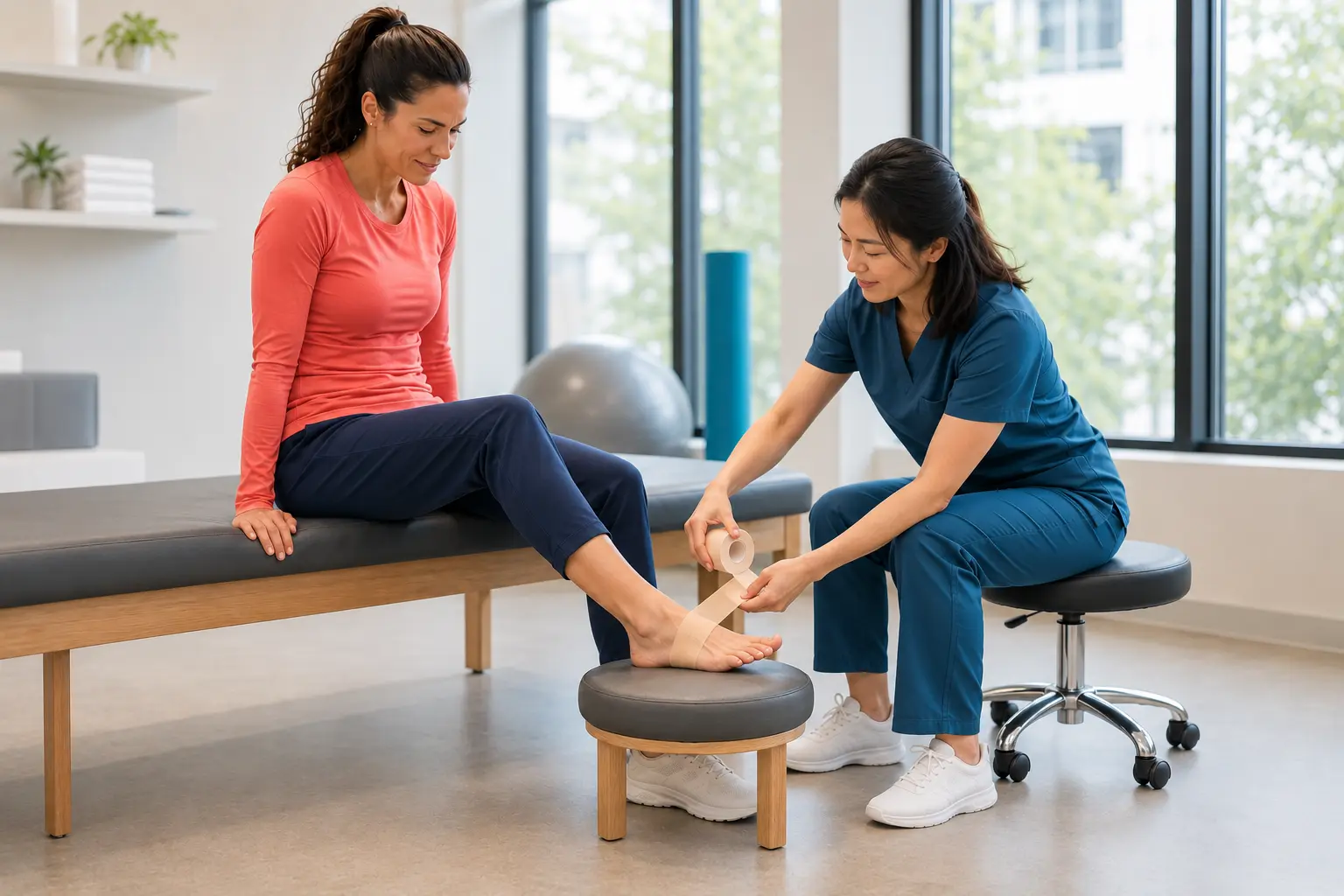
For medial tibial stress syndrome, the plan commonly modifies the provoking running dose, maintains conditioning where appropriate, and rebuilds calf, foot, hip, and impact capacity. Footwear or a temporary support strategy may be considered when an individual trial improves comfort. Manual therapy can address a measured ankle or foot restriction, and dry needling may be used for a distinct muscular contributor only after the presentation has been appropriately screened.
Dry needling is not a treatment for a suspected tibial bone stress injury, and needling a sore calf must never be used to create false reassurance about bone pain. When bone stress is suspected, protection from provocative impact and medical coordination take priority. Cross-training can maintain fitness if the chosen mode remains symptom-free and medically appropriate.
The return plan also addresses what made the previous load difficult to absorb: lower-leg strength and endurance, foot and ankle control, running exposure, and recovery. The goal is not to eliminate every asymmetry. It is to improve the capacities and decisions that are most relevant to the runner’s pattern.
Protect when necessary
Remove painful impact and coordinate medical assessment when bone stress is plausible.
Maintain what is safe
Use symptom-free daily loading and cross-training to preserve conditioning when appropriate.
Rebuild the missing layer
Restore strength, impact tolerance, and a training progression before full mileage returns.
Return to running
Pain-free walking is a starting criterion. It is not the finish line.
After a tibial bone stress injury, return-to-running decisions consider pain-free walking, resolution of focal bony tenderness as appropriate, healing time, strength and loading tests, and imaging for selected high-risk injuries. Many programs begin with walk-run intervals on level ground and progress running volume before speed and hills.
The response should remain quiet during, after, and the day following loading. If the same focal pain returns, walking becomes painful, or symptoms begin earlier with each exposure, stop the progression and reassess. The plan can maintain or reduce the dose instead of forcing a scheduled increase.
- 01
Meet entry criteria.
Daily walking and the selected loading tests should be pain-free and clinically appropriate.
- 02
Begin with intervals.
Alternate short running and walking bouts at an easy pace on level terrain.
- 03
Repeat before increasing.
A stable response during, after, and the next day earns the next step.
- 04
Add speed and hills later.
Faster loading and terrain are separate stressors, not automatic additions.
What the plan should give you
A careful decision now can protect the running you want to return to.
High-quality sports care is not defined by keeping every athlete training at all costs. It is defined by recognizing which symptoms can be modified and loaded, which require protection, and how to preserve as much safe conditioning as possible while the tissue recovers.
When impact needs to pause, it can feel as though you have lost your routine, your stress relief, and the training identity built around it. The plan should still show you what can be trained safely, how healing is being judged, and what must be true before the first walk-run interval.
Once running is appropriate, the progression should be just as specific: an entry dose, a next-day check, objective lower-leg capacity, and deliberate exposure to the distance, surface, pace, and terrain the runner needs.

Continue exploring
Choose the next question that fits your symptoms.
Part 1: Runner’s knee
Understand front-of-knee pain through training demand, strength, and selected gait changes.
Read nextPart 2: Achilles pain
See how calf capacity and progressive tendon loading prepare a return to miles.
Read nextRunning & sports rehabilitation
Learn how one-on-one sports care integrates examination, loading, and return-to-activity testing.
Read nextCommon questions
Practical answers for the next step.
How can I tell shin splints from a stress fracture?
Diffuse tenderness spread along the inner shin is more consistent with medial tibial stress syndrome, while a sharply focal spot, painful walking, swelling, or rest and night pain raises greater concern for bone stress injury. The patterns can overlap, and no single self-test safely replaces an examination.
Can I run through shin splints?
Continuing may be reasonable only when the presentation has been screened, symptoms remain mild and stable, and daily activity and the next-day response are not worsening. Focal, escalating, or persistent bone pain should not be tested through another run.
Will an X-ray show a tibial stress injury?
Sometimes, but early radiographs can be normal. MRI may be considered when clinical suspicion remains and the result will change management. Imaging decisions depend on the location, risk, symptoms, and medical examination.
Can dry needling help shin splints?
It may address a clearly identified muscular contributor in selected cases after bone stress and other conditions have been screened. It does not treat a tibial bone stress injury and should not be used to mask pain so a runner can continue an unsafe load.
What should return to running look like after bone stress injury?
Criteria commonly include pain-free walking, appropriate healing for the injury location, and satisfactory loading tests. Return often begins with easy walk-run intervals, builds volume before speed, and requires a quiet response during, after, and the next day.

Written & clinically reviewed by
Dr. Brandon Lim, PT, DPT, CMTPT, FMSC
Dr. Lim is the founder of Limitless Physiotherapy in Columbia, Maryland. His one-on-one approach integrates detailed examination, movement assessment, manual therapy, dry needling, and progressive exercise according to each person's presentation and goals.
Meet Dr. LimSelected sources
Evidence behind the discussion.
- Kakouris N, Yener N, Fong DTP. A systematic review of running-related musculoskeletal injuries in runners. Journal of Sport and Health Science. 2021.
- Winters M. The diagnosis and management of medial tibial stress syndrome: an evidence update. Unfallchirurg. 2020.
- Warden SJ, Edwards WB, Willy RW. Optimal load for managing low-risk tibial and metatarsal bone stress injuries in runners. JOSPT. 2021.
- George ERM, et al. Criteria and guidelines for returning to running following a tibial bone stress injury: a scoping review. Sports Medicine. 2024.
- Frandsen JSB, et al. How much running is too much? Identifying high-risk running sessions in a 5,200-person cohort. British Journal of Sports Medicine. 2025.
Stop running and arrange prompt assessment when the bone-stress pattern is concerning.
Prompt evaluation is appropriate for sharply focal bone tenderness, pain with walking, swelling, pain at rest or at night, a worsening limp, or symptoms that begin earlier and intensify on successive runs. Seek urgent medical care for severe pain after trauma, inability to bear weight, marked swelling, a cold or pale foot, or new weakness or numbness.