

Back pain after golf can be confusing. You may feel fine on the front nine, tighten up late in the round, or wake the next morning barely able to turn. You stretch the sore spot, it settles down—and then the same thing happens the next time you play.
When pain keeps returning, the most useful question is not only “What hurts?” It is also “Which mobility, force, timing, or workload variable changed what the lumbar region had to tolerate?”
The short answer
Your lower back may be doing more than its share—or simply more than it is ready to tolerate right now.
Sometimes the problem is mainly local, such as an irritated joint or muscle. Sometimes the back is also making up for limited or harder-to-control movement elsewhere. Often fatigue, practice volume, and recovery are part of the same picture. A useful evaluation sorts out those pieces instead of guessing from the pain location alone.
Why adjacent regions and swing load matter
Golf looks smooth, but the swing is a fast athletic event.
In a fraction of a second, the feet, legs, hips, pelvis, rib cage, shoulders, arms, and club must create force, transfer it, and then slow everything down. When one part contributes less, the shot still has to happen. Another part may pick up more of the work.
The club makes that task more demanding. It is a long lever, so a relatively small change in body position or timing can create a much larger change at the clubhead. The golfer has to control that lever accurately, often for dozens of full swings and many more practice swings in a single day.
This is the body–swing connection. It does not mean every ache comes from a hidden fault or that every golfer needs the same swing. Research has not identified one universally “bad” swing that explains back pain in everyone. It does tell us that the back is one part of a much larger movement, so the rest of that movement deserves attention when symptoms keep returning.

Upper trunk and rib cage
Where is your turn coming from?
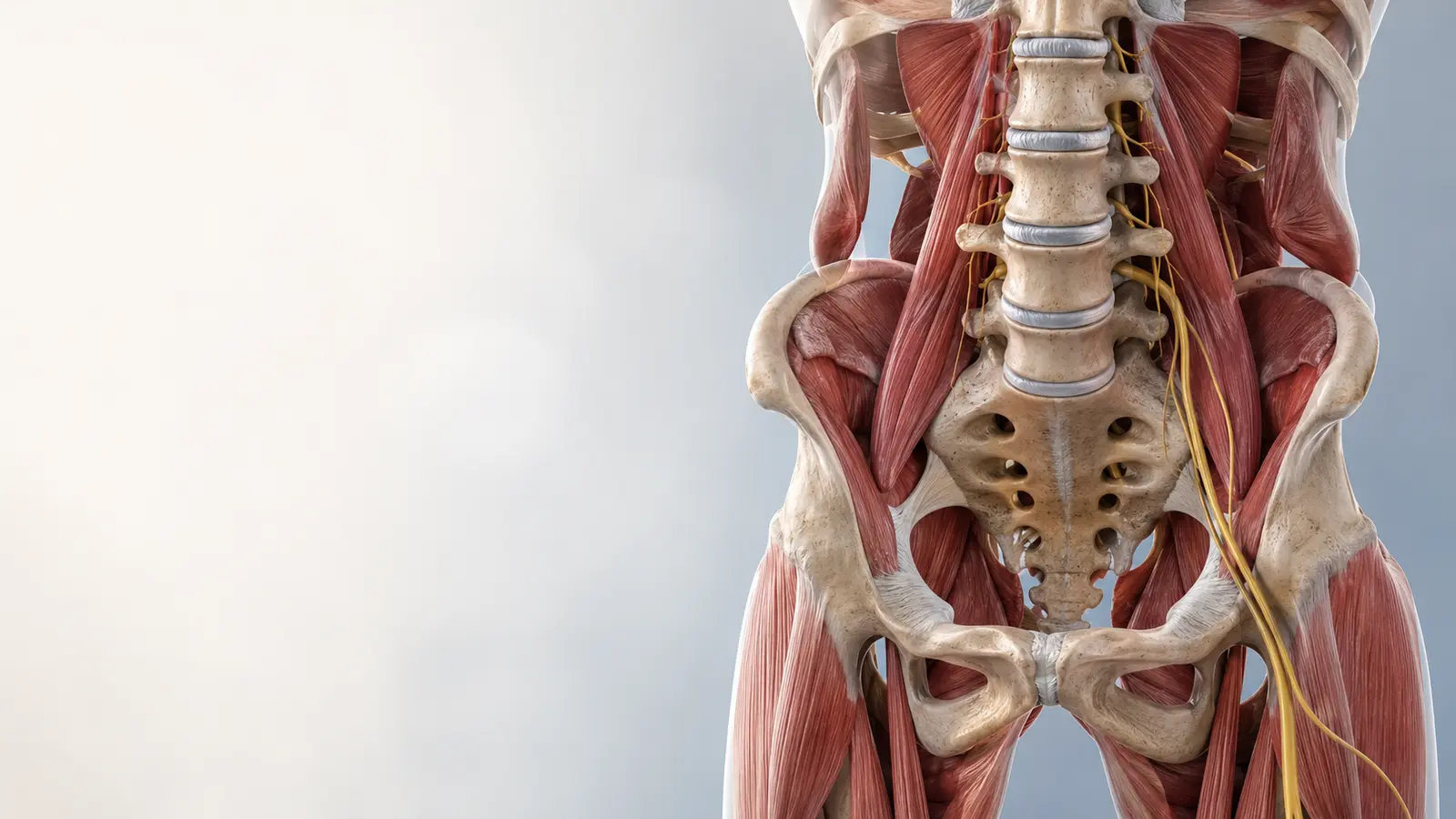
The lower back is meant to move, but it is only one part of the turn. The rib cage and upper back, pelvis, hips, shoulders, and even the feet all help create the rotation seen in a golf swing.
If the upper trunk does not turn comfortably, a golfer may still reach the top of the backswing by extending or side-bending more through the lower back, moving the pelvis differently, or letting the arms travel farther. That may work for a while. Repeated over a full round, however, the back may be asked to produce and control more motion than it currently tolerates well.
The goal is not to chase the largest possible turn. It is to have enough comfortable motion—and enough control—to complete the swing without one area constantly making up the difference.
Anatomically, the lumbar vertebrae sit between a rotating rib cage and the sacrum and pelvis. The hip joints then connect the pelvis to the legs. Those regions do not move as one rigid block: each can contribute some rotation, side-bending, flexion, extension, and force control, with the amount changing across the swing.
Can you turn comfortably?
Check whether the rib cage can rotate in both directions.
Can the trunk and pelvis move separately?
They should not have to turn as one rigid block.
Can you control the motion at speed?
Useful range should stay organized as speed and fatigue increase.
Pelvis and hip motion
Can each hip do its job when its turn comes?
For a right-handed golfer, the trail hip needs room to accept the backswing, while the lead side must accept load and allow the pelvis to continue rotating through impact and the finish. The directions reverse for a left-handed golfer.
The two sides are solving different parts of the same task. The trail side helps the golfer load and turn without simply drifting away from the target. The lead side has to receive force and provide a base that lets the pelvis keep moving through the ball.
If one hip does not provide enough usable motion or control, the body finds another route. The golfer may sway farther, slide toward the target, lift out of posture, or make a quick effort with the trunk and arms to return the club to the ball. The important point is not the label. It is whether that strategy is repeatedly making the lower back work harder.
Mobility and control are not the same. One golfer may truly lack hip rotation. Another may have plenty of range on the treatment table but struggle to use it while standing, turning quickly, or balancing on one side. Those golfers need different plans.
From the ground up
Pressure can shift before the body visibly moves very far.
Golfers often use “weight shift” to describe two related but different things. One is the changing pressure under the feet—how hard each foot is pressing into the ground. The other is the movement of the golfer's center of mass, or where the body's mass is centered, through space. They influence one another, but they are not the same measurement.
In many right-handed swings, pressure builds more under the trail foot during the backswing. As the golfer prepares to change direction, pressure under the lead foot can begin increasing while the club is still completing the backswing. The body can start using the ground to organize the transition before a large shift is easy to see on video. That is the useful idea behind the phrase “force precedes motion.”
How the feet help organize the transition
A useful pressure shift has three jobs.
Load
Build support under the trail side while staying balanced during the backswing.
Change direction
Begin building support under the lead side as the club completes the backswing.
Accept the load and keep turning
Use the lead side as a stable base for rotation through impact and a balanced finish.
How hard each foot is pressing into the ground changes as the swing develops.
The lower body drifts so far toward the target that stabilizing and continuing to rotate may become harder.
Foot and ankle motion can matter here too. If a golfer cannot comfortably load the trail foot, accept force through the lead foot, or stay balanced on uneven ground, the body may create a different solution farther up the chain. That is why the feet are worth examining—but not blaming automatically.
Strength, timing, and fatigue
Timing matters, but the body is not a row of dominoes.
The golf swing is often described as a sequence that builds from the lower body through the pelvis and trunk, then into the arms and club. That is a useful overview, but real swings overlap. One body part does not stop completely before the next one begins.
The practical question is whether the golfer can create force, transfer it, and then control the club without a last-second rescue. A golfer can have excellent flexibility and still struggle when the movement becomes fast or fatigue begins to change the timing.
- Create force through the ground and lower body while staying balanced.
- Transfer force through the pelvis, trunk, arms, and club without a last-second rescue.
- Control force through impact and follow-through so the lower back is not always absorbing the finish.
Fatigue often reveals what the first few swings hide.
Some golfers feel great on the first tee and hurt by the back nine. Others tolerate a round but flare after a large bucket of balls on a practice mat. A movement that is comfortable for ten swings may become irritating after one hundred.
That is why the amount of golf matters as much as the appearance of the swing. A recent jump in rounds, range sessions, speed training, lessons, work demands, or other exercise can push the total load beyond what the back is ready to recover from.
The round includes more than full swings. Practice swings, bending to tee or retrieve the ball, walking hills, carrying a bag, sitting in a cart, and the drive to and from the course all contribute to the day's total demand.
- Do symptoms begin during the swing, late in the round, or the next morning?
- Did the number of weekly swings or holes change recently?
- Is the driver different from the irons or wedges?
- Do range mats, long drives, cart sitting, or carrying the bag add to the pattern?
- How much recovery occurs between golf, work, exercise, and sleep?
How the pieces can add up
A common example: the back becomes the problem solver.
This is one possible pattern—not a diagnosis for every golfer with back pain.
Imagine a golfer who has difficulty loading the trail hip. The pelvis drifts instead of turning comfortably around that side. If the upper trunk also has limited rotation, the golfer may create extra extension and side-bending through the lower back just to complete the backswing.
On the way down, the lead side is late to accept the load. The golfer lifts out of posture and makes a quick effort with the trunk and arms to find the ball. It may still look like a perfectly playable shot—but the back has helped solve several problems in one very short moment.
Repeat that pattern through a round, add fatigue, and the lower back may eventually object. Another golfer may have excellent mobility and simply lack endurance. Another may have increased practice volume too quickly. The story matters because the treatment should match the reason the back is being overloaded.
What a good evaluation should feel like
Not a hunt for faults—a search for what changes the problem.
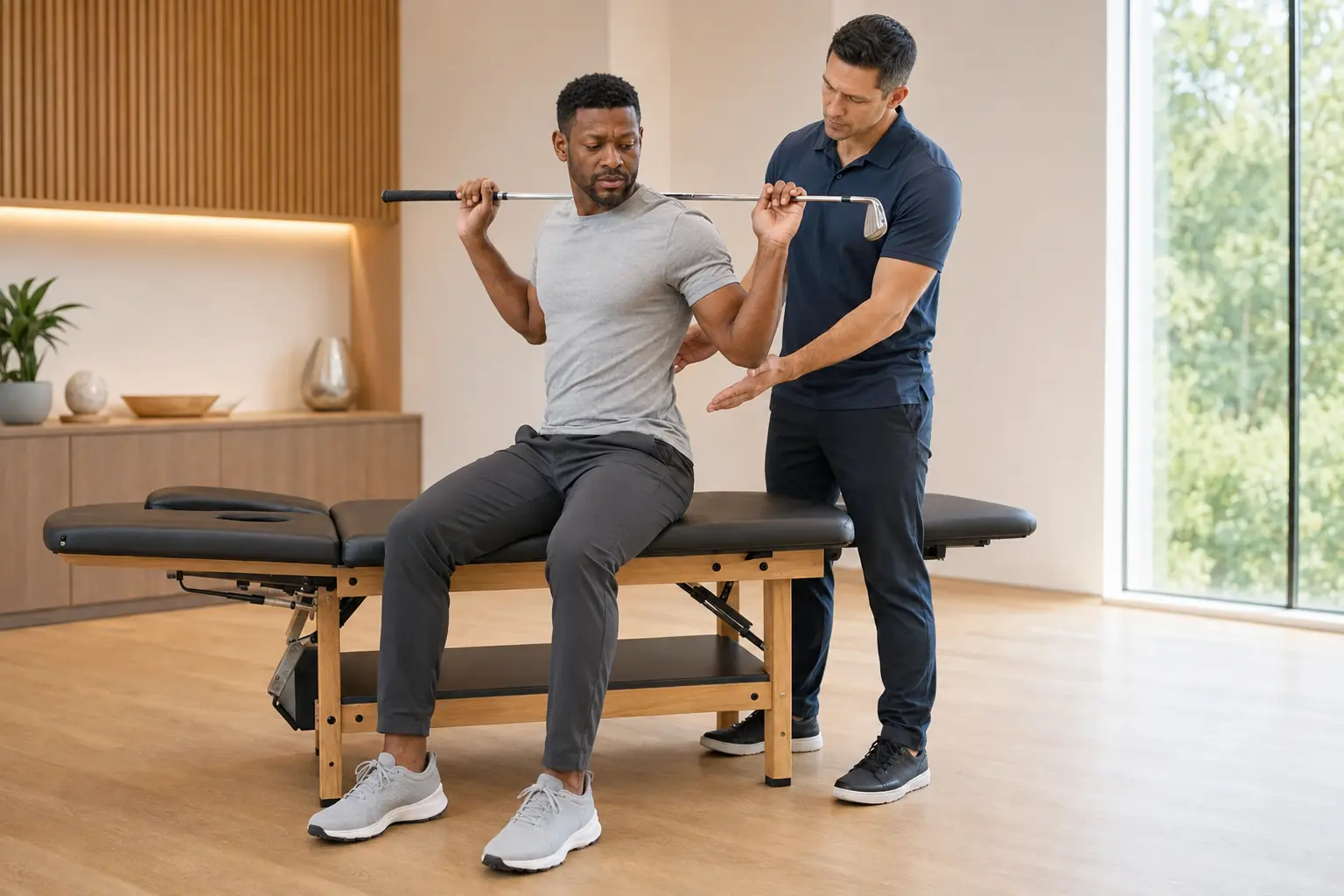
Movement screens are best used to describe the options a golfer has—not to predict who will develop pain. In a prospective study of 41 injury-free young elite male golfers, a 30-test screen did not effectively identify who would develop lower-back pain over the next six months.
- 01
Start with your story.
When does the pain begin? Which clubs or situations bring it on? What changed in practice, training, work, sleep, or recovery?
- 02
Examine the painful area.
The back itself still comes first: symptom behavior, motion, strength, neurologic findings, and signs that may require medical referral.
- 03
Test the body–swing connections that make sense.
Upper-back rotation, hip motion, ankle and foot function, balance, strength, control, and endurance are considered only when they fit the pattern.
- 04
Use the response to prioritize the plan.
If a targeted treatment, exercise, cue, or load adjustment makes the familiar movement easier or less painful, that response helps guide the plan. If it does not, the plan should change.
Health and performance have different roles
Do you need a physical therapist or a golf instructor?
Sometimes both. A golf instructor understands club delivery, ball flight, and technical strategy. A physical therapist evaluates the painful area and determines whether the body has the motion, strength, control, and tolerance needed for the technique you are trying to use.
You should not be forced into a position your body cannot comfortably access. At the same time, improving hip or upper-back motion does not automatically fix club mechanics. The best care keeps those two jobs clear and connects them when needed.
What treatment may include
The plan should match the reason your back is being overloaded.
There is no single “golf back pain” program. A locally irritated back, a true hip-motion restriction, a loss of trunk control late in the round, and a sudden jump in practice volume are different problems. They should not receive the same collection of stretches.
- Calm an irritable back while keeping you appropriately active.
- Temporarily adjust swing count, speed, club selection, or practice surface when the current exposure is too high.
- Restore useful hip, upper-back, foot, or ankle motion when the examination shows a meaningful limitation.
- Build trunk, hip, and lower-body strength, balance, rotational control, and endurance for the back nine.
- Progress from controlled drills to partial swings, full swings, range volume, and course play while checking the next-day response.
Depending on the diagnosis, hands-on treatment or dry needling may be considered as a short-term adjunct for symptom relief or easier movement. Suitability and response vary, and neither replaces the progressive loading needed to tolerate golf again.
When golf-related back pain needs medical attention.
Seek urgent medical care when back pain follows significant trauma or comes with progressive leg weakness, new numbness in the groin or saddle area, loss of bowel or bladder control, fever, or another sudden neurologic change.
Arrange an assessment when pain repeatedly returns with golf, travels into the leg, changes how you walk or move through daily life, or is not improving as expected. Severe unrelenting night pain, unexplained weight loss, or systemic illness also deserves prompt medical attention.
The bottom line
The lower back can be the painful region without being the only relevant finding.
Recurring golf pain does not automatically mean your body is broken or your swing is bad. It often means the demands of the swing, the amount you are practicing, and your current movement capacity are not matching as well as they could.
The right plan may include calming the irritated tissue, restoring useful motion, improving strength and endurance, changing practice volume for a period of time, and coordinating with a golf instructor when technique is part of the picture.
At Limitless Physiotherapy in Columbia, Maryland, golf-related care begins with a one-on-one clinical and movement assessment. The goal is not to make every golfer move the same way. It is to understand why your back keeps being overloaded and help you return to practice and play with more confidence.

Common questions
Golf, movement, and lower-back pain.
Does back pain mean I have a bad golf swing?
No. There is no single perfect swing for every body, and a visible swing characteristic does not automatically explain pain. The important question is whether your movement, physical capacity, or amount of golf is placing more demand on your back than it can comfortably handle right now.
Should I stretch my lower back before I play?
Not automatically. A gentle warm-up may help, but repeatedly stretching the sore spot may miss the reason it keeps tightening. Some golfers need more upper-back or hip mobility; others need better strength, control, endurance, or a slower build-up in practice volume.
Can I continue golfing with lower-back pain?
Many golfers can keep playing with temporary changes in volume, warm-up, club selection, or swing intensity. The decision depends on the severity and behavior of your symptoms. Worsening pain, pain traveling into the leg, progressive weakness or numbness, or a major change in daily function should be evaluated.
Is a golf movement screen the same as a physical therapy evaluation?
No. A movement screen looks at mobility, balance, and coordination. A physical therapy evaluation also examines the painful area, strength, neurologic findings, medical history, symptom behavior, and whether referral or imaging may be appropriate.
Why does my back hurt after the round instead of during the swing?
Pain that appears later can reflect accumulated load and fatigue. The total number of swings, walking, time in the cart, range practice, work, sleep, and recovery can all affect when the back reaches its current limit.

Written & clinically reviewed by
Dr. Brandon Lim, PT, DPT, CMTPT, FMSC
Dr. Lim is the founder of Limitless Physiotherapy in Columbia, Maryland. His one-on-one approach connects a detailed clinical examination with movement assessment, hands-on treatment when appropriate, and progressive exercise built around each person's goals.
Meet Dr. LimResearch & professional references
Sources behind the article.
The article is written for golfers, but the clinical distinctions and terminology are grounded in the research and professional resources below.
View references
Peer-reviewed research
- Williamson TR, et al. Epidemiology of musculoskeletal injury in professional and amateur golfers: a systematic review and meta-analysis. British Journal of Sports Medicine, 2024.
- Watson M, et al. Biomechanical parameters of the golf swing associated with lower back pain: a systematic review. Journal of Sports Sciences, 2023.
- Smith JA, et al. Risk Factors Associated With Low Back Pain in Golfers: A Systematic Review and Meta-analysis. Sports Health, 2018.
- American College of Radiology. ACR Appropriateness Criteria®: Low Back Pain.
- Bourgain M, et al. Golf Swing Biomechanics: A Systematic Review and Methodological Recommendations for Kinematics. Sports, 2022.
- Smith AC, et al. Comparison of centre of gravity and centre of pressure patterns in the golf swing. European Journal of Sport Science, 2017.
- Quinn SL, et al. Lower Quadrant Swing Biomechanics Identifies Golfers With Increased Risk of Low Back Pain: A Prospective Longitudinal Cohort Study. Journal of Sport Rehabilitation, 2022.
- Quinn SL, Olivier B, McKinon W. The efficacy of injury screening for lower back pain in elite golfers. South African Journal of Physiotherapy, 2023.
- Sheehan WB, et al. Physical Determinants of Golf Swing Performance: A Review. Journal of Strength and Conditioning Research, 2022.