
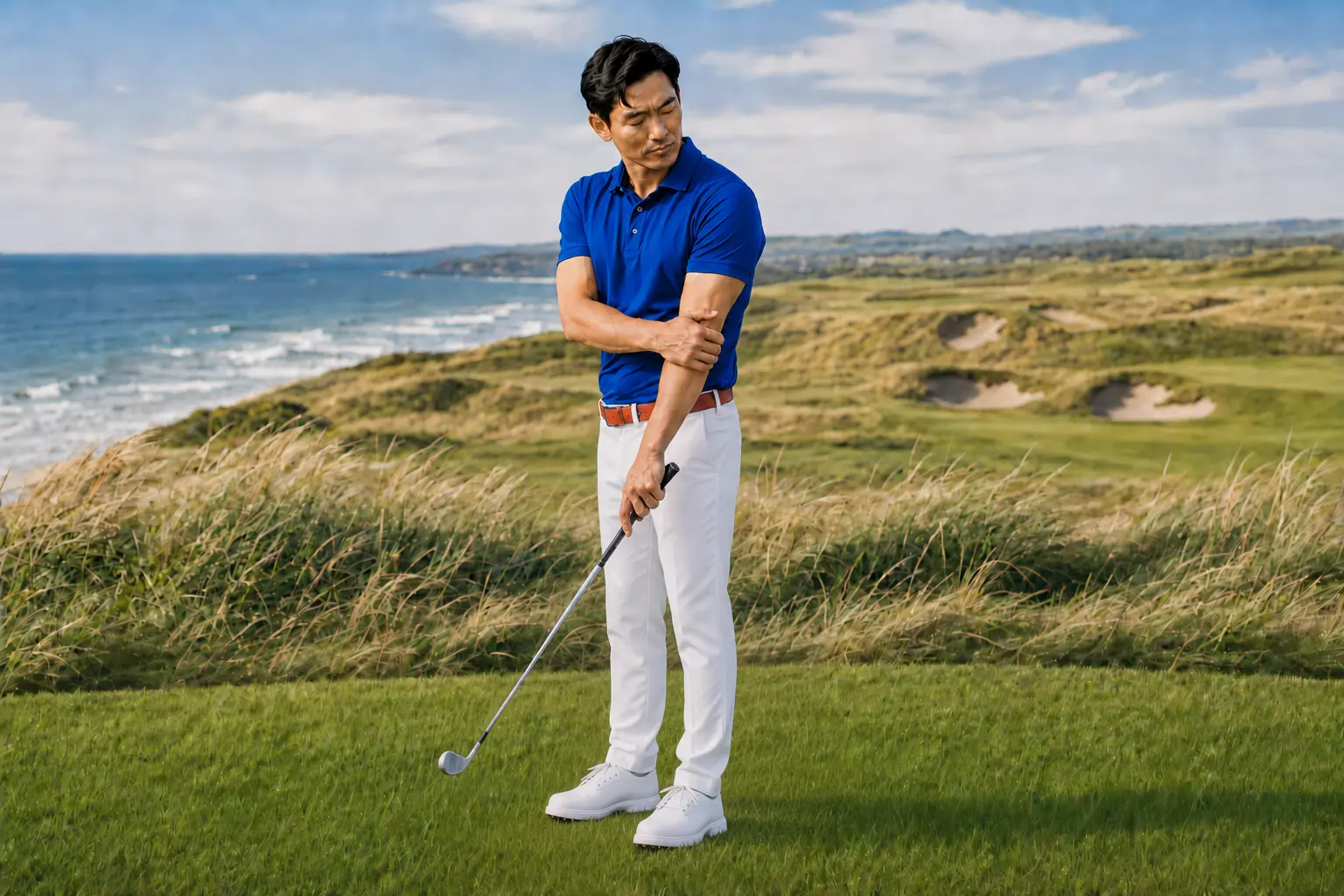
Golfers use the label “golfer's elbow” for almost any pain from the forearm to the hand. Sometimes that label fits. Often it is too broad to be useful.
Pain on the inside of the elbow, outside of the elbow, back of the wrist, thumb side, or little-finger side can involve different tissues. Gradual soreness after two large buckets of balls is a different story from sharp pain after striking a root. Tingling into the fingers is different again.
A whole-swing assessment should never skip the painful area or blame the hips for every sore elbow. It should answer a more specific question: Why did this part of the arm have to manage this amount and type of force, at this point in the swing, with this golfer's current capacity?
The short answer
Your hands are the final connection to the club—and they have a lot to manage.
The wrists and forearms control the clubface, transmit force, absorb vibration, and help slow the club after impact. Pain can develop when local tissue is irritated, grip demand is high relative to your capacity, the club meets the ground abruptly, swing volume rises too quickly, or the arms repeatedly make a late correction. More than one of those factors may be present.
Start with the painful area
“Where exactly?” matters more than “Is it golf-related?”
Symptom location does not prove which structure is painful, but it helps narrow the examination. The behavior of the pain matters just as much: gripping, resisting wrist motion, rotating the forearm, pressing through the hand, moving the neck, or feeling numbness can point the assessment in different directions.
Inside of the elbow
A flexor-pronator tendon pattern is possible, but joint, nerve, and referred symptoms can overlap.
Outside of the elbow
Extensor-tendon loading is common, but the radial nerve, joint, and neck may need consideration.
Thumb side or back of the wrist
Tendons, joints, and a sprain or impact injury may behave differently from simple post-practice soreness.
Little-finger side of the wrist
The TFCC region, ECU tendon, joint, and hook of the hamate are among the areas an examination may need to distinguish.
“Tendinopathy” also does not automatically mean ongoing inflammation. Persistent tendon pain is better understood through the tissue's current load tolerance, irritability, and function than through a promise to “get rid of inflammation.”
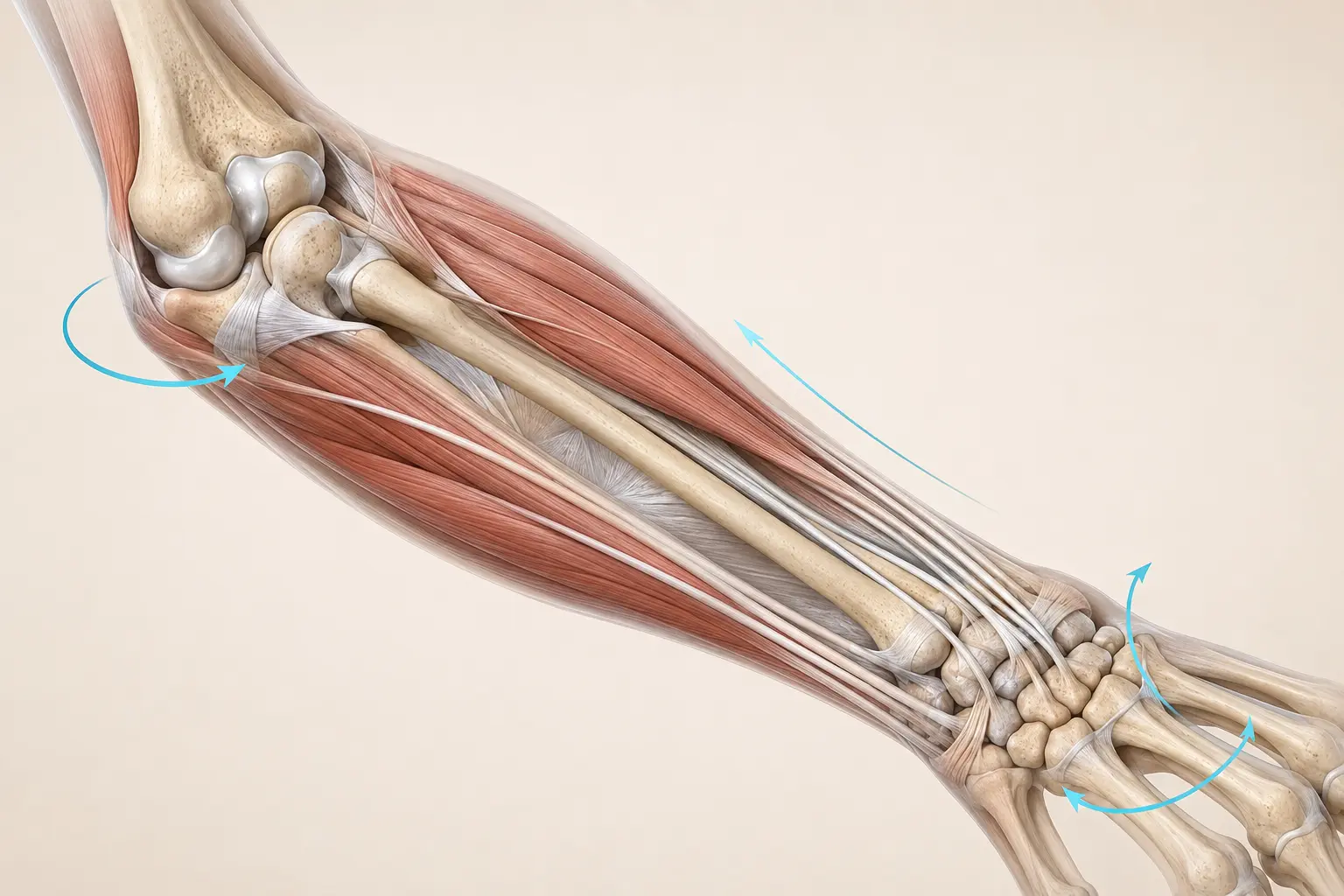
The elbow is not only a hinge. The humerus meets the ulna for bending and straightening, while the radius rotates around the ulna as the palm turns. Farther down, the radius, ulna, carpal bones, and forearm tendons coordinate wrist position and grip. Golf therefore spreads load across several joints and muscle-tendon groups rather than one isolated “elbow tendon.”
The wrists do not mirror one another
The lead and trail wrist have different jobs.
The lead side is the side closer to the target at address. It is the left side for a right-handed golfer and the right side for a left-handed golfer. The other side is the trail side.
Through the backswing, downswing, impact, and finish, the two wrists move through different combinations of bending, side-to-side motion, and forearm rotation. A 2023 study of sub-elite right-handed golfers found clearly different lead- and trail-wrist movement patterns across the swing. That supports a practical point: the side that hurts and the phase that hurts can guide the questions, but neither identifies a diagnosis by itself.
One golfer may feel the lead wrist during the transition. Another may feel the trail wrist at impact with a heavy strike. Another may finish the round comfortably and notice elbow soreness when lifting a coffee mug the next morning. Those are not interchangeable presentations.
Grip demand and forearm capacity
Grip pressure is only one part of forearm demand.
Grip demand is not only how tightly someone squeezes on one swing. It can mean the peak force, the percentage of the golfer's available strength, how long the tension is held, or whether the forearm can repeat the effort through a full session.
A golfer with lower grip and forearm capacity may need to use a high percentage of that capacity just to control the club. The grip may look relaxed and still be demanding. A stronger golfer may create a large force but tolerate it easily. That is why grip strength, pain during gripping, endurance, and the response across repeated swings can all matter.
What about grip size, shaft material, and other equipment?
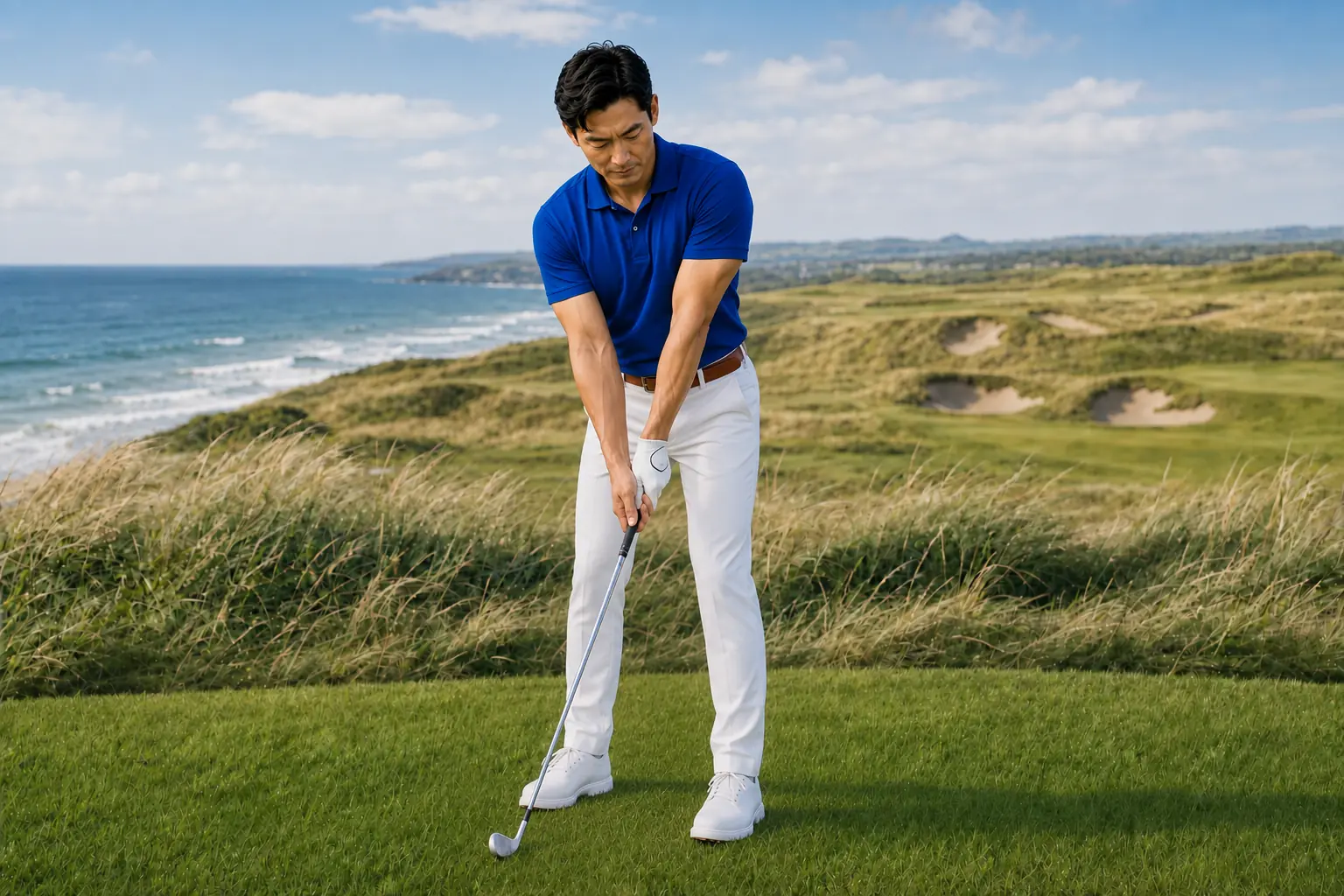
Equipment can change muscle demand, but the evidence does not support a universal prescription. A 2024 prospective case series of 30 right-handed golfers found that one ergonomic grip reduced activity in at least one measured forearm muscle during some swing phases. A 2026 prospective case series of 40 right-handed golfers found lower activity in two measured lead-arm muscles during late follow-through with the tested graphite shaft than with the tested steel shaft. Neither study tested pain relief, injury prevention, or long-term outcomes.
Equipment therefore belongs in the assessment, especially after a recent change. It should not become a sales pitch or a substitute for examining the painful tissue, swing exposure, and physical capacity.
When the club meets the ground
A sudden impact and a gradual overload are different problems.
A fat shot, heavy rough, firm mat, buried lie, root, or hidden stone can send an abrupt load through the club into the hands and arms. A golfer who feels immediate sharp pain, swelling, loss of grip, or focal palm or wrist pain after one strike deserves more caution than someone with mild soreness after a large increase in practice.
Gradual symptoms may reflect accumulated exposure: hundreds of grips, repeated wrist motion, and many small impacts arriving faster than the tissue can recover. The same golfer can also have both—a forearm that was already irritated and one unusually heavy strike that pushes it over the line.
Low-point control and club delivery belong with the golf professional. The physical therapist's job is to determine what was injured, whether the arm and the rest of the body can tolerate the task, and how to reload it safely.
The arms do not swing alone
Limited contribution from the trunk or lower body can increase corrective demand at the hands and forearms.
The lower body and trunk help create and organize the motion that reaches the arms. If the golfer loses balance, changes direction late, stops turning, or rises out of posture, the hands and forearms may make a quick correction to return the clubface to the ball.
That is a movement hypothesis—not a rule. An arm-dominant swing is not automatically harmful, and a visible swing characteristic does not prove why a tendon hurts. The observation becomes useful only when three things line up:
- The pattern appears during the golfer's familiar painful task.
- The examination finds a plausible physical or load-related reason for the correction.
- A targeted change improves the symptom, the task, or the golfer's ability to repeat it.
Shoulder position and forearm rotation also help control the club. Restricted motion can narrow the options available to the hands, but having plenty of motion without strength or timing can be just as relevant. There is no single “perfect release” that every body must reproduce.
Practice load and fatigue
Symptoms can emerge only after repeated swings and accumulated fatigue.
A range session can create a very different exposure from a round. The golfer may hit the same club repeatedly from a firm mat, take fewer breaks, and make far more full swings in a short period of time. Add a lesson, speed training, new clubs, yard work, lifting, or long hours at a keyboard, and the forearm's total week may look very different from the golf schedule alone.
Fatigue can change grip pressure, wrist position, impact, and the amount of correction made by the arms. Symptoms that appear late in the bucket or the following morning may point toward an endurance and load-capacity problem even when the first swings look easy.
- Did practice frequency, bucket size, or total holes change?
- Are mats worse than grass?
- Does one club or lie create a sharper response?
- Did symptoms begin after new grips, shafts, lessons, or speed work?
- How does the arm feel later that day and the next morning?
How the pieces can add up
A common example: a sore lead wrist after more range practice.
This composite example illustrates the reasoning process. It is not a diagnosis for every golfer with wrist pain.
A recreational golfer adds two weekly range sessions and practices mostly from firm mats. Little-finger-side lead-wrist pain gradually appears. Local testing reproduces the familiar pain with loaded wrist motion and gripping, so the wrist belongs directly in treatment.
Early swings are comfortable. Later in the session, heavy contact becomes more frequent and the hands make a faster correction as the body turn fades. The assessment does not declare that the trunk “caused” the wrist pain. It shows that local irritability, impact exposure, volume, and fatigue may be adding to the same problem.
The plan reduces current irritability, changes the short-term swing exposure, rebuilds wrist and forearm capacity, and coordinates technical questions about low-point control with a golf professional. The painful swing and next-day response are re-tested as volume returns.
What a good evaluation should clarify
The diagnosis comes from the details—not the name of the sport.

- 01
Clarify the location and how it began.
Inside or outside elbow? Which side of the wrist? Gradual soreness or one hard strike? Swelling, clicking, numbness, or loss of grip changes the priorities.
- 02
Examine the elbow, wrist, and hand.
Motion, resisted testing, grip, joint behavior, focal tenderness, and symptom reproduction help narrow the working diagnosis.
- 03
Screen the nerve and neck when the story calls for it.
Tingling, hand weakness, symptoms traveling from the neck, or findings that do not fit the local tissue deserve a broader neurologic examination.
- 04
Recreate the relevant golf demand.
Grip, forearm rotation, club, surface, impact pattern, swing phase, speed, and fatigue are considered when they can be tested safely.
- 05
Alter one relevant factor and compare the response.
A useful modification should change something meaningful: pain, grip, swing tolerance, impact comfort, or the next-day response.
Treatment and return to golf
The arm needs the right dose of work—not endless rest.
Treatment depends on the diagnosis and irritability. An acute impact injury may need protection and medical imaging. A tendon-related presentation generally needs progressive loading. Nerve symptoms, joint instability, and referred pain require different plans.
- Temporarily adjust swing count, surface, club selection, and intensity without shutting down every useful activity.
- Rebuild wrist flexor and extensor, forearm rotation, grip, and finger capacity in tolerable stages.
- Add shoulder, trunk, hip, or lower-body work only when testing shows that it changes the arm's task.
- Progress from short clubs and partial swings to full speed, varied lies, larger practice volume, and course play when appropriate.
- Track the response during practice and the following morning, not only how the first few swings feel.
Depending on the diagnosis, manual therapy, dry needling, taping, or a brace may be considered as short-term adjuncts for symptom management. Suitability and response vary, and none replaces the progressive loading and golf exposure needed to make the arm reliable again.
Different professionals, different questions
Where physical therapy ends and golf instruction begins.
A golf professional addresses club delivery, strike pattern, and technical strategy. A physical therapist determines whether the elbow, wrist, shoulder, neck, and the rest of the movement system have the capacity to tolerate that strategy.
The best answer is sometimes collaborative: protect and reload the tissue, improve the physical option that is genuinely limited, and let the golf professional decide how to organize the club.
When elbow or wrist pain needs prompt medical attention.
Seek urgent care after a significant impact when there is:
Visible deformity, rapid swelling, an open injury, severe pain with inability to move or grip, or a hand or fingers that become cold, pale, blue, or markedly numb.
Arrange a timely assessment for:
Persistent focal palm or wrist pain after a club strike, progressive tingling or hand weakness, painful clicking or instability, symptoms extending from the neck, or pain that is not improving as expected.
The bottom line
Elbow or wrist pain can be local without being isolated.
Golf-related arm pain is not automatically a grip problem, a swing fault, or “golfer's elbow.” The answer begins with the local diagnosis and becomes clearer when impact, equipment, forearm capacity, fatigue, and the rest of the swing are considered together.
At Limitless Physiotherapy in Columbia, Maryland, golf-related care begins with a one-on-one clinical and movement assessment. The goal is to identify what your arm is reacting to, build the capacity it needs, and return you to practice and play with a plan you understand.
Common questions
Golf, grip, and arm pain.
Is every inside-elbow pain in a golfer “golfer’s elbow”?
No. Pain on the inside of the elbow can fit a wrist-flexor or pronator tendon pattern, but the joint, ulnar nerve, neck, and other tissues can produce overlapping symptoms. The location is a useful clue, not a complete diagnosis.
Should I use a counterforce brace while golfing?
A brace may make gripping or swinging more comfortable for some tendon-related elbow presentations, but it does not identify the diagnosis or replace progressive loading. If it causes tingling, pressure discomfort, or no meaningful benefit, it should not be treated as mandatory.
Can grip size or shaft type cause elbow or wrist pain?
Equipment can change how the forearm muscles work, but no single grip or shaft is proven to prevent or cure golf-related arm pain. Fit, comfort, club weight, swing exposure, tissue capacity, and the way the club meets the ground all belong in the same discussion.
Can I keep playing with mild elbow or wrist pain?
Often, yes—with a temporary change in swing count, intensity, club selection, or surface. Stop and arrange an assessment if pain is sharp or worsening, follows a hard impact, causes swelling or loss of grip, includes numbness or weakness, or changes normal use of the hand.
Why does a practice mat bother my wrist more than grass?
A firm mat may offer less forgiveness when the club strikes the surface before the ball, so the club and arms may receive a more abrupt load. The total number of nearly identical swings in a range session can also be much higher than the exposure during a varied round.
Do I need an X-ray, ultrasound, or MRI?
Not automatically. Imaging is more urgent after significant trauma, deformity, marked swelling, focal bony tenderness, or loss of normal hand function. For gradual pain, the history and examination often guide the first step; imaging is added when it is likely to change the plan.

Written & clinically reviewed by
Dr. Brandon Lim, PT, DPT, CMTPT, FMSC
Dr. Lim is the founder of Limitless Physiotherapy in Columbia, Maryland. His one-on-one approach connects a detailed clinical examination with movement assessment, hands-on treatment when appropriate, and progressive exercise built around each person's goals.
Meet Dr. LimResearch & clinical references
Sources behind the article.
The article translates the research into patient-friendly language. Its conclusions stay within what the cited studies and clinical guidelines can support.
View references
- Williamson TR, et al. Epidemiology of musculoskeletal injury in professional and amateur golfers: a systematic review and meta-analysis. British Journal of Sports Medicine, 2024.
- Creighton A, Cheng J, Press J. Upper Body Injuries in Golfers. Current Reviews in Musculoskeletal Medicine, 2022.
- Robinson PG, et al. What differences exist between the lead and trail wrist in extensor carpi ulnaris activity and golf swing joint kinematics in sub-elite golfers? Journal of Sports Sciences, 2023.
- Bochnia JM, et al. An Ergonomic Golf Grip Leads to Lower Forearm Muscle Activity. BMC Musculoskeletal Disorders, 2024.
- Grieß D, et al. Graphite shafts reduce forearm muscle activity in golf. BMC Musculoskeletal Disorders, 2026.
- Lucado AM, et al. Lateral Elbow Pain and Muscle Function Impairments: Clinical Practice Guidelines. Journal of Orthopaedic & Sports Physical Therapy, 2022.
- American College of Radiology. ACR Appropriateness Criteria®: Acute Hand and Wrist Trauma.
- American College of Radiology. ACR Appropriateness Criteria®: Acute Elbow or Forearm Pain.
- Bourgain M, et al. Golf Swing Biomechanics: A Systematic Review and Methodological Recommendations for Kinematics. Sports, 2022.