

Shoulder pain during golf can seem easy to explain. It hurts at the top, so the golfer assumes the joint is tight. It hurts through impact, so the rotator cuff gets blamed. It aches in the follow-through, so someone says to hold the shoulder blades “down and back.”
Each observation may be a clue. None is a diagnosis. The lead and trail shoulders move differently, the shoulder blade adapts to a rib cage that is turning, and the arm controls a long club moving quickly. The shoulder also has to tolerate that work again and again.
A useful assessment therefore keeps two questions together: What is happening in the painful shoulder? And what is the swing asking that shoulder to do?
The short answer
Shoulder pain can be local even when the demand comes from the whole swing.
The rotator cuff, biceps, AC joint, shoulder joint, labrum, bursa, osteoarthritis, instability, and symptoms referred from the neck can overlap. Once the local problem is considered, the assessment may also need to examine shoulder and rib-cage motion, strength, scapular control, swing phase, speed, fatigue, and total practice load.
Two shoulders, different jobs
The lead and trail shoulder do not mirror one another.
The lead shoulder is closer to the target at address—the left shoulder for a right-handed golfer and the right shoulder for a left-handed golfer. The other side is the trail shoulder.
During the backswing, the trail arm commonly rises and rotates while the lead arm moves across the body. Through the downswing, impact, and follow-through, those roles change quickly. The shoulder positions seen on video are also affected by the rib cage turning underneath them, so the arm cannot be interpreted as though the torso were fixed.

Pain at the top of the backswing may narrow the questions, but it does not prove a rotator cuff problem. Pain after impact may suggest a different loading phase, but it does not identify one tissue either. The side, location, timing, and clinical examination have to agree.
The shoulder blade needs room to move
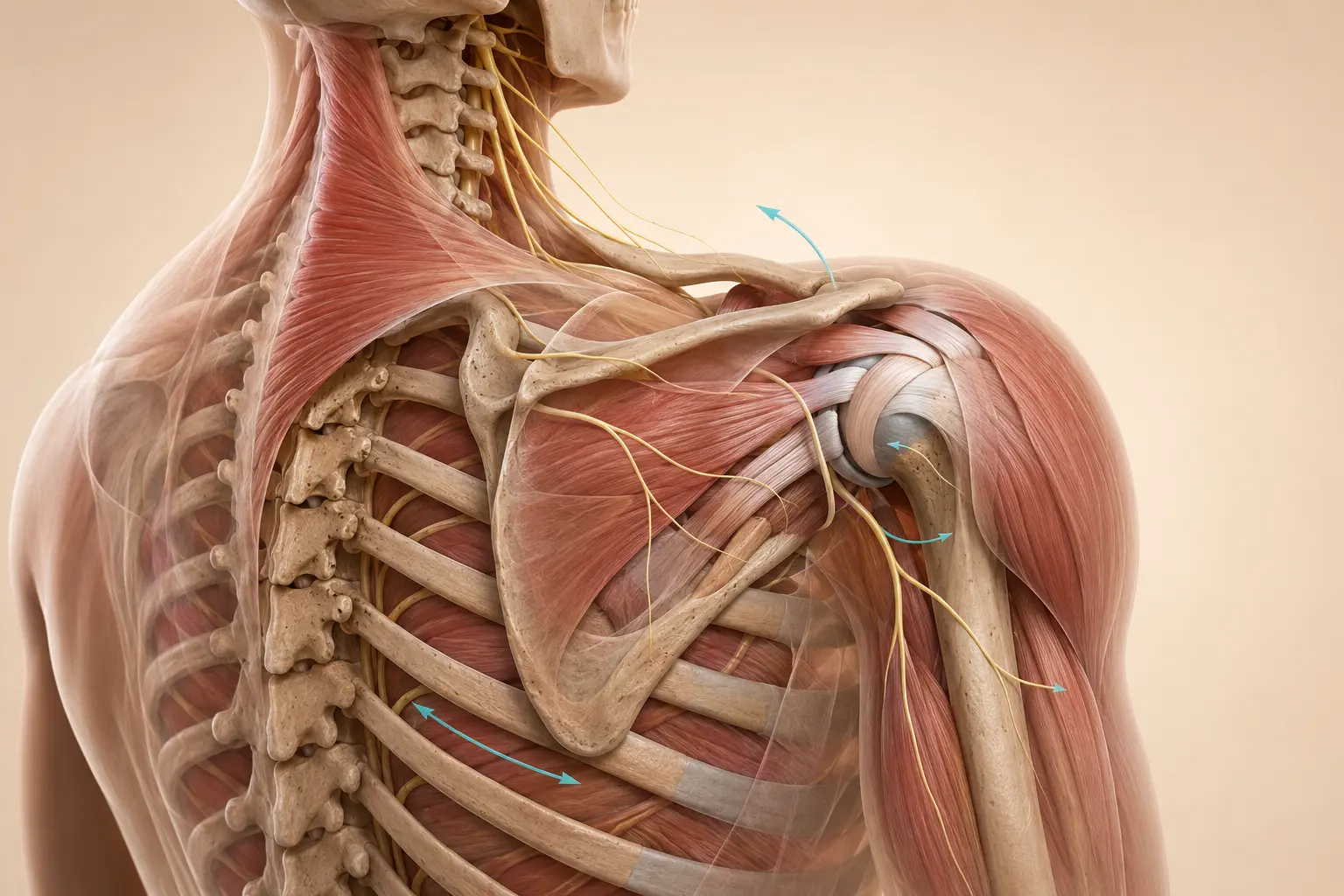
The scapula rests on a rib cage—not on a flat wall.
The shoulder blade naturally rotates, tilts, glides forward and backward, and changes its position as the arm moves. During a golf swing, the surface underneath it is also changing because the rib cage is rotating and side-bending.
That is why “pin your shoulder blades down and back” is not a universal solution. Holding the scapula rigid can remove motion the shoulder normally uses. The better question is whether the shoulder blade can move and control the arm in a way that is comfortable, strong, and repeatable for this golfer.
A visible difference between sides can be worth examining, but it becomes clinically useful only when it connects to symptoms, strength, fatigue, or a meaningful change in the golf task.
The humeral head moves in the shallow glenoid on the scapula, while the rotator-cuff tendons help center and control that joint. The scapula itself glides and rotates on the rib cage through muscular control rather than through a true bone-on-bone joint. That shared motion is why shoulder range cannot be separated completely from scapular and trunk position.
Upper trunk and rib-cage rotation
Limited thoracic rotation can change the range and load required at the shoulder.
If the upper trunk does not turn comfortably, the golfer may still reach the top by moving farther through the shoulder, changing the shoulder blade position, extending the lower back, or lifting the arms. That solution may be playable. It may also change the demand on a painful shoulder.
This does not mean everyone needs a larger shoulder turn. More rotation is not automatically better, and a slow seated test cannot show how the golfer uses that motion at full speed. The useful questions are:
Is the motion available?
Check for enough comfortable trunk and shoulder motion.
Can you use it in your golf posture?
Table range does not always carry over to a standing swing.
Can you repeat it as speed increases?
The motion should remain controlled as fatigue builds.
Range is not the same as readiness
A shoulder can be mobile and still be underprepared for golf.
One golfer may have a true joint restriction. Another may stop moving because the shoulder is painful and protective. A third may have plenty of range—or even instability—but lack the strength and timing to control the club near the end of that range.
Those golfers should not all receive the same stretching program. The shoulder may need carefully restored motion, cuff and deltoid strength, scapular control, faster force production, or endurance across repeated swings. The answer comes from the examination and the golfer's response, not from assuming that every golf shoulder is “tight.”
The 2025 rotator cuff tendinopathy clinical practice guideline includes assessment, rehabilitation, and return-to-sport recommendations for recreational and elite athletes. Its broader message fits golf well: diagnosis, load management, progressive exercise, and return to function belong in the same plan.
Speed has to be controlled
The follow-through is part of the swing, not an afterthought.
Shoulder and scapular muscles are active in different patterns throughout the swing. After impact, the body still has to manage the speed of the arms and club and arrive at a balanced finish. The shoulder shares that job with the trunk, hips, and lower body.
In a small motion-analysis study of 11 professional and 5 amateur golfers, peak upper-torso rotational velocity occurred after impact. The study did not measure shoulder injury, but it reinforces an important point: substantial movement continues after the ball is gone. A golfer may be strong enough to create speed once but not prepared to control the finish repeatedly.
- The cuff helps keep the ball of the shoulder centered as the arm changes direction and speed.
- Scapular muscles position the shoulder blade for the moving arm rather than simply holding it in one place.
- The trunk and lower body help distribute the work of slowing the swing and maintaining balance.
Pain in the follow-through does not automatically mean a “deceleration injury.” It tells the examiner which phase and repeated demand deserve closer testing.
When the shoulder has to do more
When trunk and lower-body contribution changes, the arms can carry more of the acceleration demand.
If pressure transfer is late, the pelvis and trunk contribute less, or posture changes during the downswing, the golfer may use the arms and shoulders to accelerate or redirect the club. That can change shoulder demand.
It remains a hypothesis to test. A fast, arm-dominant swing is not inherently pathologic. The observation matters only when it connects to the painful phase, a relevant physical finding, fatigue, and a response to a targeted change.
The opposite mistake is also possible: blaming the thoracic spine or hips simply because golf is a whole-body sport. If the upper back turns well and changing it does not alter the shoulder task, it may not belong at the center of treatment.
Practice volume and recovery
A round, a range session, and speed training place different demands on the shoulder.
Drivers, long irons, wedges, rough, uneven lies, and repeated swings from a mat place different demands on the shoulder. Carrying a bag, lifting at work, strength training, racquet sports, and sleeping on the painful side can add to the same week.
New lessons or speed training can change both technique and volume. A movement that feels easy for the first few swings may become less controlled after sixty. The location and timing of symptoms can therefore tell only part of the story unless the workload and next-day response are also known.
- Does pain occur at the top, during impact, or in the finish?
- Does one club or lie produce a different response?
- Did practice volume, speed work, or equipment change recently?
- Does carrying the bag or another activity add to the shoulder load?
- How does the shoulder feel later that day and the next morning?
How the pieces can add up
A common example: trail-shoulder pain near the top of the backswing.
This composite example illustrates clinical reasoning. It is not a diagnosis for every golfer with shoulder pain.
A recreational golfer develops trail-shoulder pain near the top of the backswing after increasing range volume. The examination finds pain-limited external rotation and reduced cuff endurance. A seated trunk test shows enough upper-back rotation, so “more thoracic mobility” is not automatically the answer.
The first swings are comfortable. As the session continues, trunk control fades and the golfer repeatedly lifts the trail elbow to find the top position. The plan addresses the irritable shoulder, restores tolerable motion, and builds cuff and scapular endurance. Swing volume is progressed while the painful backswing and next-day response are re-tested.
A golf professional helps decide the technical solution. Physical therapy prepares the shoulder and trunk to tolerate the solution rather than forcing a generic backswing shape.
What a good evaluation should clarify
Find the local problem, then test the connections that fit.

- 01
Start with the local shoulder.
Active and passive motion, strength, symptom location, joint behavior, instability signs, and the response to load help shape the working diagnosis.
- 02
Screen the neck and nervous system when needed.
Pain traveling below the shoulder, numbness, tingling, hand weakness, or findings that do not fit the shoulder deserve a broader examination.
- 03
Test shoulder blade, rib-cage, and trunk options.
The goal is not to label every asymmetry. It is to see whether available motion, strength, and control change the painful arm position or swing.
- 04
Observe the relevant swing phase.
Lead or trail side, backswing, impact, finish, club, speed, volume, and fatigue all help recreate the demand safely.
- 05
Test a targeted change against the painful swing.
A meaningful response in pain, motion, strength, swing tolerance, or next-day recovery helps decide what belongs in the plan.
Treatment and return to golf
Restore what is needed, strengthen what must work, and reload the swing.
Treatment should follow the diagnosis and the golfer's current irritability. A stiff shoulder, a painful but mobile cuff, an unstable joint, and symptoms referred from the neck require different priorities.
- Temporarily adjust painful swing volume, speed, club selection, or backswing length while maintaining safe activity.
- Restore only the shoulder or upper-back motion that the examination shows is meaningfully limited.
- Progress rotator cuff, deltoid, and scapular strength from controlled positions toward faster, golf-relevant work.
- Add trunk, hip, and lower-body work when testing shows those regions alter the shoulder's task.
- Build from partial swings to full swings, repeated club-specific work, range volume, and course play while monitoring recovery.
Depending on the diagnosis, manual therapy or dry needling may be considered as a short-term adjunct for symptom relief or easier movement. Suitability and response vary. The lasting goal is a shoulder and movement system prepared to handle golf—not temporary relief without progressive loading.
Different professionals, different questions
Where physical therapy ends and golf instruction begins.
A golf professional understands club delivery, ball flight, and the technical options available to the player. A physical therapist determines whether the shoulder and the rest of the body have the motion, strength, control, and load tolerance to support those options.
Neither professional should force a golfer into a position the body cannot tolerate. Improving shoulder motion also does not automatically fix the swing. Collaboration keeps those jobs clear.
When golf-related shoulder pain needs medical attention.
Seek urgent care for:
A traumatic deformity or suspected dislocation, acute injury with inability to raise or use the arm, rapidly progressive weakness or numbness, or shoulder-region pain with chest pain, shortness of breath, sweating, or other signs of a medical emergency.
Arrange a timely assessment for:
Pain that repeatedly returns with golf, marked night pain, a meaningful loss of motion or strength, symptoms extending into the arm or hand, or a problem that is not improving as expected. Fever, systemic illness, or unexplained weight loss also warrants prompt medical attention.
The bottom line
The painful shoulder is important—but it does not swing alone.
Golf-related shoulder pain does not automatically mean the rotator cuff is torn, the shoulder is too tight, or the swing is bad. It means the local tissue, the motion available to the golfer, the way the club is controlled, and the amount of golf need to be sorted out together.
At Limitless Physiotherapy in Columbia, Maryland, golf-related care begins with a one-on-one clinical and movement assessment. The goal is to identify what your shoulder is reacting to, prepare it for the speed and volume of the swing, and help you return with a plan that makes sense.

Common questions
Golf, shoulder motion, and return to play.
Does shoulder pain mean I have a bad golf swing?
No. A visible swing position does not identify the painful tissue, and there is no single swing that fits every body. The useful question is whether the local shoulder, the movement options available to the golfer, or the amount of golf is creating more demand than the shoulder can currently tolerate.
Why does the lead shoulder hurt more than the trail shoulder?
The lead and trail shoulders move through different positions and loads, so the side that hurts can offer a useful clue. It does not make one diagnosis automatic. The exact swing phase, symptom location, local examination, and response to loading are still needed.
Should I stretch my shoulder before I golf?
A comfortable dynamic warm-up may help, but more stretching is not always the answer. A truly restricted shoulder may need mobility work; a painful, unstable, or already-mobile shoulder may need control, strength, and a more gradual exposure instead.
Can I keep golfing with mild shoulder pain?
Many golfers can continue with temporary changes in swing volume, club selection, speed, or backswing length. Stop and seek an assessment if pain is sharp or worsening, follows trauma, causes pronounced weakness or loss of motion, includes numbness or tingling, or changes normal daily use of the arm.
Does a rotator cuff tear on MRI explain my golf pain?
Not by itself. Shoulder abnormalities, including rotator cuff changes, are common on imaging in people without pain. A tear can still be clinically important, but it needs to match the history, examination, strength, symptom behavior, and function. The scan alone does not show which movement is painful, how much load the shoulder tolerates, or what return-to-golf plan is appropriate.
When is shoulder imaging useful?
Imaging is more likely to change the plan after meaningful trauma, suspected fracture or dislocation, pronounced weakness, loss of motion, or symptoms that are not following the expected course. For many gradual shoulder presentations, a clinical examination and an initial rehabilitation plan come first.

Written & clinically reviewed by
Dr. Brandon Lim, PT, DPT, CMTPT, FMSC
Dr. Lim is the founder of Limitless Physiotherapy in Columbia, Maryland. His one-on-one approach connects a detailed clinical examination with movement assessment, hands-on treatment when appropriate, and progressive exercise built around each person's goals.
Meet Dr. LimResearch & clinical references
Sources behind the article.
Golf-specific evidence is limited in several areas, so the article combines golf biomechanics and injury research with current shoulder rehabilitation guidance without treating one swing characteristic as a proven cause of pain.
View references
- Williamson TR, et al. Epidemiology of musculoskeletal injury in professional and amateur golfers: a systematic review and meta-analysis. British Journal of Sports Medicine, 2024.
- Creighton A, Cheng J, Press J. Upper Body Injuries in Golfers. Current Reviews in Musculoskeletal Medicine, 2022.
- Bourgain M, et al. Golf Swing Biomechanics: A Systematic Review and Methodological Recommendations for Kinematics. Sports, 2022.
- Desmeules F, et al. Rotator Cuff Tendinopathy Diagnosis, Nonsurgical Medical Care, and Rehabilitation: A Clinical Practice Guideline. Journal of Orthopaedic & Sports Physical Therapy, 2025.
- Hsu C, Afifi T, Isaac Z. Shoulder pathology on advanced imaging in asymptomatic non-athlete individuals: a narrative review. PM&R, 2024.
- American College of Radiology. ACR Appropriateness Criteria®: Acute Shoulder Pain.
- American College of Radiology. ACR Appropriateness Criteria®: Chronic Shoulder Pain.
- Jobe FW, et al. Rotator cuff function during a golf swing. American Journal of Sports Medicine, 1986.
- Pink M, Jobe FW, Perry J. Electromyographic analysis of the shoulder during the golf swing. American Journal of Sports Medicine, 1990.
- Kao JT, et al. Electromyographic analysis of the scapular muscles during a golf swing. American Journal of Sports Medicine, 1995.
- Steele KM, et al. Golf Swing Rotational Velocity: The Essential Follow-Through. Annals of Rehabilitation Medicine, 2018.