

Much of the advice about lifting with hypermobility stops at “strengthen the muscles around the joints” or “avoid locking out.” That does not tell you which exercises to use, how hard to work, what a normal response feels like, or what to change after a flare.
This article supplies that missing middle. The sample program is not a diagnosis or an individual prescription. It is a practical framework for an adult who has no acute injury or medical restriction preventing resistance exercise. A history of recurrent dislocation, vascular EDS, significant autonomic symptoms, recent trauma, or unexplained neurologic symptoms requires more individual guidance.
The short answer
Begin with a repeatable dose, not the lightest possible weight.
Choose four or five exercises that cover the main movement patterns. Start with two sets, stop most sets with two to four good repetitions still available, and leave enough recovery that the next session is not built on an escalating flare. When the same dose is controlled and recoverable for two exposures, change one variable: repetitions, load, range, support, speed, or total sets.
Hypermobility changes how carefully the dose may need to be selected. It does not automatically make meaningful resistance unsafe or condemn someone to tiny corrective exercises forever.
Before the first workout
Track one task, one symptom, and the next-day response.
A useful program needs a baseline. Pick one activity you want to improve—stairs, lifting a child, standing through a workday, hiking, or a gym lift—and one repeatable measure such as repetitions, load, walking time, or symptom onset. Avoid tracking every sensation in every joint at once; that makes it difficult to know whether the program is helping.
Choose a stable version
Use a bench, rack, machine, cable, or split stance when balance would otherwise hide how much force the target muscles can produce.
Use moderate effort
An initial effort around 5–7 out of 10 often leaves two to four controlled repetitions in reserve and gives room to learn the response.
Rest long enough
Rest roughly 90–180 seconds for demanding exercises. Needing more rest is not failure; it keeps fatigue from changing the task too early.
Repeat before progressing
One good session may be luck. Two similar, recoverable sessions provide better evidence that the starting dose fits.
Range and joint position
Do not confuse reaching end range with hanging passively at end range.
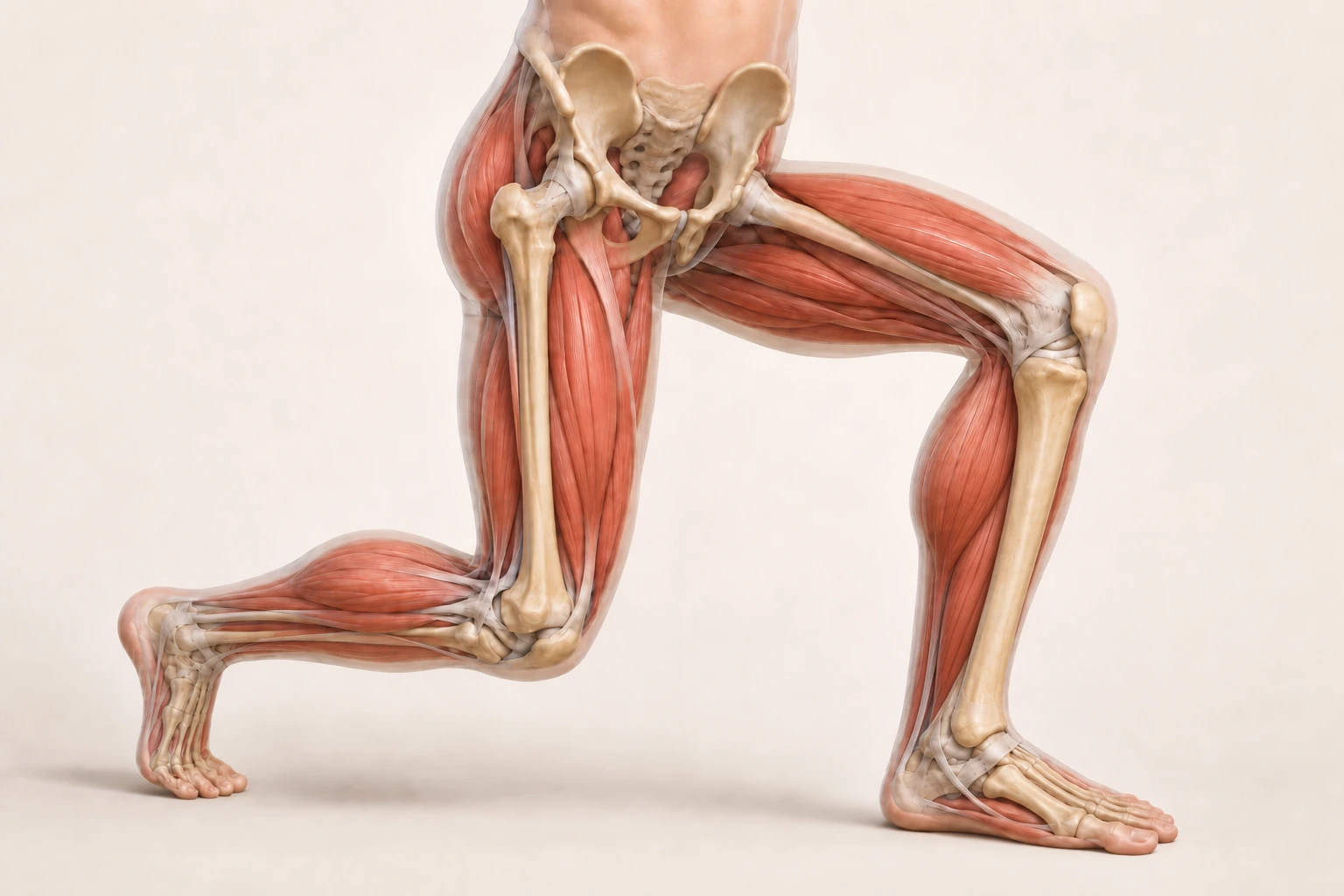
A knee or elbow can reach full extension while muscle remains active and the movement stays deliberate. That is different from rapidly snapping into the last few degrees and resting on passive structures, especially when load and fatigue are high. A blanket instruction to keep every joint slightly bent may reduce symptoms temporarily, but it can also leave an important range untrained.
Begin inside the range that feels secure. Slow the final part of the movement, pause briefly, and keep breathing. Expand the range or load only when the joint does not feel as though it is shifting, giving way, or relying on momentum. The goal is not perfect alignment; it is a range that remains usable under the force and fatigue your activity requires.
A practical first two weeks
Use two full-body sessions separated by at least one recovery day.
The example below deliberately starts with modest volume. Perform the main exercises for two sets during the first week. If the response is predictable, use two or three sets in week two. The listed repetitions are ranges, not tests you must pass on the first day.
Session A
Goblet box squat 2 × 6–8; half-kneeling cable press 2 × 8 each side; chest-supported row 2 × 8–10; suitcase carry 3 × 20–30 seconds each side.
Session B
Kickstand Romanian deadlift 2 × 6–8 each side; supported split squat 2 × 6–8 each side; incline or landmine press 2 × 6–10; calf raise 2 × 8–12.
Rest and effort
Rest 90–180 seconds as needed. Use a load that leaves roughly two to four controlled repetitions available instead of training to failure.
If four exercises are already too much, use three. If the lower body is the main limitation, keep one upper-body exercise and reduce a leg exercise rather than forcing the full list. Consistency with a smaller dose is more informative than alternating between an exhausting workout and several days of recovery.
Five exercise options
Each exercise has a reason, a starting dose, and one clear way to progress.
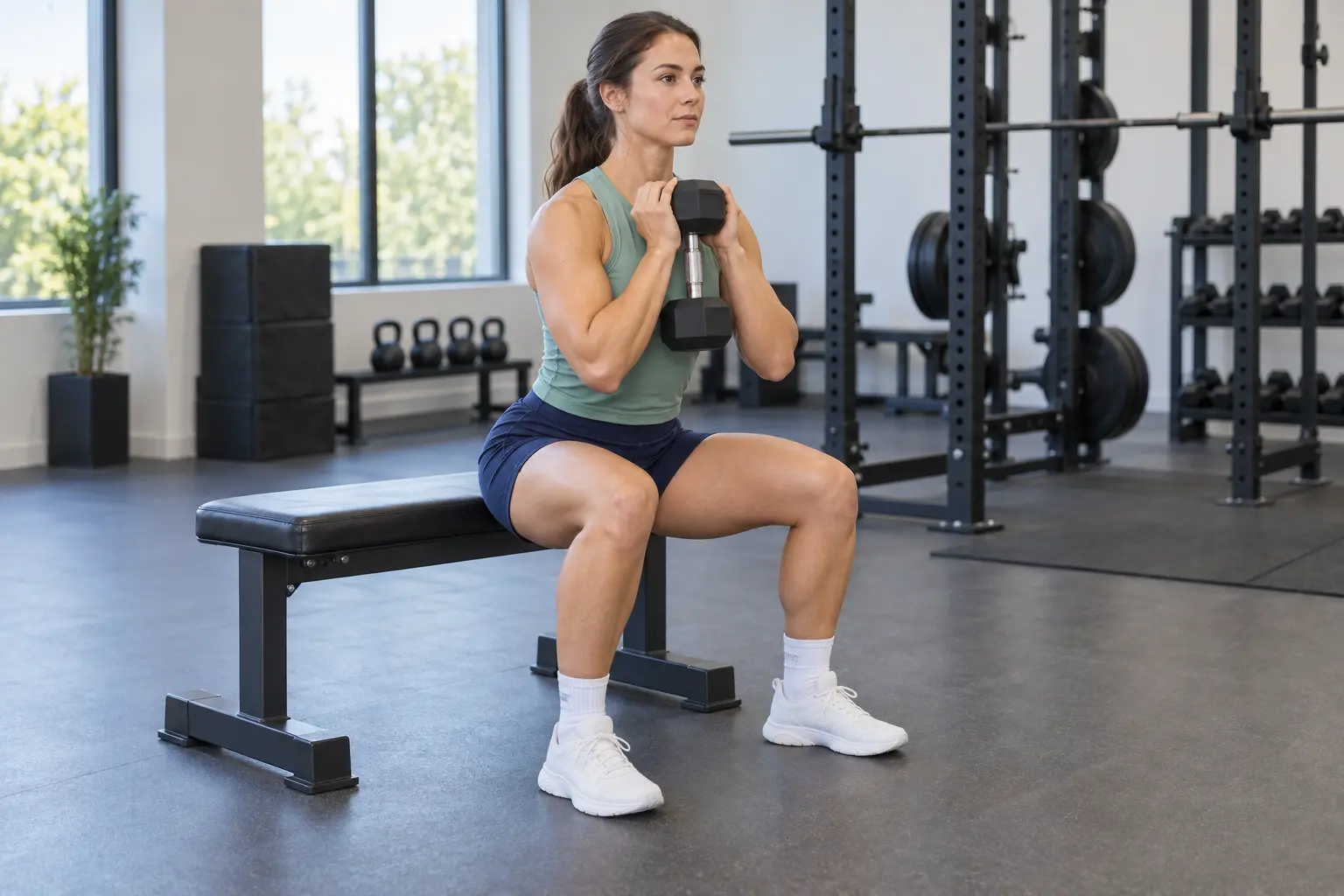
1. Goblet box squat
- Purpose: build leg strength while the bench makes depth repeatable and provides a clear stopping point.
- How: keep the whole foot in contact with the floor, lower under control, touch the bench without collapsing onto it, and stand without bouncing.
- Start: 2–3 sets of 6–10 repetitions with two to four repetitions in reserve.
- Progress: add load or use a slightly lower target—not both in the same session.
2. Split squat or reverse lunge
- Purpose: train one leg at a time while the other leg and optional hand support help manage balance.
- How: use a stance that lets both feet stay organized, lower only as far as the front hip, knee, and foot remain controlled, and allow a natural forward trunk angle.
- Start: 2–3 sets of 6–8 repetitions each side.
- Progress: use less hand support, add repetitions, increase range, or add load one step at a time.

3. Supported kickstand Romanian deadlift
- Purpose: load the hip and hamstrings with most of the work on one leg while the rear foot and free hand reduce balance demand.
- How: keep about 80–90% of the pressure through the front foot, move the hips backward, and stop where hamstring tension is clear without reaching for an arbitrary floor depth.
- Start: 2–3 sets of 6–8 repetitions each side with a slow two- to three-second lowering phase.
- Progress: add the smallest available load before removing support if balance still changes the movement.

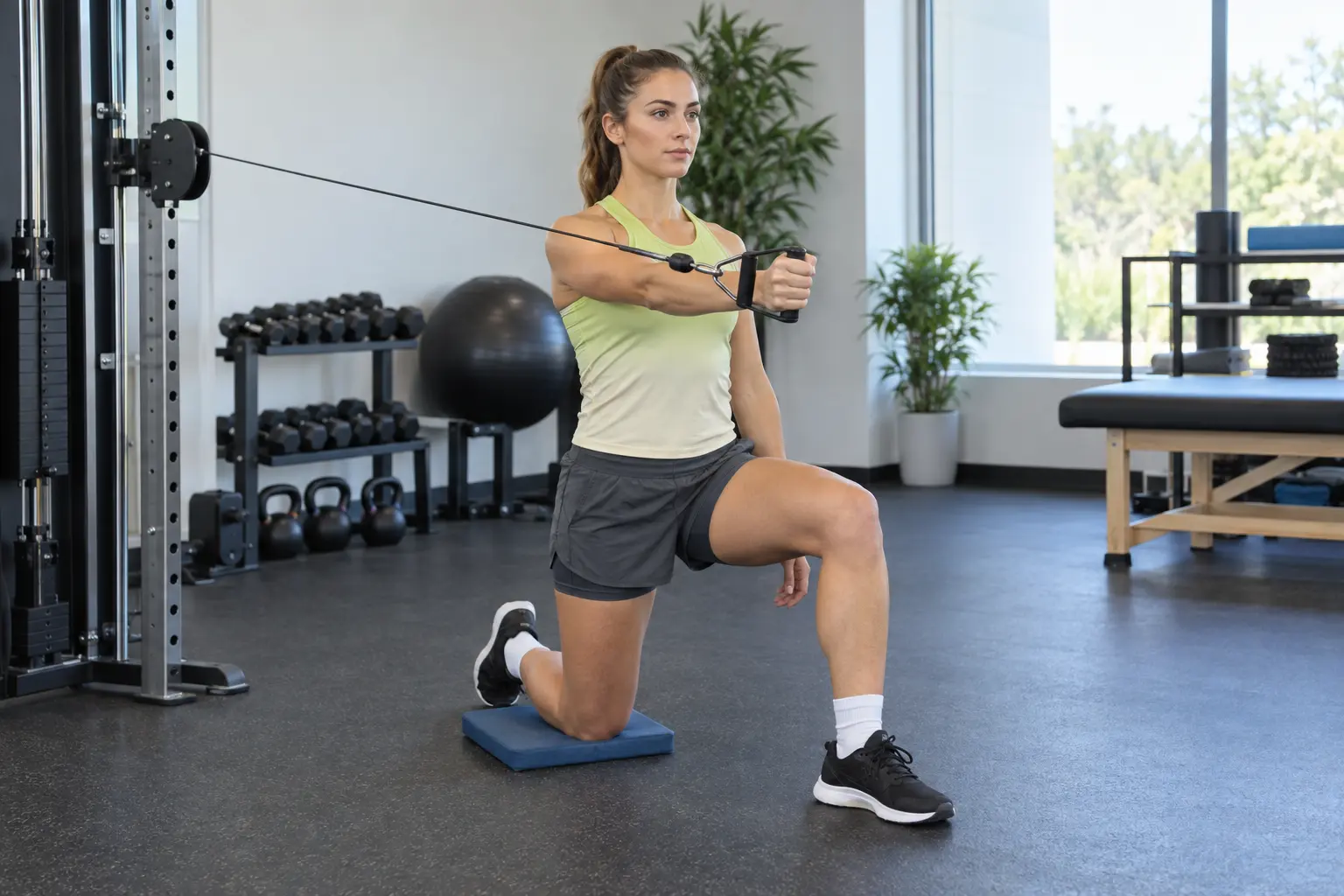
4. Half-kneeling one-arm cable press
- Purpose: train the shoulder and pressing muscles while the trunk resists unwanted rotation.
- How: stack the ribcage over the pelvis, keep the front foot planted, and press without leaning away from the cable or forcing the shoulder backward.
- Start: 2–3 sets of 6–10 repetitions each side.
- Progress: add resistance, then move to a split stance or standing press when the kneeling version is repeatable.
5. Suitcase carry
- Purpose: integrate grip, shoulder, trunk, hip, and gait control in a simple loaded task.
- How: walk normally with one weight, keep the shoulders and pelvis approximately level, and avoid shortening the stride simply to look perfectly upright.
- Start: 3 carries of 20–40 seconds each side with full recovery between carries.
- Progress: increase the distance or load. If finger or wrist instability becomes the limiting symptom, use a friendlier handle or a different trunk exercise rather than forcing grip fatigue.

A progression rule you can use
Earn the next step with two similar sessions.
- 01
Stay inside the repetition range.
If the target is 6–10 repetitions, begin near 6 and stop while the movement is still organized.
- 02
Add one or two repetitions.
When the session and next-day response are stable, add a repetition to one or more sets without changing the load.
- 03
Reach the top twice.
Complete the top of the range with similar control and recovery on two separate sessions.
- 04
Add the smallest practical load.
Increase by the smallest available increment, return toward the lower end of the repetition range, and reassess.
Load is only one progression. More range, less external support, a longer carry, another set, faster intent, impact, and training under fatigue are separate variables. Increasing several at once makes a flare difficult to interpret.
During, after, and the next day
Use the response to decide whether to continue, adjust, or stop.
Continue
The effort is mainly muscular, the joint feels secure, technique remains recognizable, symptoms do not escalate across the set, and daily function is near its usual baseline by the next day.
Adjust
Joint pain rises from set to set, form changes early, fatigue spreads beyond the target muscles, sleep or daily activity is disrupted, or the response is still clearly elevated when the next session approaches.
Stop and assess
There is sharp or unfamiliar pain, giving way, a subluxation or dislocation, new swelling after trauma, progressive numbness or weakness, fainting, chest pain, or another concerning systemic response.
When a session is too much, change one thing at the next exposure: remove one set, shorten the range, reduce the load by roughly 10–20%, add support, or allow more rest. Do not automatically discard an exercise that was useful at a smaller dose.
Muscle soreness and joint irritation often behave differently.
- Typical training soreness is usually felt in the muscles that worked, often appears later, and gradually improves with ordinary movement.
- A joint response may feel more focal or deep, include swelling, catching, shifting, or giving way, and make the same joint less tolerant of daily tasks.
- A systemic flare may include disproportionate fatigue, orthostatic symptoms, sleep disruption, or widespread symptom escalation that is not explained by one trained muscle group.
These patterns help organize the next decision; they do not diagnose the cause. Persistent or worsening symptoms deserve an appropriate clinical assessment.
POTS, fatigue, and variable days
Keep the strength stimulus and reduce the unnecessary cost of the session.
- Change the position: use seated, supported, or floor-based versions when repeated standing transitions drive symptoms.
- Change the order: group floor exercises together and rise slowly rather than alternating up and down every set.
- Change the density: rest longer, perform fewer exercises, or split one session into two shorter blocks.
- Use a reduced-day plan: keep the same exercises but perform one set of each, or choose the two most important movements.
- Follow the medical plan: fluid, sodium, compression, medication, and heart-rate guidance must account for the individual’s diagnoses and clinician recommendations.
What the research can and cannot tell us
Exercise is supported; one universal hypermobility program is not.
A 2024 scoping review found the strongest physical-therapy support for therapeutic exercise and motor-function training, while also noting that dosage guidance remains limited. A 2026 meta-analysis of six studies and 231 participants found improvements in pain, quality of life, and proprioception, but not a significant pooled strength improvement; certainty remained low and the studies differed substantially.
The resistance-training studies also show why supervision and dosage matter. A 2021 trial of twice-weekly, largely self-guided low-resistance training did not outperform the control group for strength or other outcomes. In contrast, a 2022 case series of 16 young women reported no major adverse events and improved symptoms and strength during supervised progressive heavy training—but it had no control group and cannot be generalized to every person with hEDS or HSD.
The defensible conclusion is not “everyone should lift heavy” or “everyone must stay light.” It is that exercise selection, effort, supervision, progression, and recovery need to be specific enough to create an adaptation and cautious enough to remain repeatable.
When the plan keeps failing
An evaluation should identify the variable that makes the dose unreliable.
- 01
Define the exact problem.
Muscle fatigue, joint pain, instability, recurrent subluxation, nerve symptoms, dizziness, and delayed widespread fatigue require different decisions.
- 02
Reproduce the real task.
Test the range, load, repetition number, position, or fatigue state that actually creates the symptom.
- 03
Review the whole week.
Strength sessions, classes, work, caregiving, walking, sleep, illness, and autonomic symptoms all contribute to the recoverable dose.
- 04
Change one variable and retest.
Support, stance, range, tempo, load, rest, or exercise order should remain only if it improves the target task or response.
Read the rest of this series: why hypermobility can hurt and where dry needling may—and may not—fit. For barbell-specific decisions, see why a squat, deadlift, or press can become painful.
Common questions
Practical answers for the next step.
Is weight training unsafe if I am hypermobile?
Not automatically. Research supports therapeutic exercise and motor-control training, but it does not identify one best program for every person with HSD or hEDS. The useful starting point depends on symptoms, instability or dislocation history, medical conditions, training experience, and recovery. Begin with a dose you can repeat and progress from the response.
Should I avoid heavy weights forever?
No universal rule requires every hypermobile person to stay with light weights. A small uncontrolled case series found that selected young women with knee hypermobility and pain tolerated twice-weekly supervised heavy resistance training for 12 weeks, but that study cannot establish safety or effectiveness for everyone. Heavier loading should be built gradually after the exercise, range, and weekly dose are repeatable.
Should I keep my knees and elbows slightly bent during every exercise?
Usually not as a permanent rule. Repeatedly hanging passively at end range can be provocative for some people, especially under fatigue. Full extension can also be a normal position that needs strength and control. Practice the range deliberately at a manageable load rather than either snapping into it or avoiding it forever.
How hard should the first strength sessions feel?
A reasonable first trial is often an effort of about 5 to 7 out of 10, finishing most sets with roughly two to four good repetitions still available. That is a starting framework, not a medical rule. The important test is whether technique remains controlled and the symptoms and fatigue recover as expected before the next session.
How do I know whether pain during exercise is acceptable?
Do not judge the session by one pain number alone. Note whether the symptom is familiar, whether the joint feels secure, whether it escalates from repetition to repetition, and whether you return toward your usual baseline afterward. Sharp pain, giving way, a subluxation or dislocation, new swelling, progressive numbness or weakness, dizziness, or a large lasting flare calls for stopping or changing the plan.
What if POTS or fatigue limits my strength training?
Use positions and session structure that reduce unnecessary orthostatic demand: seated, supported, or floor-based exercises; fewer exercises; longer rest; slower position changes; and a cooler environment. Hydration, sodium, compression, and medication decisions should follow your medical plan, especially if another condition limits fluid or salt intake.
Are braces, straps, or machines cheating?
No. Support is a dosage tool. A machine, bench, rack, lifting strap, or brace can reduce a limiting balance, grip, or coordination demand so a target muscle can be trained. The support can remain, decrease, or change according to the goal; it does not have to be removed simply to make an exercise look more functional.

Written & clinically reviewed by
Dr. Brandon Lim, PT, DPT, CMTPT, FMSC
Dr. Lim is the founder of Limitless Physiotherapy in Columbia, Maryland. His one-on-one approach integrates detailed examination, movement assessment, manual therapy, dry needling, and progressive exercise according to each person's presentation and goals.
Meet Dr. LimSelected sources
Evidence behind the discussion.
- Hakim A. Hypermobile Ehlers-Danlos Syndrome. GeneReviews, updated 2024.
- Brittain MG, et al. Physical therapy interventions in generalized hypermobility spectrum disorder and hypermobile Ehlers-Danlos syndrome: a scoping review. Disability and Rehabilitation, 2024.
- Buryk-Iggers S, et al. Exercise and rehabilitation in people with Ehlers-Danlos syndrome: a systematic review. Archives of Rehabilitation Research and Clinical Translation, 2022.
- Luder G, et al. Effect of resistance training on muscle properties and function in women with generalized joint hypermobility: a randomized controlled trial. BMC Sports Science, Medicine and Rehabilitation, 2021.
- Henriksen P, et al. Supervised heavy resistance training is tolerated and potentially beneficial in women with knee pain and knee joint hypermobility: a case series. Translational Sports Medicine, 2022.
- Zabriskie HA, et al. Rationale and feasibility of resistance training in hEDS/HSD: a narrative review. Journal of Functional Morphology and Kinesiology, 2022.
- Ebrahimi E, et al. The effect of therapeutic exercises in individuals with joint hypermobility syndrome: a systematic review and meta-analysis. Egyptian Rheumatology and Rehabilitation, 2026.
When strength training needs medical coordination first.
Recurrent dislocations, rapidly increasing instability, marked swelling, a recent traumatic injury, progressive weakness or numbness, fainting, chest pain, severe or changing autonomic symptoms, and unusual systemic or vascular findings warrant appropriate medical assessment. A future plan may still include strength training, but diagnosis and safety constraints come first.
This article is not a screening tool for hEDS, HSD, vascular EDS, POTS, or another medical condition. Do not use a Beighton score or a social-media checklist as a substitute for a complete diagnostic evaluation.