
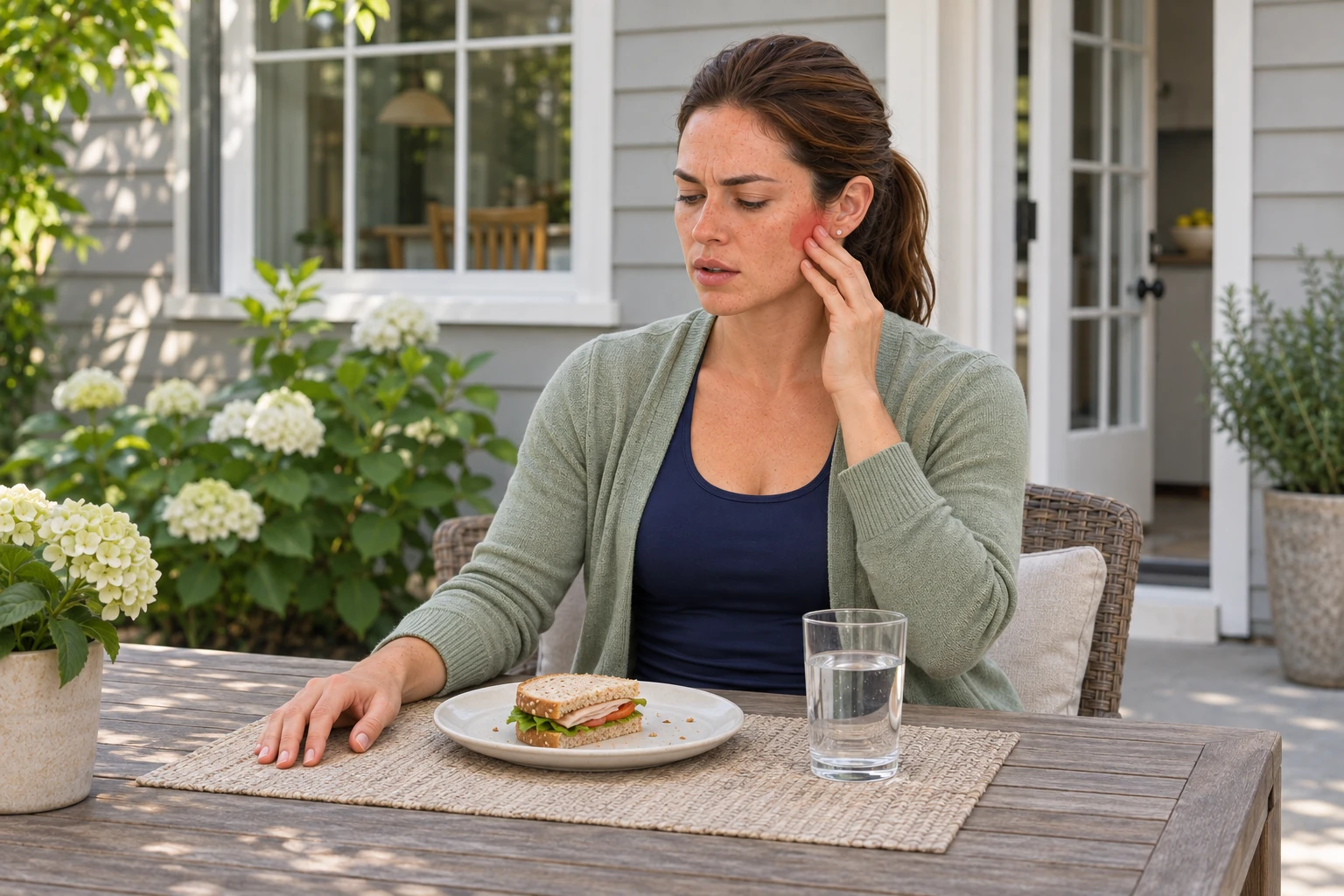
You can point to the ache with one finger, right in front of your ear. By the end of lunch, it has spread into your cheek or temple. Your jaw may click when you yawn, and turning your head can bring out a second ache. The useful question is which movement brings on your familiar symptoms and what changes them.
The temporomandibular joints (TMJs) connect your jaw to your skull. Temporomandibular disorders (TMDs) include conditions of these joints and the muscles that move the jaw. Muscle pain and joint pain can coexist. Your dentist, physician, and physical therapist may each have a role when symptoms overlap.
When jaw pain needs medical or dental care
- Call 911 if new jaw discomfort comes with chest pressure, shortness of breath, cold sweating, or other signs of a possible heart attack. Trouble breathing or swallowing with rapidly increasing face or neck swelling also needs emergency care.
- Seek urgent assessment if your jaw is stuck open and cannot close, opening suddenly becomes much more limited, or the bite changes after an injury. Fever with facial swelling or difficulty opening may indicate infection. Avoid forcing the jaw open or trying to put it back yourself.
- Get prompt medical evaluation if you are over 50 and develop a new headache with jaw fatigue or pain during chewing. Any new vision change in that setting needs immediate medical attention.
- Start with the relevant clinician if one tooth reacts to hot, cold, or biting, or if you have new hearing loss, ear drainage, or a persistent lump. Sudden hearing loss should be assessed urgently.
What changes when you chew, open, or turn your head?
Muscle-related pain may feel like a spreading ache or fatigue after chewing, clenching, or talking. In a standard TMD exam, the clinician checks whether jaw movement or pressure on the masseter and temporalis reproduces the pain you recognize from daily life. Ordinary soreness under pressure can occur in many people.
Joint-related pain is often most noticeable just in front of the ear with opening, chewing, or joint loading. The jaw initially rotates and also translates forward as it opens wider. The exam compares opening and side-to-side movement, where the pain starts, whether the jaw catches, and whether the limitation is new. A painless click alone generally needs no treatment. A click followed by a new loss of opening can change the urgency of assessment.
Neck-related symptoms can overlap jaw pain and headache. If the temple ache changes when you turn your neck but stays the same with chewing, the neck deserves its own examination. If a long meal brings on your familiar cheek ache and neck movement brings on a separate headache, those symptoms may need different approaches.
Where jaw and neck muscles can refer pain
Referred pain is pain felt away from the region that provokes it. Researchers have reproduced overlapping patterns from superficial jaw and neck muscles in people with muscle-related TMD. The diagrams combine those observations with descriptions from clinical literature. The deep-muscle patterns have weaker diagnostic support. A spot on the face cannot identify a single muscle, and proving that pressure can reproduce pain does not show what started or maintains it.
Masseter
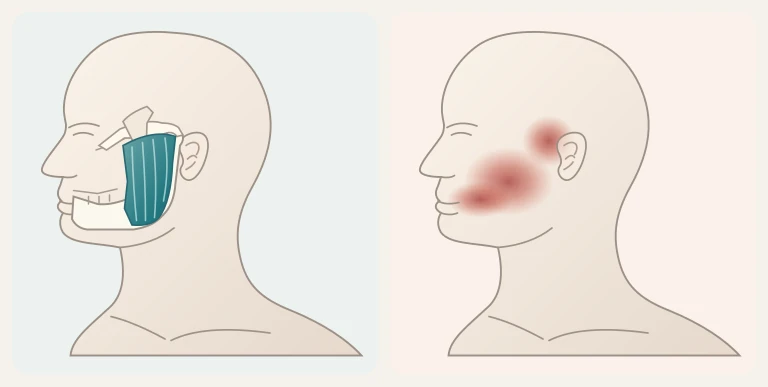
A strong jaw closer along the cheek and outer jaw angle.
A broad cheek or jaw ache that may be felt near the ear or in the back teeth. Chewing and clenching may bring on the familiar ache. A tooth that hurts with temperature or biting needs dental assessment.
Temporalis
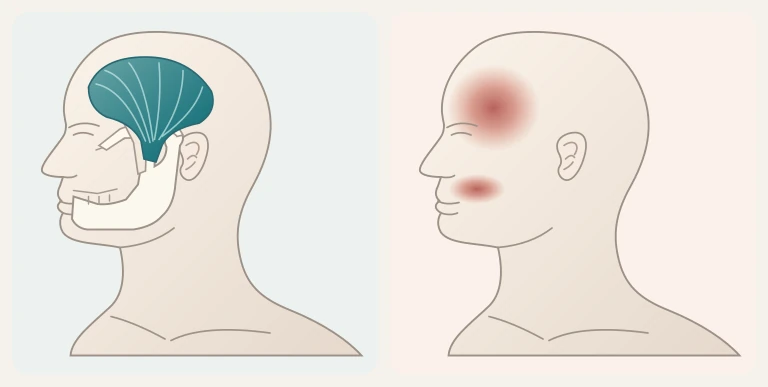
A fan-shaped jaw closer on the side of the head.
An ache at the temple, sometimes felt toward the upper teeth. A familiar temple headache that changes with jaw use deserves a jaw exam alongside a headache history.
Lateral pterygoid
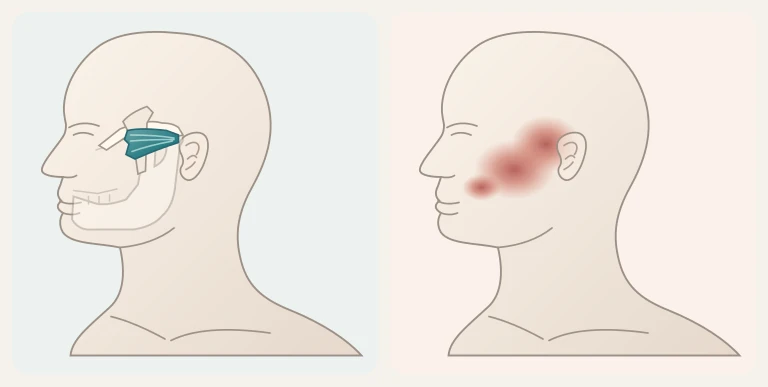
A deep muscle involved in forward and side-to-side jaw motion and coordination during opening and closing.
Clinical reports describe deep cheek, preauricular, or upper-jaw pain that can feel as though it comes from the joint. The pattern overlaps joint pain. Tenderness in this area is common and cannot isolate the muscle.
Medial pterygoid
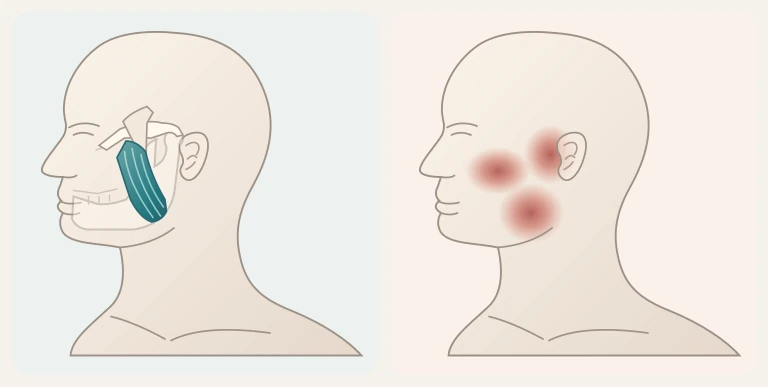
A deep jaw closer on the inside of the jaw angle that also assists side-to-side motion.
Discomfort may feel deep at the jaw angle, cheek, or ear region. Clinical reports also describe referral toward the upper teeth or temple. These are possibilities to check against the full exam.
Suboccipitals
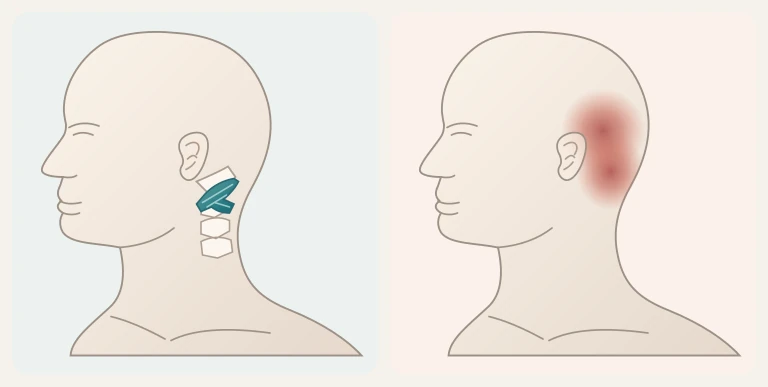
Small muscles at the base of the skull that help control upper-neck movement.
An ache behind the head that can spread upward. If neck motion reproduces the familiar headache and jaw use does little to change it, examine the upper neck and consider other headache diagnoses.
Upper trapezius
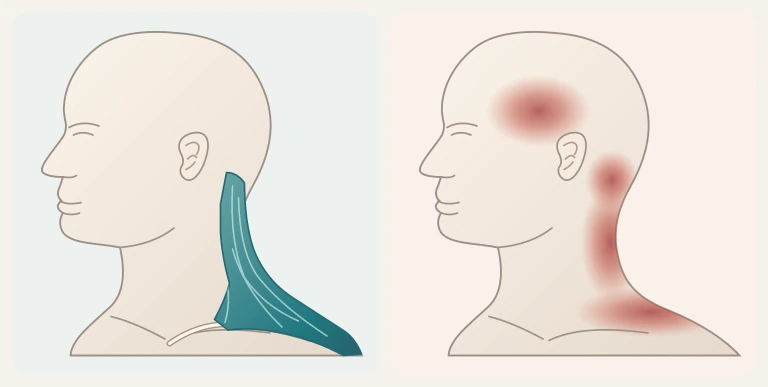
A muscle spanning the top of the shoulder and side of the neck.
Pain can spread from the shoulder or side of the neck toward the head, sometimes the temple. Compare how symptoms respond to neck motion and shoulder loading before attributing them to the jaw.
Sternocleidomastoid (SCM)
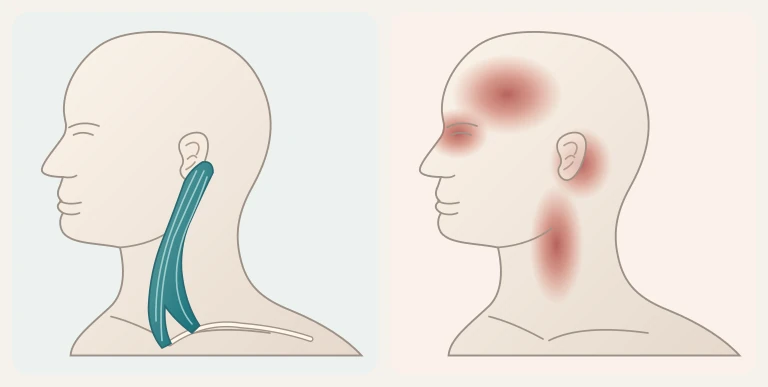
A superficial neck muscle that helps turn and tilt the head.
Pain may be felt along the neck, behind the ear, or toward the head or face. New dizziness, hearing changes, or visual symptoms need their own assessment. Avoid deep self-pressure over the front or side of the neck.
Digastric
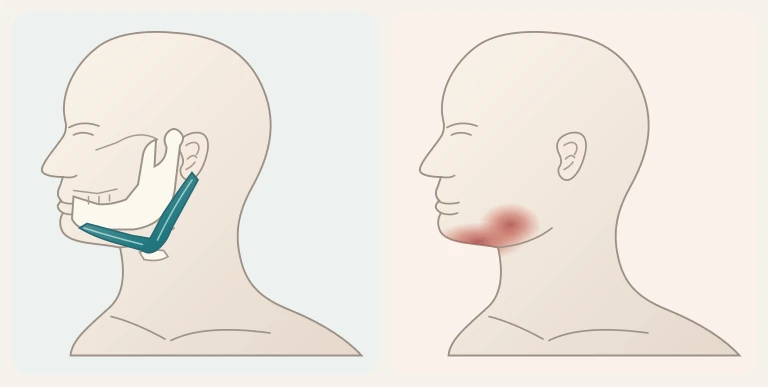
A two-bellied muscle beneath the jaw that helps open it when the hyoid is stable and participates in swallowing.
Discomfort can feel under the chin or along the underside of the jaw. Referral patterns here are poorly established. Painful swallowing, new swelling, or a lump calls for medical or dental assessment.
The DC/TMD examination uses masseter and temporalis palpation for common muscle-pain diagnoses. Deep lateral pterygoid-region palpation was dropped from the required exam because tenderness there can produce false positives. Findings make more sense when the location, timing, and movement response fit together.
How a physical therapist treats the joint itself
A jammed or pinching feeling can come from a painful joint, a jaw that is guarding, or both. After checking the history and comfortable range, the therapist can compare how your symptoms respond to supported movement. When a joint is stiff and appropriate to mobilize, the therapist may use gentle distraction to reduce compression during the technique, a small forward glide when translation is limited, or a side glide when a specific side-to-side movement is restricted. The direction and pressure depend on the exam and your comfort.
Some techniques can be performed externally. Intraoral examination or treatment is explained first and uses gloves and your consent. If the jaw tends to slip, locks open, or is already very mobile, control and smaller movements may be more appropriate than gaining range. A new lock or suspected dislocation warrants assessment before mobilization.
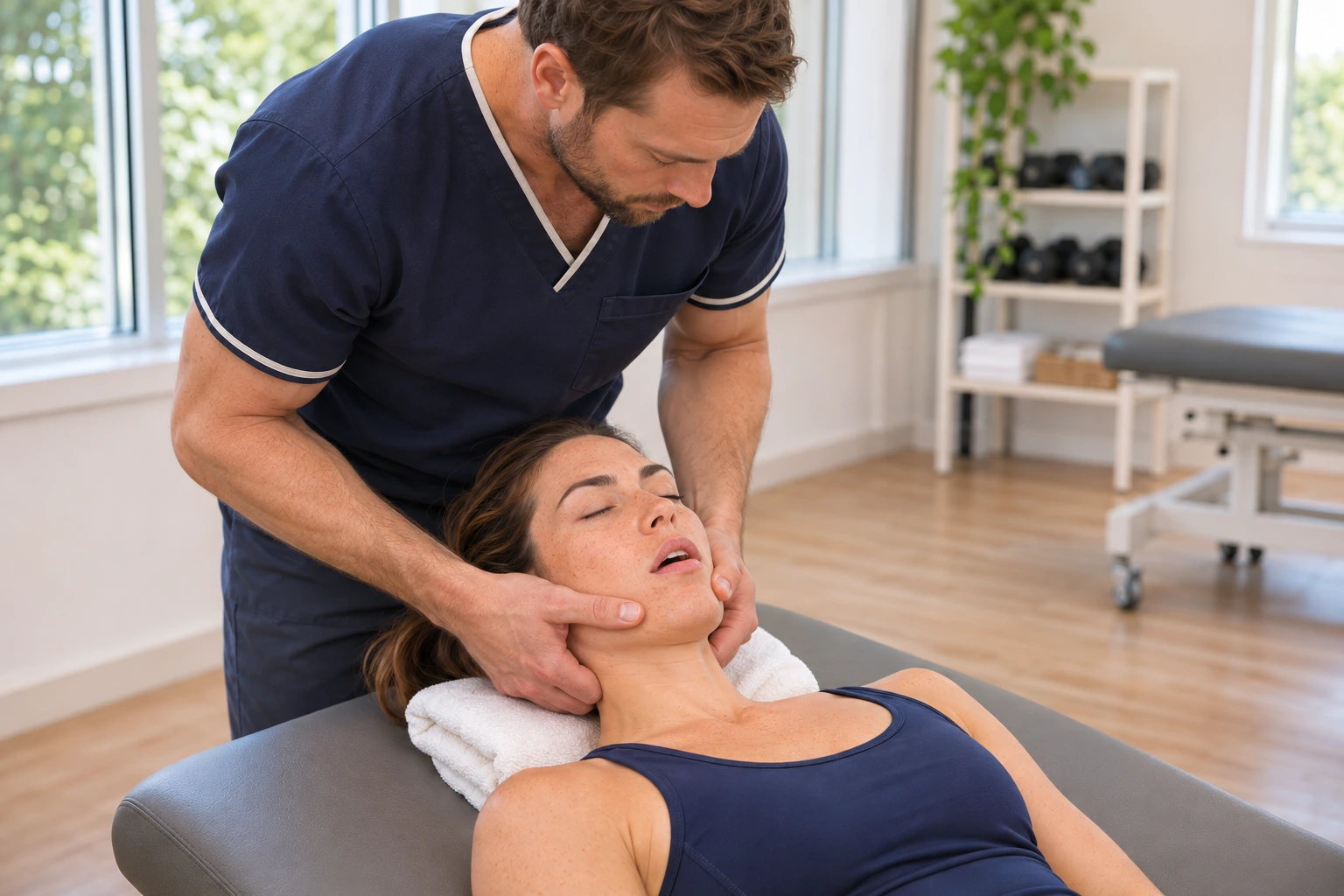
Retest a task that matters. Compare comfortable opening, the pinch you feel while taking a bite, or ease of talking. If that task feels easier after treatment, practice it within a tolerable range and check the response later that day. Manual therapy also includes work on selected jaw muscles or upper-neck mobility when the examination shows a relevant contribution.
The 2023 BMJ guideline for chronic painful TMD lasting at least three months strongly supports therapist-assisted mobilization, manual trigger point therapy, supervised jaw exercise and stretching, and usual conservative care. Its accompanying analysis found about 36 additional people per 100 reached a meaningful pain improvement with assisted jaw mobilization compared with placebo or sham. This was a model-based group estimate across chronic TMD studies.
How much can dry needling help?
When familiar muscle pain limits chewing or makes it hard to practice opening, dry needling can be considered as an optional part of care. A good reason to try it is a specific goal you can retest, such as opening more comfortably or getting through a meal with less ache. The masseter and temporalis have been studied directly. A deep muscle close to a nerve or blood vessel calls for a different risk assessment. A referral pattern alone is insufficient to select a target.
- Immediate results. A 2026 sham-controlled trial randomized 44 people with muscle-related TMD, with 40 completing the assessment. Pain during activity fell by about 13 points on a 100-point scale after masseter and anterior temporalis needling, compared with about 1.5 points after sham. The measurement was at 10 minutes. The study did not establish how long the relief lasted.
- Short-term results. A 2024 review of 24 trials found low-certainty evidence for improved opening and very low-certainty evidence for lower pain compared with sham at roughly 3–10 weeks. The trials did not establish a reliable added pain benefit over usual care alone. Results varied widely, and reporting of side effects was incomplete.
- Deep muscles and electrical treatment. A small lateral pterygoid trial compared dry needling, percutaneous electrolysis, and sham in selected patients. Percutaneous electrolysis uses a different electrical approach from electro dry needling. Evidence from that trial cannot establish that adding comfortable electrical stimulation is superior for TMD, or that the other muscles in this guide should routinely be needled.
At Limitless, electro dry needling is an option when the examination and safety screening support it. It uses gentle, controlled electrical pulses through selected needles, adjusted to comfort. Discuss risks and preferences first, especially for treatment around the jaw, neck, or upper shoulder. Common after-effects include temporary soreness or minor bruising or bleeding. The clinician can compare the same movement after treatment and decide with you how the response fits your exercise plan.
How dry needling and electro dry needling fit into care at Limitless
Exercises and everyday changes to try
These are starting options for familiar, nonurgent symptoms. If there is a new lock, injury, or severe swelling, get assessed before exercising. Stay in a comfortable range and keep the first session small.
Reset your resting jaw
Let your lips stay relaxed and leave a little space between your teeth. If comfortable, let the tongue rest lightly on the roof of your mouth. Take two easy breaths. Repeat when you catch yourself clenching at a computer or in the car. Use light contact rather than pressing the tongue into the palate.
Practice a small, smooth opening
Use a mirror with your head level. Start with the teeth apart. Open slowly a small amount and close smoothly. You can lightly rest the tip of the tongue behind the upper front teeth as a cue to limit the first part of the opening. Try five easy repetitions once daily to start. Avoid chasing perfect symmetry or a larger opening if it provokes pain, catching, or a sense of slipping.

Try an easy neck turn if your neck also feels stiff
Sit with your shoulders relaxed and teeth slightly apart. Turn your head a little to one side, then return to center. Try three easy turns each way in a comfortable range. Stop if it brings on dizziness, a new headache, or symptoms down the arm. If turning the neck reliably changes the jaw or temple symptoms, report that during your assessment. That observation helps decide whether neck treatment belongs in your plan.
Build chewing tolerance in steps
For a few days during a flare, cut tougher food into smaller bites and take breaks if the ache builds. Pause gum and repeated wide bites. When smaller meals feel manageable during and afterward, try a few bites of one slightly firmer food. Review the response that evening and the next morning before adding more. If there is lingering soreness or daily activities are harder, reduce the next dose. Persistent locking or worsening opening merits reassessment.

Bring one jaw task you want to make easier
At Limitless Physiotherapy in Columbia, MD, you’ll work one-on-one with Dr. Brandon Lim. Bring the task that matters to you, whether that is eating an apple, talking through a meeting, or opening for a dental appointment. Note when the pain starts, where it travels, whether the jaw catches or locks, and how long the symptoms last. We can compare jaw and neck movements, choose a treatment to try, and measure your response using the same task or a comfortable version of it.
Explore neck, headache, and TMJ physical therapy in Columbia, MD · What to expect at your first visit
Common questions
Can jaw muscles cause ear or tooth pain?
Pain from the chewing muscles or TMJ can be felt around the ear or teeth. A jaw movement or examination that brings on your familiar pain is one clue. New hearing changes, ear drainage, or sensitivity in a particular tooth deserve an ear or dental evaluation.
Should I treat a jaw click that does not hurt?
Painless clicking is common. If you can eat and open normally, the noise alone generally needs no treatment. Painful clicking, repeated locking, or a change in opening deserves an assessment.
How much can dry needling help TMJ pain?
Some people with muscle-related TMD get short-term relief. In one small trial, activity pain fell about 13 points on a 100-point scale after masseter and temporalis needling, versus about 1.5 points with sham, at 10 minutes. A useful response is one that makes a task easier and carries over into your plan.
What if my jaw gets stuck open?
Seek urgent medical or dental care if your mouth is stuck open and you cannot close it. Leave repositioning to a clinician. Sudden loss of opening, especially after trauma or with swelling or fever, also needs prompt assessment.

About the clinician
Dr. Brandon Lim, PT, DPT, CMTPT, FMSC
I founded Limitless Physiotherapy in Columbia, Maryland. My one-on-one approach connects a detailed examination with hands-on care and progressive exercise tailored to your symptoms, activity, and goals.
About my approachSelected sources
Evidence behind the discussion.
- NIDCR. Temporomandibular disorders. Patient guide to symptoms and conservative care.
- Schiffman E et al. Diagnostic Criteria for Temporomandibular Disorders (DC/TMD). J Oral Facial Pain Headache, 2014. PMID 24482784.
- Fernández-de-las-Peñas C et al. Referred pain from masticatory and neck-shoulder muscles in women with TMD. J Pain, 2010. PMID 20494623.
- Huff KD, Benoliel R. Clinical Handbook for Oral, Facial, and Head Pain. 2023. Figure 1, clinical descriptions of muscle referral. DOI 10.11607/ofph.3488.
- National Academies of Sciences, Engineering, and Medicine. Temporomandibular Disorders: Priorities for Research and Care. 2020. Appendix D, masticatory anatomy.
- Fernández-de-las-Peñas C et al. Myofascial trigger points and sensitization in tension-type headache. Cephalalgia, 2007. Clinical review of head and neck referral.
- The Trigger Point & Referred Pain Guide. Jaw and neck referral diagrams. Educational atlas.
- Wright EF, North SL. Management and treatment of temporomandibular disorders. J Man Manip Ther, 2009. Clinical perspective.
- Shaffer SM et al. Temporomandibular disorders. Part 2: conservative management. J Man Manip Ther, 2014. Clinical review.
- Busse JW et al. Management of chronic pain associated with temporomandibular disorders. BMJ, 2023. Clinical practice guideline.
- Yao L et al. Management of chronic pain secondary to TMD. BMJ, 2023. Systematic review and network meta-analysis.
- Kuzdzal A et al. Dry needling for orofacial pain. Pain Rep, 2024. Systematic review of 24 trials.
- Immediate effects of dry needling in myofascial TMD. Healthcare, 2026. Sham-controlled trial. PMID 42512705.
- López-Martos R et al. Percutaneous electrolysis and dry needling for temporomandibular myofascial pain. Med Oral Patol Oral Cir Bucal, 2018. PMID 29924769.
- Calixtre LB et al. Upper cervical mobilization and craniocervical flexor training in women with TMD. J Oral Rehabil, 2019. PMID 30307636.
- Newcastle Hospitals NHS Foundation Trust. TMD self-care and controlled jaw opening.
- Royal College of Surgeons of England. Management of painful TMD in adults. Clinician summary.
- American Heart Association. Warning signs of a heart attack.