

When discomfort begins near the inside border of the shoulder blade and later reaches the shoulder or arm, it can be difficult to know where to start. You may massage the sore spot, stretch the shoulder, or change your desk setup—yet the familiar ache, burning, heaviness, tingling, or loss of confidence keeps returning when you work, lift, train, drive, or sleep.
The location of a symptom is an important clue, but it is not a verdict. The neck, nerve roots, shoulder, scapula, upper thoracic region, and nearby muscles share anatomy and overlapping symptom patterns. A useful examination identifies which system reproduces the familiar problem, checks for neurologic change, and then re-tests the activity you want back.
The short answer
Symptoms can travel without every traveling symptom being the same problem.
Cervical joints can refer pain toward the shoulder blade. An irritated cervical nerve root can create pain, tingling, numbness, or weakness into the shoulder and arm. Sensitive muscles can reproduce recognizable pain away from the spot being examined. Shoulder structures can also refer pain into the upper arm. The pattern matters, but the full clinical examination determines what the pattern means.
One region, different mechanisms
Three pathways can look surprisingly similar.
Cervical referred pain
Joints and other structures in the neck can produce pain in the neck, upper back, or scapular region without a loss of nerve function.
Nerve-root symptoms
Irritation or compression of a cervical nerve root may produce radiating pain plus sensory, strength, or reflex changes in the arm.
Myofascial referral
A sensitive muscle may reproduce a familiar symptom locally or at a distance, often overlapping neck, shoulder, and arm patterns.
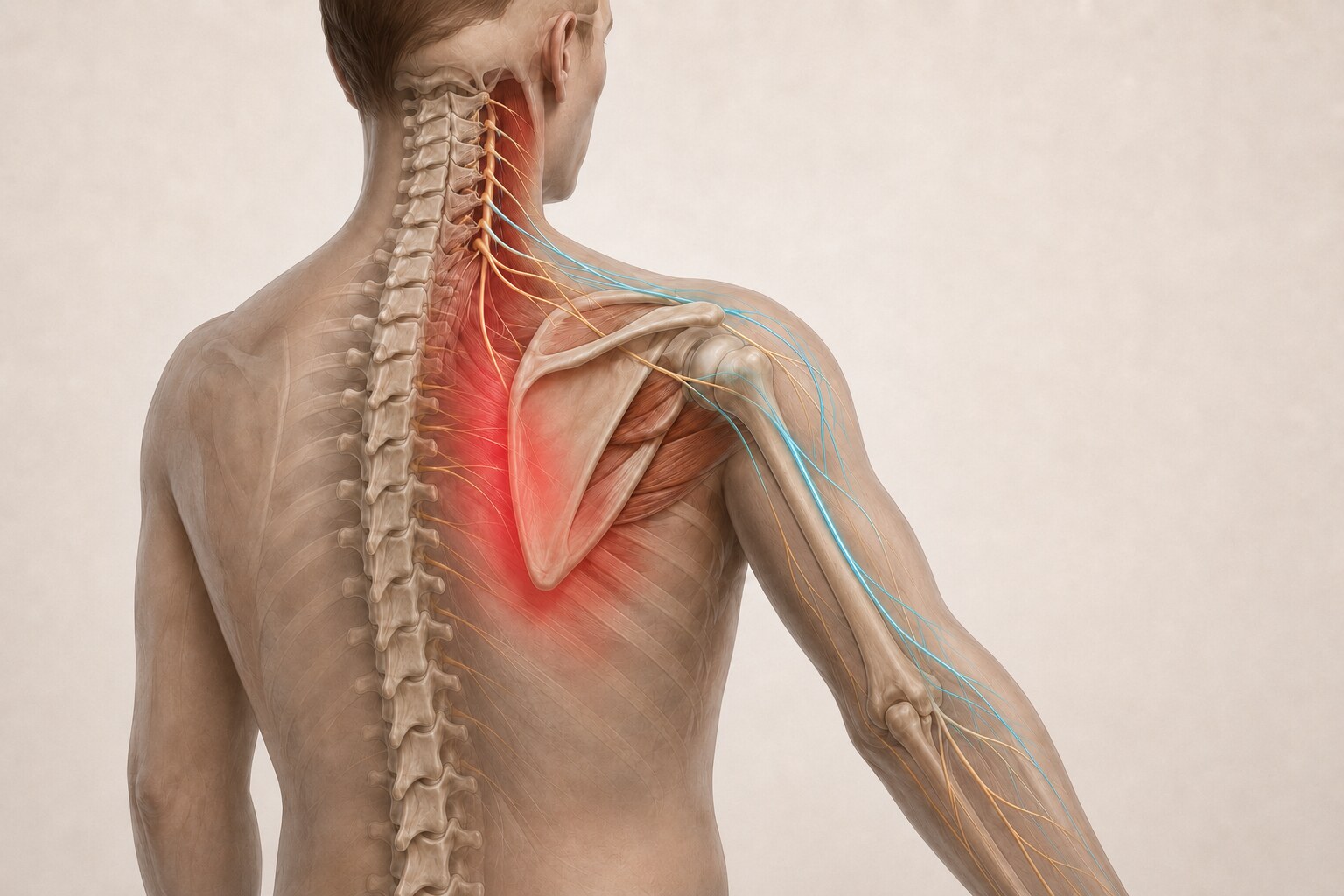
Research using diagnostic stimulation and surgical observations has shown that cervical structures and compressed nerve roots can produce pain around the suprascapular, interscapular, and scapular regions. A 2025 scoping review also found that scapular pain was frequently described with cervical radiculopathy and could appear before arm symptoms. That is why a persistent “knot” beside the shoulder blade deserves more than an assumption that the rhomboid simply needs to be released.
Sensory maps need context
Dermatomal patterns overlap and must be interpreted with the neurologic examination.
A dermatome is an area of skin associated primarily with sensory input from one spinal nerve root. Clinicians use these maps to organize an examination, but real people do not always match a textbook diagram. Adjacent territories overlap, published maps differ, and pain often spreads beyond a neat band. In one clinical study, cervical nerve-root pain was non-dermatomal in nearly 70% of the roots assessed.
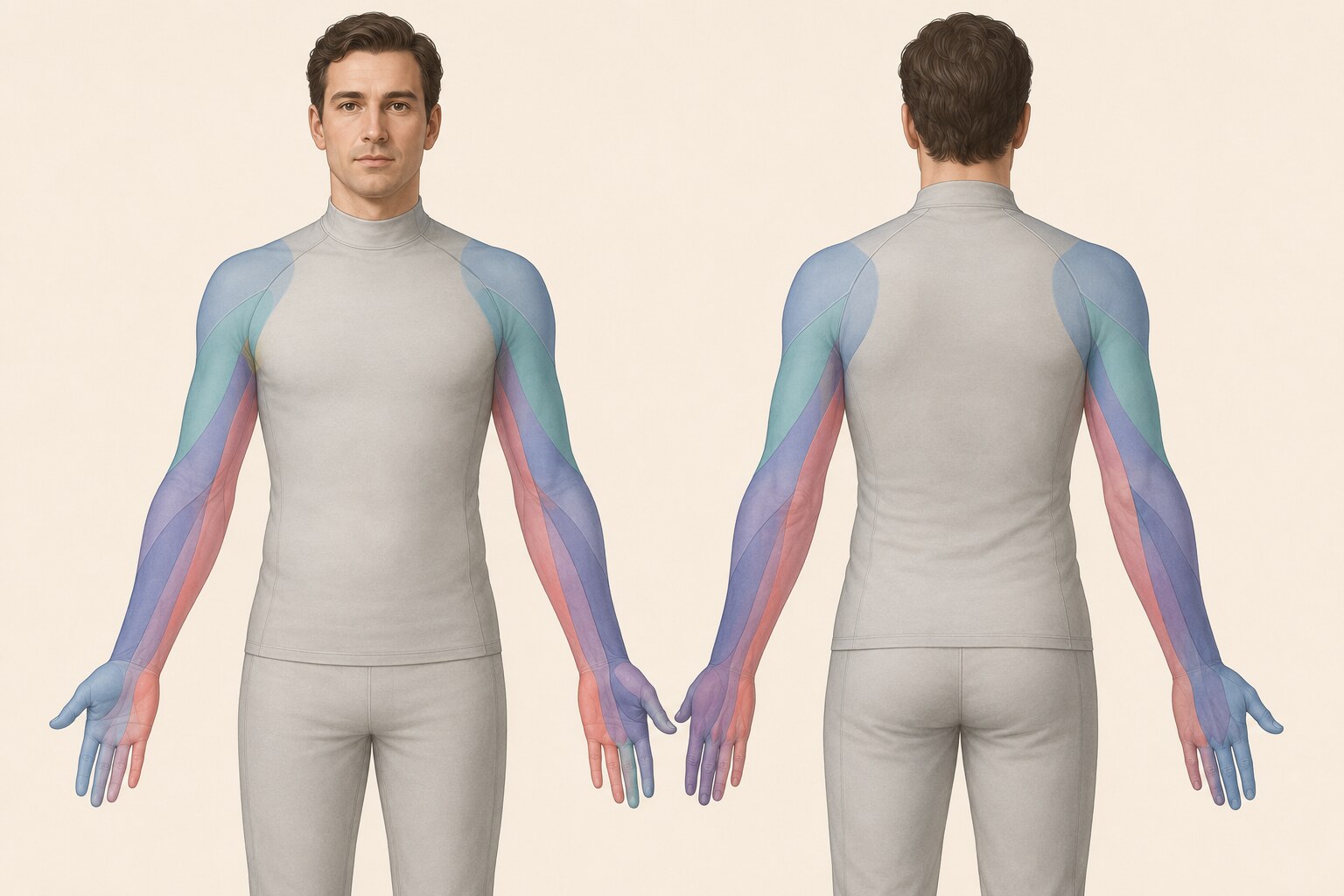
Lateral upper arm
Often considered alongside shoulder-abduction strength and the biceps reflex.
Thumb-side forearm
Often considered with wrist-extension strength and biceps or brachioradialis reflex findings.
Central hand
Often considered with elbow-extension strength and the triceps reflex.
Ulnar hand
Often considered with finger-flexion strength and symptoms toward the ring or small finger.
Medial forearm
Often considered with finger-abduction strength and the broader neurologic examination.
For that reason, a diagnosis should not be based on a pain drawing alone. Sensation, strength, reflexes, cervical movement, neurodynamic testing, symptom relief or provocation, and the behavior of the shoulder all add information. A cluster of findings is more useful than one “positive” test.
The muscle map is not the diagnosis
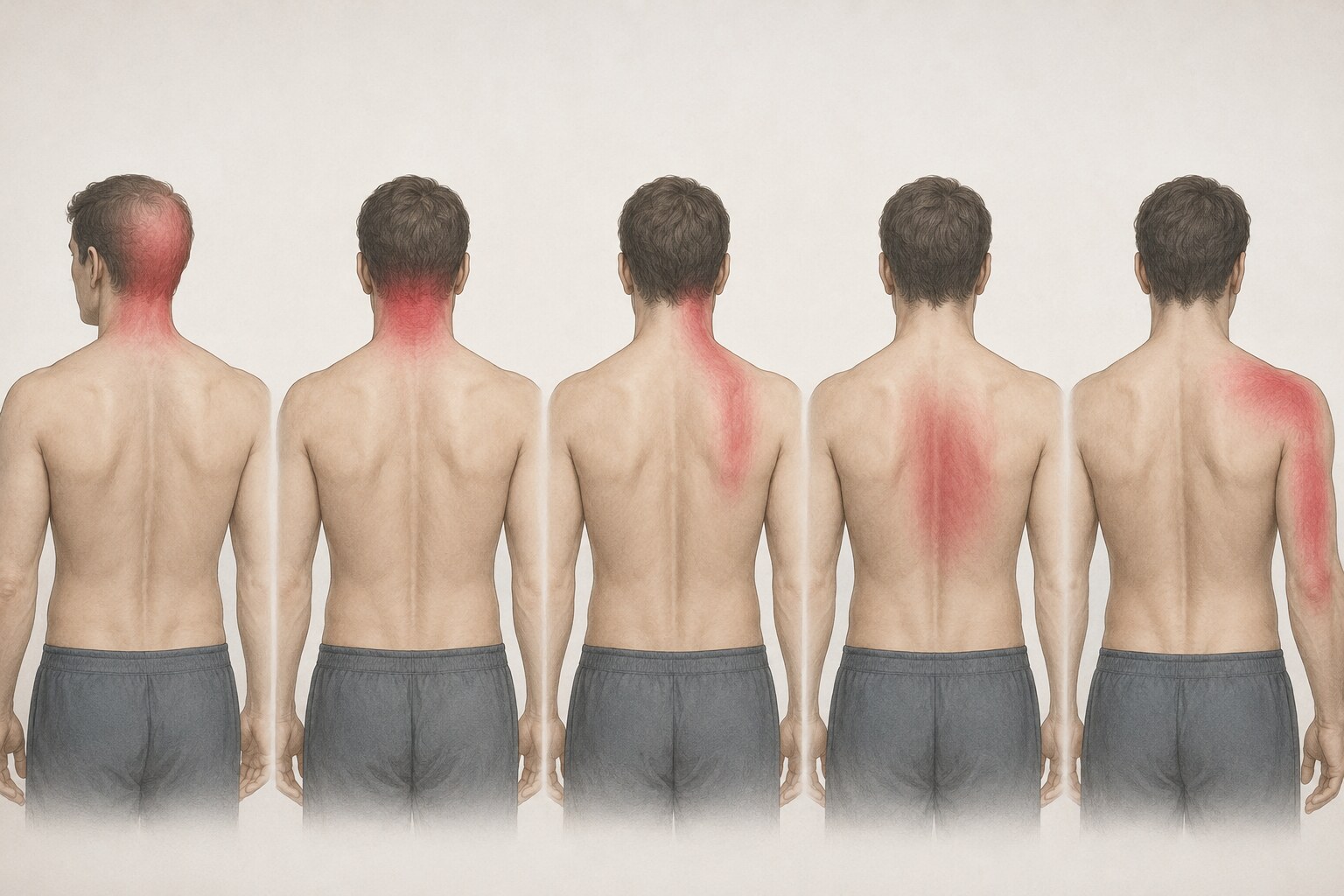
Muscles can refer pain—but their patterns overlap.
Myofascial trigger points are clinically described as sensitive spots within muscle that can reproduce local or referred pain when examined. In one small study of workers with neck or shoulder symptoms, palpation of several upper-quarter muscles—including the splenius capitis, levator scapulae, upper trapezius, infraspinatus, and deltoid—reproduced portions of participants' familiar pain. That does not create a universal map. There is no accepted reference standard for identifying a trigger point, and studies of palpation reliability have reported important limitations. Trigger-point findings can support the clinical picture, but palpation alone is not sufficiently reliable to identify the sole cause of a person's symptoms.
Familiar reproduction
Does pressure reproduce the person's recognizable complaint, or only create a new tender sensation at the spot being pressed?
Movement behavior
Does the symptom also change with neck movement, shoulder loading, arm position, breathing, or sustained posture?
Neurologic context
Strength, sensation, reflex, coordination, and neurodynamic findings carry more weight than a referral drawing alone.
Re-test the response
If a targeted muscle intervention changes a meaningful movement, the response may guide care without proving that one muscle caused the entire problem.
The scapula and thoracic region
Thoracic and scapular findings are tested as contributors, not assumed causes.
The levator scapulae attaches the upper cervical vertebrae to the top of the scapula. The rhomboids connect the medial scapular border to the upper thoracic spine. The trapezius spans the skull, neck, thoracic spine, and shoulder girdle. These shared attachments help explain why neck motion, arm loading, breathing strategy, or sustained positioning can change the same symptom.
That does not mean there is one perfect posture or that every rounded shoulder must be corrected. The useful question is whether thoracic or scapular movement changes the familiar symptom, whether the region has enough capacity for the task, and whether training it helps you move with less restriction. Appearance alone is not a diagnosis.
Clinical reasoning in action
How an examination separates overlapping patterns.
- 01
Define the familiar symptom.
Location, quality, timing, aggravating positions, sleep, training load, and whether symptoms travel or change with coughing, neck motion, or arm position narrow the possibilities.
- 02
Screen the cervical and neurologic systems.
Cervical movement, sensation, strength, reflexes, neurodynamic tests, coordination, and other safety findings help determine whether a nerve root or spinal cord requires attention.
- 03
Examine the shoulder, scapula, and thoracic region.
Rotator-cuff loading, shoulder mobility, scapular control, thoracic motion, and muscle response help identify local findings that may mimic or contribute to neck-related symptoms.
- 04
Use one controlled change to narrow the pattern.
If a cervical position, nerve movement, shoulder load, scapular strategy, or targeted muscle intervention changes the familiar symptom, that response helps focus the plan.

A composite clinical pattern
When the painful spot is only part of the explanation.
This example combines patterns seen in practice; it does not describe one identifiable patient. Individual presentations and results vary.
Consider an active adult with a persistent ache between the right shoulder blade and spine. Massage provides temporary relief, but longer computer work and overhead training create burning toward the lateral arm. The shoulder is mildly sensitive to load, yet neck positioning also reproduces the familiar scapular symptom and the neurologic screen shows a subtle strength difference.
That combination deserves a cervical and nerve-root hypothesis—not an automatic diagnosis based on the pain location. If a cervical unloading position reduces the arm symptom, progressive cervical and upper-quarter exercise improves capacity, and the neurologic findings remain stable or improve, those responses guide conservative care. If weakness progresses or the findings do not fit, medical referral becomes part of good care.
Another person with pain in the same scapular location may have a normal neurologic examination and a reproducible muscle-related or shoulder-loading pattern. The location is similar; the treatment plan should not be.
Treatment should match the finding
Treatment should address both symptom irritability and the strength or tolerance the task requires.
For many non-emergency presentations, care may combine education, modification of the most provocative load, cervical and thoracic movement, progressive upper-quarter strengthening, and nerve-mobility exercises or traction, when indicated. The exact combination depends on whether the dominant pattern is cervical referred pain, nerve-root involvement, a local shoulder problem, a muscle-related contribution, or more than one of these.
Manual therapy and manipulation may provide short-term symptom or mobility changes for a selected patient. Dry needlingmay be considered when a muscle-related finding is reproducible and the response helps movement. Neither technique “puts the spine back in place,” and dry needling does not treat a compressed nerve root. A useful response should create an opportunity to move, load, and return to what matters.
- Reduce irritability without creating unnecessary fear of normal neck or arm movement.
- Monitor neurologic function so changes in strength, sensation, reflexes, or coordination are not missed.
- Restore useful options in the neck, thoracic region, scapula, shoulder, and nervous system when testing shows they matter.
- Build capacity for the work, training, sleep position, lifting, reaching, or sport that has been limited.
Before your evaluation
Four details that help make the first visit more specific.
- Does the symptom stay near the neck or shoulder blade, or travel below the elbow into the hand?
- Is it an ache, burning, tingling, numbness, heaviness, weakness, or more than one of these?
- Which neck, shoulder, arm, sleep, or work position changes it—and what relieves it?
- What do you want to do comfortably or confidently again?

When neck and arm symptoms need prompt medical attention.
Seek prompt evaluation for progressive arm or hand weakness, increasing clumsiness or loss of dexterity, balance or walking changes, symptoms in both arms, major trauma, fever or signs of infection, unexplained weight loss, a history of cancer with new symptoms, or severe unrelenting pain. New bowel or bladder changes are especially concerning when accompanied by gait disturbance, loss of hand coordination, bilateral neurologic symptoms, or other signs of spinal-cord involvement. Sudden, unusual neck or head pain with new dizziness, double vision, difficulty speaking or swallowing, facial symptoms, loss of coordination, or another focal neurologic change requires urgent medical evaluation. Chest pressure, shortness of breath, sweating, nausea, or other possible cardiac symptoms with arm or shoulder pain require emergency care.
Common questions
Neck, shoulder-blade, and arm symptoms.
Can a problem in the neck cause pain between the shoulder blades?
Yes. Cervical joints, nerve roots, and muscles that connect the neck to the shoulder blade can all refer symptoms toward the upper back or medial border of the scapula. That location alone does not identify the source, so the neck, neurologic system, shoulder, and thoracic region should be examined together.
Does pain traveling down the arm always mean a pinched nerve?
No. Nerve-root irritation can cause radiating pain, numbness, tingling, or weakness, but muscles and shoulder structures can also refer symptoms into the arm. A neurologic examination—including sensation, strength, reflexes, and appropriate provocation or relief tests—helps determine whether a nerve root is involved.
How can I tell whether my pain is coming from my neck or shoulder?
There is no single home test that can reliably separate every neck and shoulder condition. Clues include whether neck movement changes the familiar symptom, whether symptoms extend below the elbow, whether numbness or weakness is present, and whether shoulder loading reproduces the problem. The most useful answer comes from combining these findings and re-testing them rather than relying on one clue.
Can dry needling help neck or shoulder-blade pain?
Dry needling may help selected people when a reproducible muscle-related component contributes to pain or movement sensitivity. It does not decompress a cervical nerve root and should not replace a neurologic examination. When appropriate, it is usually paired with movement, progressive exercise, and a plan for the activity the person wants to resume.
When should neck and arm symptoms receive prompt medical attention?
Prompt assessment is appropriate for progressive arm or hand weakness, increasing loss of coordination, balance or walking changes, symptoms in both arms, major trauma, fever or systemic illness, or severe unrelenting symptoms. New bowel or bladder changes are especially concerning when they occur with gait disturbance, loss of hand coordination, bilateral neurologic symptoms, or other signs of spinal-cord involvement. Sudden, unusual neck or head pain accompanied by new dizziness, double vision, difficulty speaking or swallowing, facial symptoms, loss of coordination, or another focal neurologic change requires urgent medical evaluation. Chest pressure, shortness of breath, sweating, or nausea with arm or shoulder pain requires emergency evaluation.

Written & clinically reviewed by
Dr. Brandon Lim, PT, DPT, CMTPT, FMSC
Dr. Lim is the founder of Limitless Physiotherapy in Columbia, Maryland. His one-on-one approach integrates detailed cervical and neurologic examination, movement assessment, manual therapy, dry needling, and progressive exercise according to each person's presentation and goals.
Meet Dr. LimSelected sources
Evidence behind the discussion.
- Blanpied PR, et al. Neck Pain: Revision 2017 Clinical Practice Guidelines. Journal of Orthopaedic & Sports Physical Therapy, 2017.
- Murphy DR, et al. Pain patterns and descriptions in patients with radicular pain: does the pain necessarily follow a specific dermatome? Chiropractic & Osteopathy, 2009.
- Tanaka Y, et al. Cervical roots as origin of pain in the neck or scapular regions. Spine, 2006.
- Mizutamari M, et al. Corresponding scapular pain with the nerve root involved in cervical radiculopathy. Journal of Orthopaedic Surgery, 2010.
- Wainner RS, et al. Reliability and diagnostic accuracy of the clinical examination and patient self-report measures for cervical radiculopathy. Spine, 2003.
- Carmichael J, et al. Scapular pain in cervical radiculopathy: a scoping review. North American Spine Society Journal, 2025.
- Fernández-de-las-Peñas C, et al. Referred pain from myofascial trigger points in head, neck, shoulder, and arm muscles reproduces pain symptoms in workers. The Clinical Journal of Pain, 2012.
- Lucas N, et al. Reliability of physical examination for diagnosis of myofascial trigger points: a systematic review of the literature. The Clinical Journal of Pain, 2009.
- Rushton A, et al. International Framework for Examination of the Cervical Region for Potential of Vascular Pathologies of the Neck. JOSPT, 2023.