

Shoulder pain often announces itself at an exact moment. You reach into a cabinet, slide an arm into a jacket, press a weight, serve a tennis ball, or lie on that side—and the shoulder catches.
It is understandable to wonder whether this is “impingement,” bursitis, a rotator cuff tear, or a bone spur. Each term may describe part of a shoulder presentation, but none can be confirmed from one painful movement. The same symptom can arise from different clinical patterns, and the same imaging finding can matter greatly in one person and be incidental in another.
The short answer
A painful arc is a pattern—not a diagnosis.
Pain through part of the lifting arc can fit a rotator cuff–related pattern, but it cannot prove that a tendon is being pinched by bone, distinguish tendon pain from bursal sensitivity, or show whether a tear is clinically meaningful. The goal is to determine what is irritable, what function has changed, and what capacity must be rebuilt for reaching, lifting, sleeping, or sport.
What the timing can suggest
The point at which reaching hurts helps organize the examination.
Pain location and timing narrow the questions. They do not settle the diagnosis because shoulder conditions overlap, and the cervical spine or nervous system can sometimes produce symptoms around the shoulder or arm.
Middle of the lift
A painful catch through mid-range may fit a rotator cuff–related or subacromial pain pattern. Strength, motion, recent loading, and neck findings determine how much weight to give it.
Top of the shoulder
Focal AC-joint symptoms may become more noticeable with cross-body reaching, pressing, or side-lying. The location is suggestive, not definitive.
Stiff in several directions
When active and assisted motion are both progressively restricted, the joint and capsule deserve closer attention. Frozen shoulder, arthritis, and guarding can overlap.
Front of the shoulder
The biceps tendon, rotator cuff, joint, and nearby tissues can all create anterior pain. Tenderness or one resisted test cannot isolate a single source.
Changed by the neck
Symptoms below the elbow, tingling, numbness, neurologic weakness, or a strong response to neck position make a cervical and neurologic screen especially important.
The language of impingement
“Something is being pinched” is often too simple an explanation.
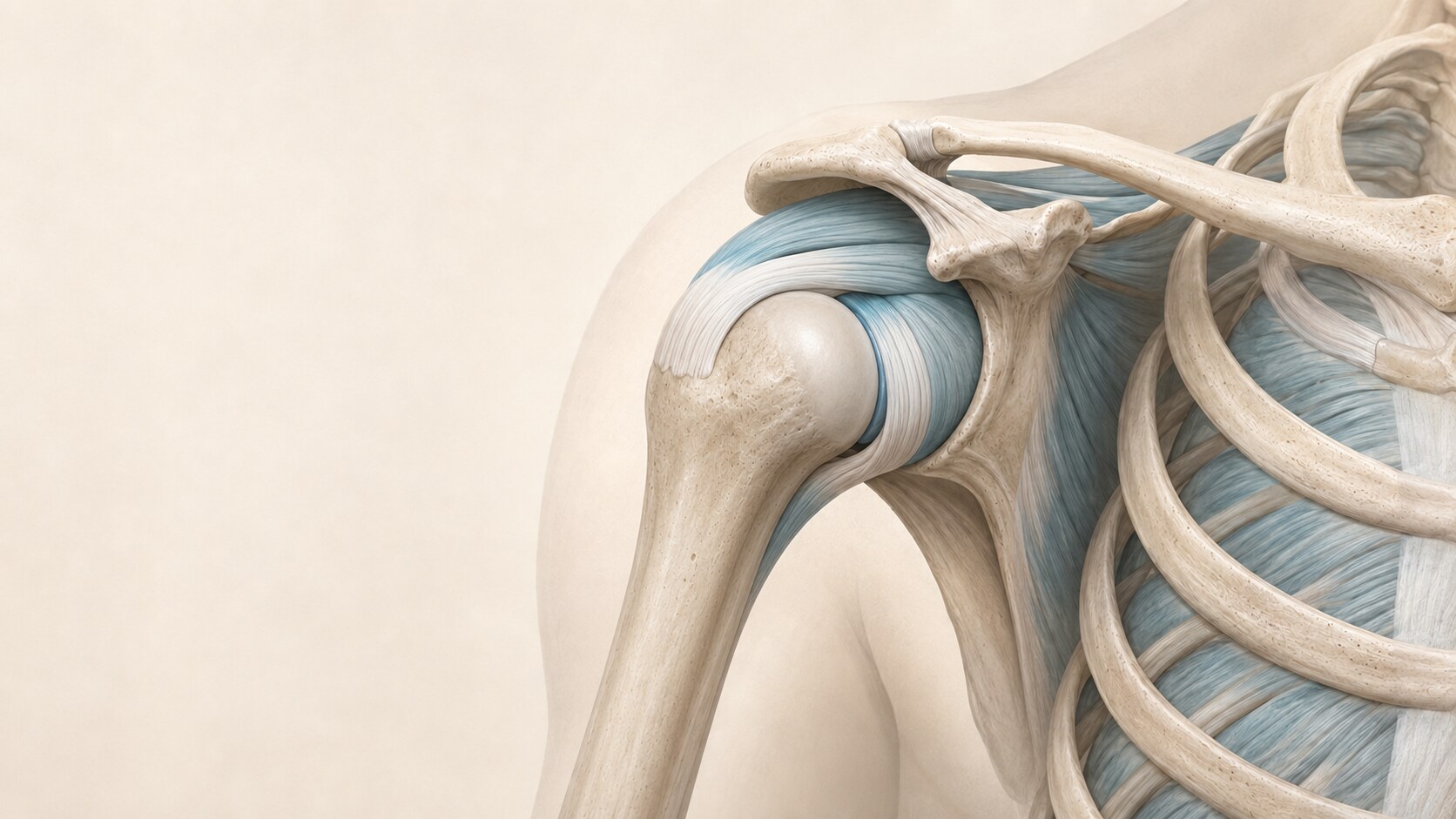
The word impingement has traditionally suggested that the acromion or a spur repeatedly compresses the rotator cuff and bursa. Contact and compression occur in a moving shoulder, but a painful test does not prove that abnormal bone-on-tendon pinching is the primary cause.
Acromial shape and spurs do not consistently match pain, and rotator cuff changes are common in people without symptoms. Pain can improve as strength, load tolerance, sleep, and movement options improve even though bone shape has not changed. Long-term placebo-controlled trials have also found no important benefit from surgery intended only to create more subacromial space for persistent nontraumatic pain.
That does not mean surgery is never appropriate. Acute traumatic tears, instability, advanced joint disease, and other structural problems follow different pathways. It means “pinching” alone is usually not a complete explanation for nontraumatic pain with reaching.
The examination matters more than the label
What a useful shoulder evaluation should clarify.
The 2025 rotator cuff tendinopathy clinical practice guideline recommends combining a detailed history with active and passive motion, objective strength assessment, and a cervical screen when appropriate. Special tests can contribute, but the examination should not depend on one positive maneuver.
- 01
Define what changed.
A fall with immediate weakness is approached differently from an ache that appeared after a sudden increase in swimming, pressing, throwing, or work volume.
- 02
Compare active and passive movement.
Preserved passive motion with difficulty actively lifting raises different questions than restriction in both. The comparison forms a hypothesis; it does not make the diagnosis by itself.
- 03
Measure strength and load response.
The examiner considers force, pain, side-to-side or task-related deficits, and whether the familiar symptom appears—not merely whether one test is “positive.”
- 04
Screen the neck and neurologic system when indicated.
Sensation, reflexes, myotomal strength, coordination, and symptom response to neck movement help identify a possible cervical or nerve-root contribution.
- 05
Recreate the activity that matters.
A slow arm raise is not a tennis serve, swim stroke, heavy press, repeated work reach, or overhead task under fatigue. The relevant task should guide the progression.

The MRI deserves context
A rotator cuff finding is not automatically the whole explanation.
Imaging is valuable when it answers a question that may change management: suspected fracture or dislocation, a substantial traumatic tear, advanced arthritis, calcific tendinopathy, an unclear presentation, surgical planning, or symptoms that are not improving as expected.
Imaging findings and pain do not match perfectly. In a 2026 population-based study, 602 Finnish adults ages 41–76 received clinical examinations and MRI of both shoulders. MRI-defined rotator cuff abnormalities—including tendinopathy and partial- or full-thickness tears—were present in 96% of shoulders without current symptoms and 98% of symptomatic shoulders.
The useful question is not simply whether the scan shows a tear. It is whether that finding matches how the problem began, the motion or strength that changed, and the activity the shoulder can no longer tolerate.
For an otherwise typical, nontraumatic presentation of suspected rotator cuff tendinopathy, the 2025 guideline advises against imaging simply to confirm the diagnosis during initial management. If symptoms do not meaningfully improve after an appropriate nonsurgical plan—generally within a maximum of about 12 weeks in that guideline—imaging or specialist assessment may become more useful. Major trauma, deformity, pronounced weakness, rapidly worsening function, or suspected fracture or dislocation can justify a different timeline.
- X-rays help assess bone injury, arthritis, alignment, and calcification.
- Diagnostic ultrasound can evaluate the rotator cuff dynamically and has diagnostic properties similar to MRI for many cuff disorders when performed by an appropriately trained clinician.
- MRI provides a broader view of the cuff, muscle quality, joint, labrum, bone, and other structures when that information may change a decision.
A composite clinical pattern
The same painful arc can lead to two different plans.
This example combines patterns seen in practice; it does not describe one identifiable patient. Individual presentations and results vary.
Consider an active adult whose outer-shoulder pain began after adding overhead pressing and an extra weekly pickleball session. Passive motion is nearly full. Resisted external rotation and abduction reproduce the familiar symptom, but useful force remains. Reducing pressing depth and weekly volume makes the movement tolerable, and the next-day response is stable. That pattern may support load modification and progressive rehabilitation without immediate MRI.
Now consider the same pain location after a fall, with immediate loss of function, marked weakness, and inability to hold the arm up despite relatively preserved passive motion. Early medical assessment and imaging may be more appropriate. The symptom map did not make the decision; the mechanism, loss of function, strength, and full examination did.
Build a shoulder that can reach again
Rehabilitation should progress from symptom control to useful capacity.
The 2025 guideline places active rehabilitation at the center of care for rotator cuff tendinopathy. Programs may use motor-control work, resistance training, or both, at different loads. There is no single best exercise for every painful shoulder; the plan should match the dominant limitation and progress toward the person's actual demands.
- Adjust the reactive load by changing range, resistance, speed, repetition, or frequency without unnecessarily shutting down all shoulder use.
- Restore the motion the task requires with active or assisted movement and selected mobility work when stiffness or guarding is limiting useful range.
- Build rotator cuff and shoulder-girdle strength from a tolerable starting range toward pulling, pressing, elevation, and sustained control.
- Add endurance, speed, and force transfer according to the needs of work, swimming, tennis, pickleball, golf, lifting, or another overhead activity.
- Return to the real task by reproducing its range, load, repetition, fatigue, and decision-making—not stopping at a light clinic exercise.
Movement assessment and sports rehabilitation can make that progression more specific when the goal involves repeated overhead work, speed, power, or whole-body force transfer.
The role of hands-on care and dry needling
Short-term relief should create an opportunity to progress.
Manual therapy to the shoulder, upper limb, cervical region, or thoracic region may help reduce pain in the short term for a selected person. Its value is not that it permanently “puts the shoulder back in place.” A useful response should improve a meaningful movement or make loading more manageable.
Dry needling may be considered when a reproducible muscle-related component contributes to pain, guarding, or limited movement. Evidence for its added value in subacromial pain is mixed. It should not be presented as a stand-alone correction, a way to repair a torn tendon, or a replacement for progressive rehabilitation.
Use the during-and-next-day response
Can you keep lifting or playing while the shoulder improves?
Complete rest is not automatically necessary. Some people can continue with a modified range, lighter load, slower tempo, fewer repetitions, reduced serving or throwing volume, or more recovery. Stable and tolerable symptoms that settle without progressive weakness, loss of motion, major sleep disruption, or worsening next-day function may allow modified training.
Escalating pain, declining force, increasing guarding, a growing loss of range, or a meaningful next-day reduction in function indicates that the dose or the working diagnosis should be reconsidered. There is no universal rule that every exercise must be completely pain-free, and there is no reason to force an irritable shoulder through steadily worsening pain.

When shoulder pain needs prompt medical attention.
Evidence note: The FIMAGE comparison involved adults ages 41–76 and included tendinopathy plus partial- and full-thickness tears. It does not make every tear incidental; it shows why MRI findings need the history and examination for context.
Seek prompt assessment after a major injury with visible deformity, suspected fracture or dislocation, inability to lift or use the arm, or sudden marked weakness. Rapidly progressive weakness, numbness, loss of coordination, or another neurologic change also deserves timely evaluation.
A hot, red, markedly swollen shoulder with fever or chills may indicate infection or another urgent condition. Severe unrelenting pain or concerning systemic symptoms should be discussed promptly with an appropriate medical professional. Shoulder or arm pain with chest pressure, shortness of breath, sweating, nausea, or faintness requires emergency evaluation.
Common questions
Shoulder pain, rotator cuff findings, and returning overhead.
Does pain when I raise my arm mean I tore my rotator cuff?
No. Rotator cuff tendinopathy, bursal sensitivity, joint stiffness, AC-joint pain, biceps-related symptoms, and symptoms referred from the neck can all hurt during arm elevation. Tears also range from incidental age-related findings to clinically important traumatic injuries. The mechanism, active and passive motion, objective strength, symptom behavior, and imaging when indicated help determine how much a tear should matter.
Is a painful arc the same thing as shoulder impingement?
Not exactly. A painful arc can support a rotator cuff–related clinical pattern, but it does not prove that a tendon is being abnormally pinched by bone. The term impingement may describe part of the presentation, yet it is often too narrow to explain tissue sensitivity, strength, load tolerance, training changes, and why symptoms began now.
Do I need an MRI before starting physical therapy?
Not always. For many nontraumatic rotator cuff–related presentations, a detailed history and examination can guide an initial plan. Imaging becomes more important after major trauma, when weakness is pronounced, when fracture, dislocation, or a substantial tear is suspected, when progress is not occurring as expected, or when the result would change a medical or surgical decision.
Should I stretch a painful shoulder?
Only when the examination identifies a motion restriction that should be addressed and the chosen movement is well tolerated. A feeling of tightness can reflect true stiffness, protective muscle activity, pain sensitivity, or insufficient strength and control. Repeatedly forcing an irritable end range can aggravate symptoms, while avoiding all movement can allow useful range to decline.
Can I keep lifting, swimming, or playing an overhead sport?
Often the better answer is modification rather than automatic shutdown. Range, resistance, speed, overhead volume, total weekly load, and recovery can be adjusted while motion and strength are rebuilt. Continuing is less appropriate after major trauma or when there is progressive weakness, recurrent instability, substantial loss of motion, or a steadily worsening during- and next-day response.
Does a rotator cuff tear always require surgery?
No. Tear depth and size, traumatic versus degenerative onset, age, muscle quality, weakness, activity demands, symptoms, and response to rehabilitation all influence the decision. Physical therapy can improve pain and function in some people with full-thickness tears, while a younger or highly active person with an acute traumatic tear and meaningful weakness may benefit from an early orthopedic opinion.
How long does shoulder rehabilitation take?
There is no responsible universal timeline. A mild load-related flare with preserved motion and strength may improve much faster than frozen shoulder, a substantial tear, postoperative recovery, or symptoms present for many months. Progress is better judged through changes in pain behavior, motion, strength, sleep, next-day recovery, and the ability to tolerate increasingly specific work or sport demands.

Written & clinically reviewed by
Dr. Brandon Lim, PT, DPT, CMTPT, FMSC
Dr. Lim is the founder of Limitless Physiotherapy in Columbia, Maryland. His one-on-one approach combines a detailed shoulder examination with cervical and neurologic screening when appropriate, targeted hands-on care, progressive strengthening, and return-to-activity testing built around each person's work, training, and goals.
Meet Dr. LimSelected sources
Evidence behind the discussion.
- Desmeules F, Roy JS, Lafrance S, et al. Rotator Cuff Tendinopathy Diagnosis, Nonsurgical Medical Care, and Rehabilitation: A Clinical Practice Guideline. JOSPT, 2025.
- American Academy of Orthopaedic Surgeons. Management of Rotator Cuff Injuries: Evidence-Based Clinical Practice Guideline, 2025.
- Ibounig T, Järvinen TLN, Raatikainen S, et al. Incidental Rotator Cuff Abnormalities on Magnetic Resonance Imaging. JAMA Internal Medicine, 2026.
- Nacey N, Fox MG, Blankenbaker DG, et al. ACR Appropriateness Criteria: Chronic Shoulder Pain. Journal of the American College of Radiology, 2023.
- Lafrance S, Charron M, Roy JS, et al. Exercise Therapy for Rotator Cuff–Related Shoulder Pain According to the FITT Principle: A Systematic Review With Meta-analyses. JOSPT, 2024.
- Schwank A, Blazey P, Asker M, et al. 2022 Bern Consensus Statement on Shoulder Injury Prevention, Rehabilitation, and Return to Sport. JOSPT, 2022.
- Kanto K, Paavola M, Malmivaara A, et al. Arthroscopic Subacromial Decompression Versus Placebo Surgery: 10-Year Follow-up of the FIMPACT Trial. BMJ, 2025.
- Hando BR, Rhon DI, Barker D, et al. Dry Needling Plus Manual Therapy and Exercise for Subacromial Pain Syndrome: A Sham-Controlled Randomized Clinical Trial. JOSPT, 2026.