

Hip pain can begin to shape the way you move. You cut a run short, hesitate before a hard change of direction, protect the hip during a golf swing, or modify how you lift. When the same pain keeps returning, it is reasonable to feel frustrated—especially if treatment has focused on the sore spot without explaining why the activity still feels limited.
Looking beyond the hip does not mean ignoring the hip or blaming every symptom on a “collapsed arch” or a small asymmetry. It means examining how your body shares load, identifying a small number of plausible contributors, and testing whether changing one of them actually improves the movement or symptom that matters to you.
The short answer
Where you hurt and why you hurt are related—but they are not always identical.
Hip pain may be driven primarily by local tissue sensitivity, joint structure, strength, training load, or referred symptoms. In other cases, the way the foot, ankle, knee, pelvis, or spine moves changes the demand at the hip. A good evaluation considers both, then uses re-testing to decide what belongs in your plan.
Regional interdependence
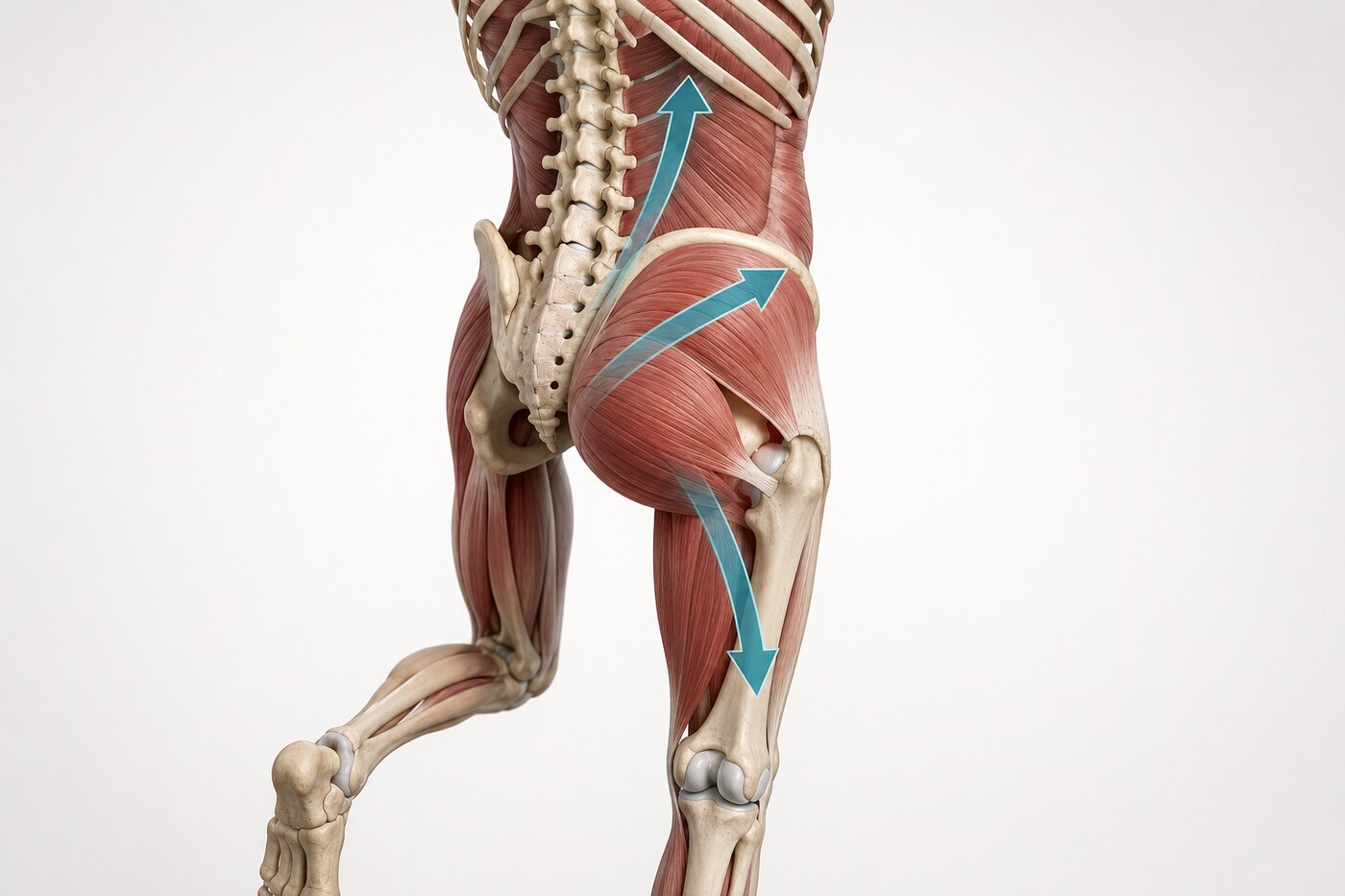
Hip loading is influenced by the foot, ankle, knee, pelvis, trunk, and task.
Running, changing direction on a field, swinging a golf club, and throwing all require several regions to coordinate. The hip produces and absorbs force, but it also responds to what happens above and below it. This is the practical idea behind regional interdependence: seemingly remote regions can influence a person's primary symptoms or function.
That idea should guide an examination, not predetermine the answer. A stiff ankle may affect one person's squat and be irrelevant to another person's hip pain. A limited hip may make the lower back work harder in one golfer, while someone else has the same limitation without pain. A finding becomes useful when it helps explain the task, changes with a targeted intervention, and can be trained in a way that supports the person's goal.
From the ground up
What the foot, ankle, and arch can contribute.
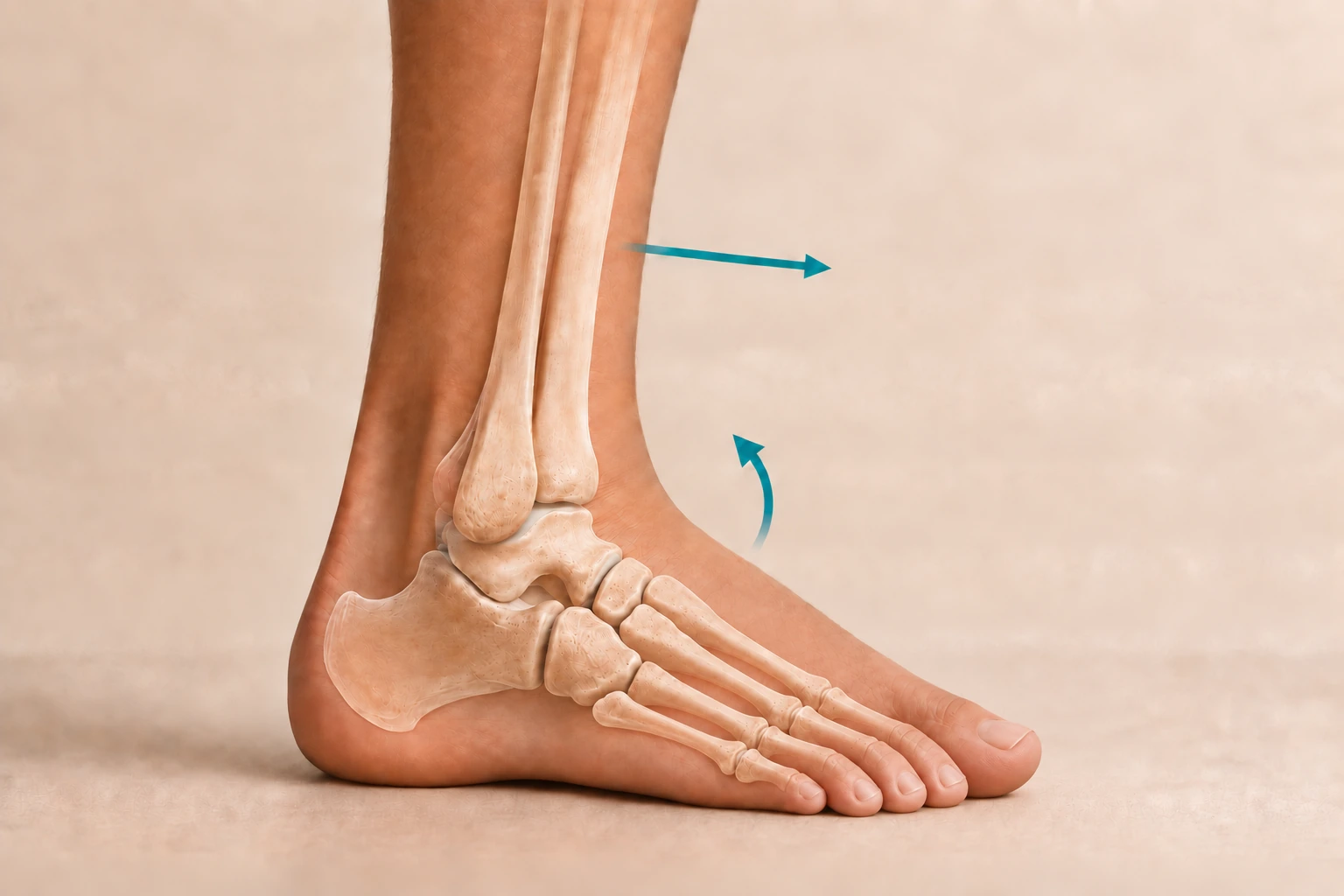
The foot is not a rigid platform. The arch normally changes shape as it accepts load and typically stiffens to help support propulsion as you push away from the ground. Pronation is therefore not automatically a flaw. The more useful questions are whether the foot can adapt, whether it can create a stable base when the task requires it, and whether the calf and foot have enough capacity for the amount of walking, running, jumping, or field and court activity you do.
Ankle dorsiflexion also matters in many weight-bearing tasks. If the shin cannot move forward over the foot as needed, the body may find motion elsewhere—perhaps through the foot, knee, hip, trunk, or a change in stride. Research has found an association between reduced ankle dorsiflexion and dynamic knee valgus, but an association is not proof that the ankle caused the pain. It is a reason to test the relationship, not to assume it.
Mobility
Can the ankle and big toe provide the motion the activity requires?
Control
Can the foot adapt to the ground without losing the strategy needed above it?
Capacity
Can the calf, foot, and lower leg tolerate the speed, volume, and force of your activity?
Movement needs context
Knee valgus and hip rotation are observations—not diagnoses.
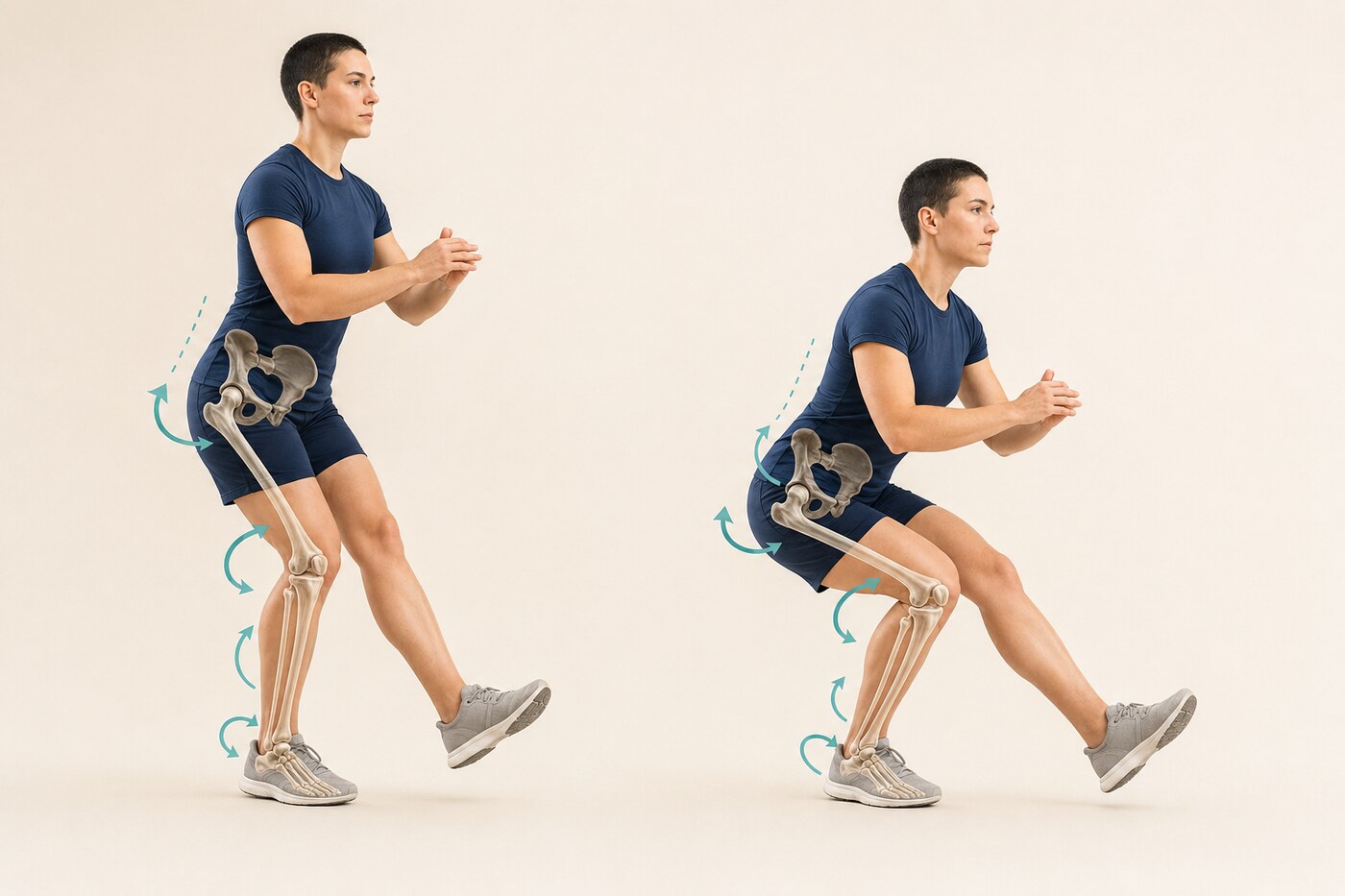
Dynamic knee valgus describes the knee moving inward relative to the hip and foot during a task. It is influenced by several regions and can be a normal part of athletic movement. It becomes more clinically interesting when it is linked to pain, appears difficult to control under the relevant load, or changes when a meaningful factor is addressed.
The same nuance applies to hip internal and external rotation. Bodies vary, sports ask for different ranges, and bony anatomy places real limits on what can or should change. The goal is not to force every hip into an ideal angle. It is to determine whether you have the mobility, strength, control, and load tolerance required for your movement.
Clinically, a difference matters only when it relates to the familiar symptom or a meaningful performance limit, changes under a relevant test, and can be addressed in a way that supports the person's goal.
Clinical reasoning in action
What a whole-chain evaluation should actually do.
- 01
Examine the hip directly.
Local mobility, strength, tissue sensitivity, joint behavior, load response, and symptoms from the back or nervous system all deserve consideration.
- 02
Observe the movement that matters.
A generic table test cannot fully represent a hill, a deep squat, a running stride, a golf swing, or a change of direction under fatigue.
- 03
Form a small number of hypotheses.
The examination should narrow the possibilities—not create an overwhelming list of everything that looks different.
- 04
Test whether a plausible change improves the task.
If improving ankle motion, changing foot support, cueing the trunk, or treating a painful hip muscle changes the target task, that response helps guide the plan.

A composite clinical pattern
Matching hip treatment to the person and the task.
This example combines patterns seen in practice; it does not describe one identifiable patient. Individual presentations and results vary.
Consider an active adult whose lateral hip pain appears during running and single-leg training. The hip itself is sensitive to load, so local strengthening belongs in the plan. A step-down also shows limited ankle motion and a strategy that shifts force quickly toward the inside of the foot and knee.
Rather than labeling that movement “bad,” the next step is to test it. If a targeted ankle intervention or a different foot strategy improves the step-down and reduces the familiar hip symptom, the lower leg has earned a place in treatment. If nothing changes, it should not be forced into the explanation.
The resulting plan might combine progressive hip loading, calf and foot capacity, a carefully dosed return to running, and short-term symptom modulation. Another person with pain in the same location may have normal ankle motion and require a completely different approach. That difference is why the examination matters.
Putting the plan together
Hands-on treatment can reduce a relevant symptom; training addresses the remaining capacity.
Manual therapy or manipulation may help a selected patient reduce short-term pain or recover useful motion. Much of the hands-on treatment evidence cited here comes from people with hip or knee osteoarthritis. Those findings should not automatically be generalized to labral injury, tendinopathy, dysplasia, hypermobility, or every other cause of hip pain.
Dry needling may be considered as a short-term adjunct for a selected patient with a reproducible muscle-related component. Its usefulness depends on the diagnosis, examination findings, and individual response. These treatments are not meant to “put the body back in alignment” or replace the need to build capacity.
When a hands-on treatment creates a useful change, the next question is what you can do with that change. Targeted exercise, progressive loading, and practice of the actual task help translate a short-term response into movement you can trust outside the clinic.
- Settle irritability without unnecessarily shutting down every activity.
- Restore useful options in the hip and any connected region shown to matter.
- Build strength and capacity for the speed, force, range, and duration your goal demands.
- Return progressively to the run, lift, trail, court, field, or daily task—not only a clinic exercise.
A useful next step
Three things to notice before your evaluation.
You do not need to diagnose yourself. These observations simply help make the first conversation more specific:
- Which activity, position, speed, or amount of load brings on the familiar symptom?
- Does the pain stay local, or does it travel into the back, groin, thigh, or below the knee?
- What do you most want to do confidently again—not only what do you want to stop hurting?

When hip pain needs prompt medical attention.
Seek urgent evaluation for an inability to bear weight after trauma, a suspected dislocation or fracture, fever with severe joint pain, rapidly progressing weakness or numbness, or symptoms suggesting a vascular or other systemic emergency.
Arrange prompt medical assessment for new, severe, progressive, or non-mechanical night pain—particularly when accompanied by unexplained weight loss, fever, systemic illness, or a history of cancer. These findings are not all emergencies, but they should not be managed solely as routine musculoskeletal pain.
Common questions
Hip pain and whole-chain care.
Can a foot or ankle problem cause hip pain?
Foot and ankle motion can change how force is managed farther up the leg, but that does not mean the foot is automatically the cause of hip pain. A useful evaluation examines the hip directly, tests a plausible foot or ankle contribution, and then re-tests the painful movement to see whether the change is meaningful.
Is knee valgus always bad?
No. Some inward knee motion is normal in many athletic tasks, and knee valgus is a description of movement rather than a diagnosis. Its relevance depends on the amount, speed, load, symptoms, control, and demands of the activity—not simply how it looks in one snapshot.
Can dry needling help hip pain?
Dry needling may be considered as a short-term adjunct for selected patients with a reproducible muscle-related component. Its usefulness depends on the diagnosis, examination findings, and the individual response. It is not appropriate for every hip condition and should support—not replace—movement, strength, progressive loading, and the activity the person wants to regain.
Should hip pain be stretched?
Not automatically. A feeling of tightness can reflect limited motion, protective muscle activity, sensitivity, or a need for greater strength and control. Stretching may help a specific finding, but repeatedly pushing into end range can be unhelpful for an irritable or hypermobile hip.

Written & clinically reviewed by
Dr. Brandon Lim, PT, DPT, CMTPT, FMSC
Dr. Lim is the founder of Limitless Physiotherapy in Columbia, Maryland. His one-on-one approach integrates detailed examination, movement assessment, manual therapy, dry needling, and progressive exercise according to each person's presentation and goals.
Meet Dr. LimSelected sources
Evidence behind the discussion.
- Academy of Orthopaedic Physical Therapy. Hip Pain and Movement Dysfunction Associated With Nonarthritic Hip Joint Pain: Clinical Practice Guideline. JOSPT, 2023.
- Lima YL, et al. The association of ankle dorsiflexion and dynamic knee valgus: a systematic review and meta-analysis. Physical Therapy in Sport, 2018.
- Dodelin D, et al. The biomechanical effects of pronated foot function on gait: an experimental study. Scandinavian Journal of Medicine & Science in Sports, 2020.
- Koshino Y, et al. Coupling motion between rearfoot and hip and knee joints during walking and single-leg landing. Journal of Electromyography and Kinesiology, 2017.
- Probst DT, et al. What is the rate of response to nonoperative treatment for hip-related pain? A systematic review with meta-analysis. British Journal of Sports Medicine, 2023.
- Runge N, et al. The benefits of adding manual therapy to exercise therapy for improving pain and function in patients with knee or hip osteoarthritis: a systematic review and meta-analysis. JOSPT, 2022.
- Jiménez-del-Barrio S, et al. Dry needling in hip or knee osteoarthritis: a systematic review and meta-analysis. Life, 2022.